
Letters to a Friend, Written to Mrs. Ezra S. Carr, 1866-1879
John Muir
THE CLASSIC COLLECTION · 1911
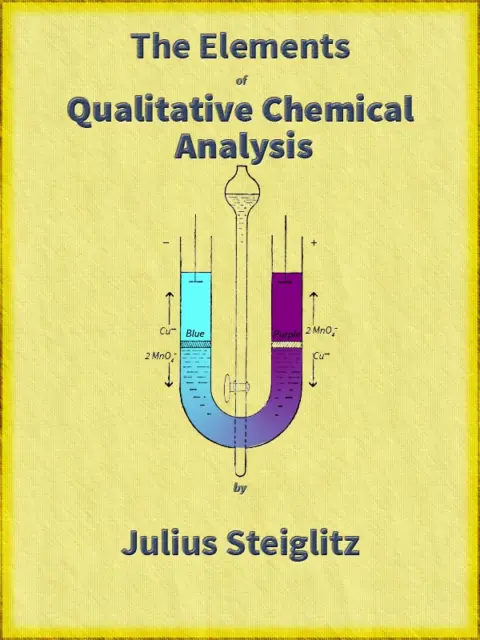
"The Elements of Qualitative Chemical Analysis, vol. 1, parts 1 and 2" by Julius Stieglitz is a scientific publication written in the early 20th century. This work focuses on qualitative chemical analysis, exploring the fundamental principles of chemistry as they relate to analytical procedures and methods. It is designed for students, aiming to enhance their understanding of various chemical reactions, solutions, and equilibrium which are critical in performing chemical analyses. At the start of this volume, the author outlines the importance of qualitative analysis in chemistry, highlighting its significance in identifying the presence of both common and rare elements in various substances. Stieglitz emphasizes the necessity for students to develop a solid theoretical foundation before engaging in laboratory work. The opening chapters introduce foundational topics such as osmotic pressure, the theory of ionization, and chemical equilibrium, laying the groundwork for systematic analytical methods. The text emphasizes a critical approach to learning, encouraging students to consult original literature and reference works to deepen their understanding of analytical techniques.
Introduction adapted from the source catalogue; source summaries may be automatically generated.
Free to read · English · 123,865 words · No account needed
MAKE TIME FOR A GOOD BOOK
On by default. Untick to stop anonymous reading totals. Each page counts after 10 seconds in view. How this works.
Anonymous counting is on unless you have switched it off.
[565] Only the simplest form of basic ionization of arsenic acid is considered. Intermediate ionization into As(OH){4}^{−}, As(OH){3}^{2−}, etc. (see p. 249), is, of course, to be assumed in any complete investigation of the subject.
[566] Arsenious acid As(OH){3}, or HAsO{2}, as well as its anions AsO{3}^{3−} and AsO{2}^{−}, may have their own characteristic tendencies to assume positive charges and be oxidized to arsenic acid and its derivatives (see footnote 1, p. 270). In ‹alkaline› solutions these tendencies, and the potentials corresponding to them, might well be more important factors in determining the course of an action, than the tendency of As^{3+} to form As^{5+}. The discussion in the text, which deals primarily with acid solutions, does not exclude such relations.
[567] A millivoltmeter is used for this experiment.
[568] See footnote 1, p. 284, in regard to the interpretation of this experiment on the basis of the theory of liberation of oxygen by arsenic acid.
[569] ‹Cf.› Smith's ‹General Inorganic Chemistry›, p. 712.
[570] The essential feature of this point of view was first published by Abegg, ‹Z. anorg. Chem.›, «39», 330 (1904), and ‹Z. phys. Chem.›, «43», 385 (1903); ‹vide› also Stieglitz, ‹Am. Chem. J.›, «39», 51 (footnote) (1908), and ‹Qualitative Analysis Notes›, University of Chicago (1905). Abegg's view has recently received support from J. J. Thomson in his ‹Corpuscular Theory of Matter›, p. 118.
[571] H^{+} does not change its valence (charge) in the action, and yet it appears as an essential component in both styles of the current equations for the oxidation-reduction reaction.
[572] A somewhat similar development of these relations, for arsenic acid, has been found in Abegg's ‹Anorg. Chem.›, III, 3, p. 552 (1907).
[573] Luther and Michie, ‹Z. für Elektroch.›, «14», 826 (1908).
[574] The calculation is based on the results obtained by Luther
and Michie.
[575] The proportion of UO{2}^{2+} converted into U^{6+} would be so minute, that in an experimental determination of the concentration [UO{2}^{2+}], the concentration [U^{6+}] would no doubt be a negligible quantity.
[576] Peters, ‹Z. phys. Chem.›, «26», 193 (1898).
[577] In other instances, the action of the hydrogen-ion in facilitating and accelerating chemical actions (often called its "catalytic effect") has been explained, in a similar fashion, as being based on ‹salt formation, followed by the ionization of the salts formed›, the ‹active› components being the ions (‹vide›, for instance, Bredig, ‹Z. für Elektroch.›, «9», 118 and «10», 586 (1904) and Stieglitz, ‹Report of the Congress of Arts and Sciences›, St. Louis, «4», 276 (1904) and ‹Am. Chem. J.›, «39», 29, 415 (1908) and later articles). In many of these cases, the ion concentrations of the reacting components have not yet been accessible to direct measurements, but the viewpoint has been sustained by quantitative studies of analogous reactions, which were selected for study, because the factors involved could be measured (‹cf.› Stieglitz, ‹loc. cit.›).
[578] Usher and Priestley, ‹Proc. Roy. Soc.›, B, «77», 369 (1905);
«78», 318 (1908).
[579] Tollens, ‹Ber. d. chem. Ges.›, «15», 1635 (1882).
[580] [Ag^{+}] × [NH{3}]^2 / [Ag(NH{3})_{2}^{+}] = 1 / 10^7.
Your reading position is saved on this browser. Take it to another device with a library code. Reading pages adapt to text, rather than matching a printed edition.
BEHIND THE BOOK
This eBook is for the use of anyone anywhere in the United States and most other parts of the world at no cost and with almost no restrictions whatsoever. You may copy it, give it away or re-use it under the terms of the Project Gutenberg License included with this eBook or online at www.gutenberg.org. If you are not located in the United States, you will have to check the laws of the country where you are located before using this eBook. Read the source licence.
The original source file, including credits and licence, is retained by this library. Request an original-format copy at no charge. Please include the book title and Project Gutenberg identifier #44986.
KEEP YOUR CURIOSITY GOING
John Muir

Asa Gray
Asa Gray

Florence Nightingale
Elizabeth Robins Pennell
Denison Olmsted