
Letters to a Friend, Written to Mrs. Ezra S. Carr, 1866-1879
John Muir
THE CLASSIC COLLECTION · 1911
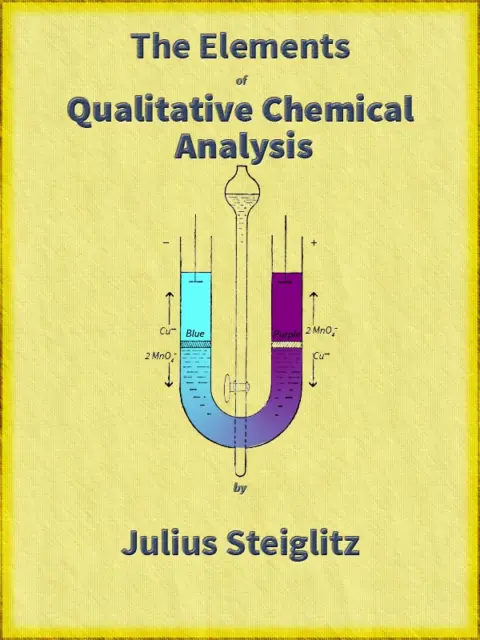
"The Elements of Qualitative Chemical Analysis, vol. 1, parts 1 and 2" by Julius Stieglitz is a scientific publication written in the early 20th century. This work focuses on qualitative chemical analysis, exploring the fundamental principles of chemistry as they relate to analytical procedures and methods. It is designed for students, aiming to enhance their understanding of various chemical reactions, solutions, and equilibrium which are critical in performing chemical analyses. At the start of this volume, the author outlines the importance of qualitative analysis in chemistry, highlighting its significance in identifying the presence of both common and rare elements in various substances. Stieglitz emphasizes the necessity for students to develop a solid theoretical foundation before engaging in laboratory work. The opening chapters introduce foundational topics such as osmotic pressure, the theory of ionization, and chemical equilibrium, laying the groundwork for systematic analytical methods. The text emphasizes a critical approach to learning, encouraging students to consult original literature and reference works to deepen their understanding of analytical techniques.
Introduction adapted from the source catalogue; source summaries may be automatically generated.
Free to read · English · 123,865 words · No account needed
MAKE TIME FOR A GOOD BOOK
On by default. Untick to stop anonymous reading totals. Each page counts after 10 seconds in view. How this works.
Anonymous counting is on unless you have switched it off.
[545] The condition for equilibrium is [Fe^{2+}] : [Fe^{3+}] = 10^{17}, in a solution considered for itself.
[546] This ratio need not be 10^{17}, since we have two solutions
combined with each other and the total potential will be expressed
by:
ε = ε{1} − ε{2} = 0.058 (log(10^{17} × [Fe^{3+}]{1} / [Fe^{2+}]{1}) − log(10^{17} × [Fe^{3+}]{2} / [Fe^{2+}]{2}))
= 0.058 log([Fe^{3+}]{1} × [Fe^{2+}]{2} / ([Fe^{2+}]{1} × [Fe^{3+}]{2})).
Equilibrium is reached when the total potential is 0. Then
[Fe^{3+}]{1} × [Fe^{2+}]{2} / ([Fe^{2+}]{1} × [Fe^{3+}]{2}) = 1
and [Fe^{2+}]{1} / [Fe^{3+}]{1} = [Fe^{2+}]{2} / [Fe^{3+}]{2}.
[547] In order to have very decided differences in the speeds of the action in the absence and presence of fluoride, it is best to use an old ferrous sulphate, or ferrous ammonium sulphate, solution which contains considerable ferric salt.
[548] ‹Vide› Peters, ‹loc. cit.›, p. 236.
[549] Ostwald [‹Lehrbuch d. allgem. Chem.›, 2d Ed., II, 883 (1893)], first emphasized the fact that potential differences are a ‹measure› of oxidizing and reducing powers.
[550] The constant is calculated from the data of Küster and Crotogino on the potential of solutions of iodine in potassium iodide [‹Z. anorg. Chem.›, «23», 88 (1900)]. Owing to the formation of complex ions I{3}^{−}, for which due allowance has not been made in the calculation, and owing to some uncertainty as to the vague definition of the concentration of iodine used, the estimation of the constant can only be considered a rough one. The value given expresses the order of the equilibrium ratio sufficiently well for our present purposes. In a recent paper, Bray and MacKay [‹J. Am. Chem. Soc.›, «32», 914 (1910)] have determined the constant for the formation of the complex ion according to I{3}^{−} ⇄ I_{2} + I^{−}, which might be used to correct the data of Küster and Crotogino; but in view of other uncertainties and inaccuracies, the correction has not been considered advisable.
Several related methods may be used to calculate the equilibrium constant for [I^{−}]^2 : [I{2}] = K from the data of Küster and Crotogino. Perhaps the simplest method is the following: A solution of iodine ([I] = 1 / 32 normal, and therefore [I{2}] = 1 / 64 molar) in 1/8 molar potassium iodide, in which, the degree of ionization being taken into account, [I^{−}] = 0.109, was observed to show a potential ε{I{2}, I^{−}} = + 0.860 (the convention as to signs, discussed on p. 261, is used here and the potential, observed against a so-called "calomel electrode," is reduced to the so-called "absolute potential"; ‹cf.› Le Blanc, ‹Lehrbuch der Elektrochemie›, p. 214). Now, ‹there must be a certain concentration of iodide-ion›, which we will call [C], ‹with which iodine› of the above concentration ‹would be directly in equilibrium› and would give no potential at all (‹cf.› pp. 261 and 258 in regard to copper). With a change in the concentration of the iodide-ion, a potential would be produced according to ε{I{2}, I^{−}} = 0.0575 log([C] / [I^{−}]). This relation is of exactly the same nature as that developed for the potential of copper plates, immersed in solutions of cupric-ion of different concentrations (but see footnote 1, p. 261, concerning the ‹sign› of the new relation). In the present case, we are dealing with univalent ions, I^{−}, in place of bivalent ions Cu^{2+}, and the factor 0.0575 is used instead of 0.0575 / 2 (see p. 261). If we insert the observed values, [I^{−}] = 0.109 and ε = 0.860, of the experiment described above, into the equation ε{I{2}, I^{−}} = 0.0575 log([C] / [I^{−}]) and solve the equation for [C], we find [C] = 10^{14}. ‹That means›, 1 / 64 molar iodine ‹would be directly in equilibrium with a concentration of iodide-ion› = 10^{14} (if this value is inserted for [I^{−}] in the logarithmic equation, the potential is found to be 0). For the condition of equilibrium for I{2} ⇄ 2 I^{−}, according to [I^{−}]^2 : [I{2}] = K, we have then (10^{14})^2 : (1 / 64) = K = 6.4E29. Similarly, for [I^{−}] = 0.109 and [I{2}] = 1 / 512 the potential ε = 0.831 is observed, and the equilibrium constant is found to be 5.1E29. When [I^{−}] = 0.109 and [I{2}] = 1 / 128, the potential is 0.850 and the constant is calculated to be 5.3E29. The mean value for K is 5.6E29. In these calculations, the formation of ions I{3}^{−}, affecting the values for [I^{−}] and [I{2}], has not been considered, and there is some doubt whether the concentrations of iodine, given by Küster and Crotogino, do not represent [I_{2}] rather than [I], as assumed in the calculations. If the former be the case, the mean value of the above experiments would be 2.8E29. The value, used in the text, is considered sufficiently accurate for the purposes of this book.
Your reading position is saved on this browser. Take it to another device with a library code. Reading pages adapt to text, rather than matching a printed edition.
BEHIND THE BOOK
This eBook is for the use of anyone anywhere in the United States and most other parts of the world at no cost and with almost no restrictions whatsoever. You may copy it, give it away or re-use it under the terms of the Project Gutenberg License included with this eBook or online at www.gutenberg.org. If you are not located in the United States, you will have to check the laws of the country where you are located before using this eBook. Read the source licence.
The original source file, including credits and licence, is retained by this library. Request an original-format copy at no charge. Please include the book title and Project Gutenberg identifier #44986.
KEEP YOUR CURIOSITY GOING
John Muir

Asa Gray
Asa Gray

Florence Nightingale
Elizabeth Robins Pennell
Denison Olmsted