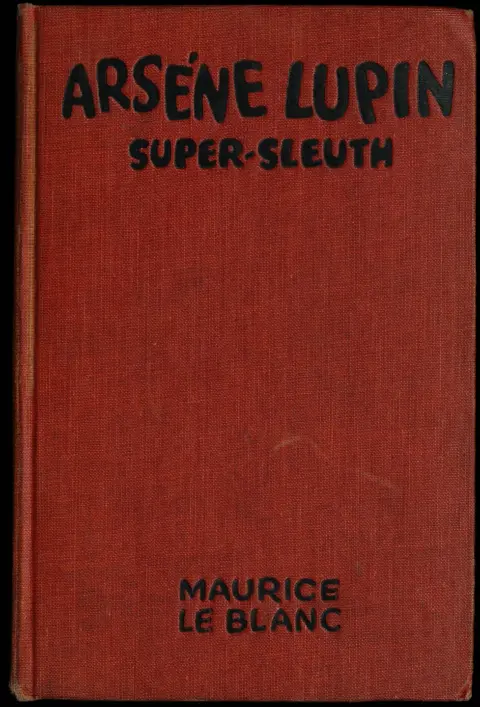
Arsène Lupin, super-sleuth
Maurice Leblanc
THE CLASSIC COLLECTION · 1922
"The Eight Strokes of the Clock" by Maurice Leblanc is a novel written during the early 20th century. This work centers around the enigmatic figure of Prince Rénine and his thrilling encounters with mystery and adventure, often involving themes of love, justice, and the intricacies of human emotion. The narrative unfolds through intriguing situations and complex characters, setting the stage for a series of thrilling escapades. The opening of the novel introduces Hortense Daniel, who contemplates eloping with a man named Rossigny, while navigating complex family dynamics and societal expectations. As she plans to escape her stifling life with Rossigny, an encounter with Prince Rénine adds layers of tension and intrigue. Following a near-assassination attempt on her, Hortense embarks on a journey with Rénine, leading to the mysterious Château de Halingre. Here, the discovery of two skeletons and a hidden telescope unfolds a storyline steeped in crime and deception. This inciting incident hints at the broader mysteries that will challenge both Rénine's skills and Hortense's heart as the plot develops.
Introduction adapted from the source catalogue; source summaries may be automatically generated.
Free to read · English · 62,989 words · No account needed
MAKE TIME FOR A GOOD BOOK
On by default. Untick to stop anonymous reading totals. Each page counts after 10 seconds in view. How this works.
Anonymous counting is on unless you have switched it off.
"Eleven o'clock," said Renine. "Whoever it is, he or she, or one of the card-players, or one of their wives, it won't be long before some one goes to the appointed place."
Nevertheless, twenty minutes passed and twenty-five; and no one stirred.
"Perhaps Madame d'Ormeval has gone." Hortense suggested, anxiously. "She is no longer on her balcony."
"If she is at the Trois Mathildes," said Renine, "we will go and catch her
there."
He was rising to his feet, when a fresh discussion broke out among the bridge-players and one of them exclaimed:
"Let's put it to d'Ormeval."
"Very well," said his adversary. "I'll accept his decision ... if he consents to act as umpire. He was rather huffy just now."
They called out:
"D'Ormeval! D'Ormeval!"
They then saw that d'Ormeval must have shut the door behind him, which kept him in the half dark, the cabin being one of the sort that has no window.
"He's asleep," cried one. "Let's wake him up."
All four went to the cabin, began by calling to him and, on receiving no answer, thumped on the door:
"Hi! D'Ormeval! Are you asleep?"
On the terrace Serge Renine suddenly leapt to his feet with so uneasy an air that Hortense was astonished. He muttered:
"If only it's not too late!"
And, when Hortense asked him what he meant, he tore down the steps and started running to the cabin. He reached it just as the bridge-players were trying to break in the door:
"Stop!" he ordered. "Things must be done in the regular fashion."
"What things?" they asked.
He examined the Venetian shutters at the top of each of the folding-doors and, on finding that one of the upper slats was partly broken, hung on as best he could to the roof of the cabin and cast a glance inside. Then he said to the four men:
"I was right in thinking that, if M. d'Ormeval did not reply, he must have been prevented by some serious cause. There is every reason to believe that M. d'Ormeval is wounded ... or dead."
"Dead!" they cried. "What do you mean? He has only just left us."
Renine took out his knife, prized open the lock and pulled back the two
doors.
There were shouts of dismay. M. d'Ormeval was lying flat on his face, clutching his jacket and his newspaper in his hands. Blood was flowing from his back and staining his shirt.
"Oh!" said some one. "He has killed himself!"
"How can he have killed himself?" said Renine. "The wound is right in the middle of the back, at a place which the hand can't reach. And, besides, there's not a knife in the cabin."
Your reading position is saved on this browser. Take it to another device with a library code. Reading pages adapt to text, rather than matching a printed edition.
Maurice Leblanc
Maurice Leblanc
Maurice Leblanc
Maurice Leblanc
BEHIND THE BOOK
This eBook is for the use of anyone anywhere in the United States and most other parts of the world at no cost and with almost no restrictions whatsoever. You may copy it, give it away or re-use it under the terms of the Project Gutenberg License included with this eBook or online at www.gutenberg.org. If you are not located in the United States, you will have to check the laws of the country where you are located before using this eBook. Read the source licence.
The original source file, including credits and licence, is retained by this library. Request an original-format copy at no charge. Please include the book title and Project Gutenberg identifier #7896.
KEEP YOUR CURIOSITY GOING
Coulson Kernahan

Maurice Baring
Frances Wright
Cécile Tormay

Frederic Jesup Stimson

W. H. P. (William Henry Pope) Jarvis