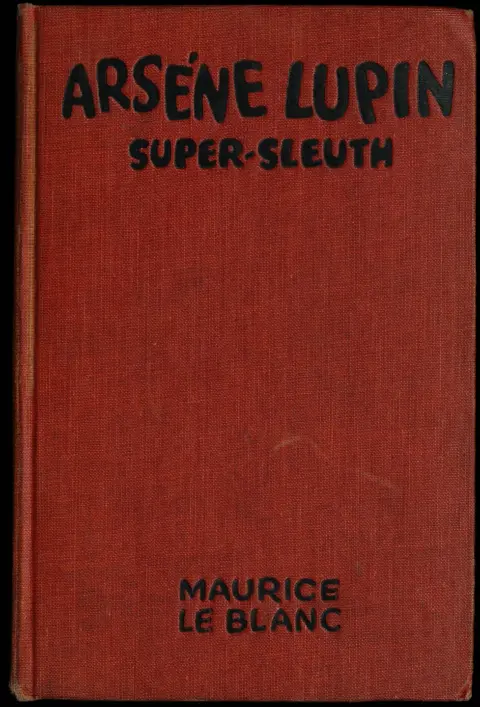
Arsène Lupin, super-sleuth
Maurice Leblanc
THE CLASSIC COLLECTION · 1922
"The Eight Strokes of the Clock" by Maurice Leblanc is a novel written during the early 20th century. This work centers around the enigmatic figure of Prince Rénine and his thrilling encounters with mystery and adventure, often involving themes of love, justice, and the intricacies of human emotion. The narrative unfolds through intriguing situations and complex characters, setting the stage for a series of thrilling escapades. The opening of the novel introduces Hortense Daniel, who contemplates eloping with a man named Rossigny, while navigating complex family dynamics and societal expectations. As she plans to escape her stifling life with Rossigny, an encounter with Prince Rénine adds layers of tension and intrigue. Following a near-assassination attempt on her, Hortense embarks on a journey with Rénine, leading to the mysterious Château de Halingre. Here, the discovery of two skeletons and a hidden telescope unfolds a storyline steeped in crime and deception. This inciting incident hints at the broader mysteries that will challenge both Rénine's skills and Hortense's heart as the plot develops.
Introduction adapted from the source catalogue; source summaries may be automatically generated.
Free to read · English · 62,989 words · No account needed
MAKE TIME FOR A GOOD BOOK
On by default. Untick to stop anonymous reading totals. Each page counts after 10 seconds in view. How this works.
Anonymous counting is on unless you have switched it off.
"Monsieur, believe me, if our engagement had been broken off for an ordinary reason, I should not have allowed Hortense to trouble you. But it is something quite different, I am absolutely convinced. There's a mystery in Jean Louis' life, or rather an endless number of mysteries which hamper and pursue him. I never saw such distress in a human face; and, from the first moment of our meeting, I was conscious in him of a grief and melancholy which have always persisted, even at times when he was giving himself to our love with the greatest confidence."
"But your impression must have been confirmed by minor details, by things which happened to strike you as peculiar?"
"I don't quite know what to say."
"These two names, for instance?"
"Yes, there was certainly that."
"By what name did he introduce himself to you?"
"Jean Louis d'Imbleval."
"But Jean Louis Vaurois?"
"That's what my father calls him."
"Why?"
"Because that was how he was introduced to my father, at Nice, by a gentleman who knew him. Besides, he carries visiting-cards which describe him under either name."
"Have you never questioned him on this point?"
"Yes, I have, twice. The first time, he said that his aunt's name was Vaurois and his mother's d'Imbleval."
"And the second time?"
"He told me the contrary: he spoke of his mother as Vaurois and of his aunt as d'Imbleval. I pointed this out. He coloured up and I thought it better not to question him any further."
"Does he live far from Paris?"
"Right down in Brittany: at the Manoir d'Elseven, five miles from Carhaix."
Renine rose and asked the girl, seriously:
"Are you quite certain that he loves you, mademoiselle?"
"I am certain of it and I know too that he represents all my life and all my happiness. He alone can save me. If he can't, then I shall be married in a week's time to a man whom I hate. I have promised my father; and the banns have been published."
"We shall leave for Carhaix, Madame Daniel and I, this evening," said
Renine.
That evening he and Hortense took the train for Brittany. They reached Carhaix at ten o'clock in the morning; and, after lunch, at half past twelve o'clock they stepped into a car borrowed from a leading resident of the district.
"You're looking a little pale, my dear," said Renine, with a laugh, as they alighted by the gate of the garden at Elseven.
"I'm very fond of Genevieve," she said. "She's the only friend I have. And I'm feeling frightened."
Your reading position is saved on this browser. Take it to another device with a library code. Reading pages adapt to text, rather than matching a printed edition.
Maurice Leblanc
Maurice Leblanc
Maurice Leblanc
Maurice Leblanc
BEHIND THE BOOK
This eBook is for the use of anyone anywhere in the United States and most other parts of the world at no cost and with almost no restrictions whatsoever. You may copy it, give it away or re-use it under the terms of the Project Gutenberg License included with this eBook or online at www.gutenberg.org. If you are not located in the United States, you will have to check the laws of the country where you are located before using this eBook. Read the source licence.
The original source file, including credits and licence, is retained by this library. Request an original-format copy at no charge. Please include the book title and Project Gutenberg identifier #7896.
KEEP YOUR CURIOSITY GOING
Coulson Kernahan

Maurice Baring
Frances Wright
Cécile Tormay

Frederic Jesup Stimson

W. H. P. (William Henry Pope) Jarvis