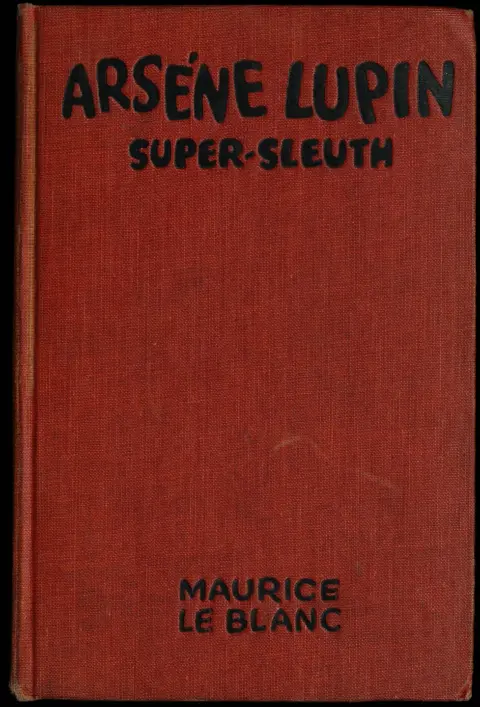
Arsène Lupin, super-sleuth
Maurice Leblanc
THE CLASSIC COLLECTION · 1922
"The Eight Strokes of the Clock" by Maurice Leblanc is a novel written during the early 20th century. This work centers around the enigmatic figure of Prince Rénine and his thrilling encounters with mystery and adventure, often involving themes of love, justice, and the intricacies of human emotion. The narrative unfolds through intriguing situations and complex characters, setting the stage for a series of thrilling escapades. The opening of the novel introduces Hortense Daniel, who contemplates eloping with a man named Rossigny, while navigating complex family dynamics and societal expectations. As she plans to escape her stifling life with Rossigny, an encounter with Prince Rénine adds layers of tension and intrigue. Following a near-assassination attempt on her, Hortense embarks on a journey with Rénine, leading to the mysterious Château de Halingre. Here, the discovery of two skeletons and a hidden telescope unfolds a storyline steeped in crime and deception. This inciting incident hints at the broader mysteries that will challenge both Rénine's skills and Hortense's heart as the plot develops.
Introduction adapted from the source catalogue; source summaries may be automatically generated.
Free to read · English · 62,989 words · No account needed
MAKE TIME FOR A GOOD BOOK
On by default. Untick to stop anonymous reading totals. Each page counts after 10 seconds in view. How this works.
Anonymous counting is on unless you have switched it off.
He handed the second receiver to Morisseau. For that matter, the voices were so distinct that Dutreuil and Hortense were able to hear every word exchanged.
"Is that you, madame?"
"Yes. Prince Renine, I believe?"
"Prince Renine."
"Oh, sir, what news have you for me? Is there any hope?" asked the old lady, in a tone of entreaty.
"The enquiry is proceeding very satisfactorily," said Renine, "and you may hope for the best. For the moment, I want you to give me some very important particulars. On the day of the murder, did Gaston Dutreuil come to your house?"
"Yes, he came to fetch my daughter and myself, after lunch."
"Did he know at the time that M. Guillaume had sixty thousand francs at his
place?"
"Yes, I told him."
"And that Jacques Aubrieux was not feeling very well and was proposing not to take his usual cycle-ride but to stay at home and sleep?"
"Yes."
"You are sure?"
"Absolutely certain."
"And you all three went to the cinema together?"
"Yes."
"And you were all sitting together?"
"Oh, no! There was no room. He took a seat farther away."
"A seat where you could see him?"
"No."
"But he came to you during the interval?"
"No, we did not see him until we were going out."
"There is no doubt of that?"
"None at all."
"Very well, madame. I will tell you the result of my efforts in an hour's time. But above all, don't wake up Madame Aubrieux."
"And suppose she wakes of her own accord?"
"Reassure her and give her confidence. Everything is going well, very well
indeed."
He hung up the receiver and turned to Dutreuil, laughing:
"Ha, ha, my boy! Things are beginning to look clearer. What do you say?"
It was difficult to tell what these words meant or what conclusions Renine had drawn from his conversation. The silence was painful and oppressive.
"Mr. Chief-Inspector, you have some of your men outside, haven't you?"
"Two detective-sergeants."
"It's important that they should be there. Please also ask the manager not to disturb us on any account."
And, when Morisseau returned, Renine closed the door, took his stand in front of Dutreuil and, speaking in a good-humoured but emphatic tone, said:
"It amounts to this, young man, that the ladies saw nothing of you between three and five o'clock on that Sunday. That's rather a curious detail."
"A perfectly natural detail," Dutreuil retorted, "and one, moreover, which proves nothing at all."
"It proves, young man, that you had a good two hours at your disposal."
"Obviously. Two hours which I spent at the cinema."
"Or somewhere else."
Dutreuil looked at him:
"Somewhere else?"
Your reading position is saved on this browser. Take it to another device with a library code. Reading pages adapt to text, rather than matching a printed edition.
Maurice Leblanc
Maurice Leblanc
Maurice Leblanc
Maurice Leblanc
BEHIND THE BOOK
This eBook is for the use of anyone anywhere in the United States and most other parts of the world at no cost and with almost no restrictions whatsoever. You may copy it, give it away or re-use it under the terms of the Project Gutenberg License included with this eBook or online at www.gutenberg.org. If you are not located in the United States, you will have to check the laws of the country where you are located before using this eBook. Read the source licence.
The original source file, including credits and licence, is retained by this library. Request an original-format copy at no charge. Please include the book title and Project Gutenberg identifier #7896.
KEEP YOUR CURIOSITY GOING
Coulson Kernahan

Maurice Baring
Frances Wright
Cécile Tormay

Frederic Jesup Stimson

W. H. P. (William Henry Pope) Jarvis