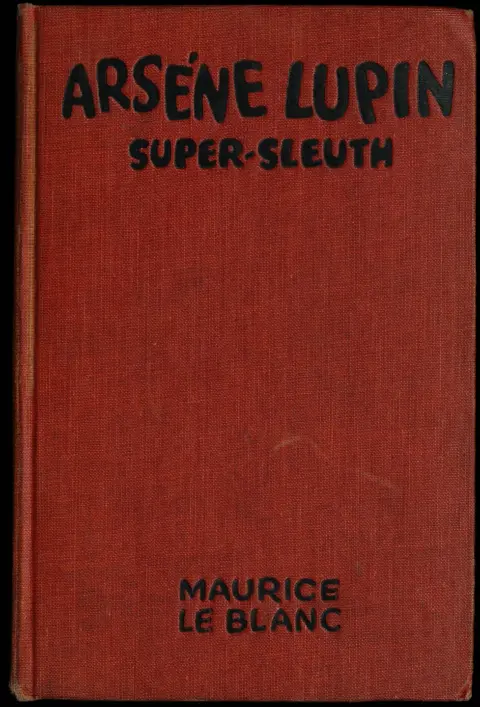
Arsène Lupin, super-sleuth
Maurice Leblanc
THE CLASSIC COLLECTION · 1922
"The Eight Strokes of the Clock" by Maurice Leblanc is a novel written during the early 20th century. This work centers around the enigmatic figure of Prince Rénine and his thrilling encounters with mystery and adventure, often involving themes of love, justice, and the intricacies of human emotion. The narrative unfolds through intriguing situations and complex characters, setting the stage for a series of thrilling escapades. The opening of the novel introduces Hortense Daniel, who contemplates eloping with a man named Rossigny, while navigating complex family dynamics and societal expectations. As she plans to escape her stifling life with Rossigny, an encounter with Prince Rénine adds layers of tension and intrigue. Following a near-assassination attempt on her, Hortense embarks on a journey with Rénine, leading to the mysterious Château de Halingre. Here, the discovery of two skeletons and a hidden telescope unfolds a storyline steeped in crime and deception. This inciting incident hints at the broader mysteries that will challenge both Rénine's skills and Hortense's heart as the plot develops.
Introduction adapted from the source catalogue; source summaries may be automatically generated.
Free to read · English · 62,989 words · No account needed
MAKE TIME FOR A GOOD BOOK
On by default. Untick to stop anonymous reading totals. Each page counts after 10 seconds in view. How this works.
Anonymous counting is on unless you have switched it off.
"What do you mean?"
The count had risen from his chair. Hortense, greatly excited, said:
"Are you really sure that there has been a murder and that the murder was done by some one belonging to the house?"
"Quite sure."
"But why are you so certain?"
"Because I know who the two victims were and what caused them to be
killed."
Prince Renine was making none but positive statements and his method suggested the belief that he supported by the strongest proofs.
M. d'Aigleroche strode up and down the room, with his hands behind his
back. He ended by saying:
"I always had an instinctive feeling that something had happened, but I never tried to find out.... Now, as a matter of fact, twenty years ago, a relation of mine, a distant cousin, used to live at the Domaine de Halingre. I hoped, because of the name I bear, that this story, which, as I say, I never knew but suspected, would remain hidden for ever."
"So this cousin killed somebody?"
"Yes, he was obliged to."
Renine shook his head:
"I am sorry to have to amend that phrase, my dear sir. The truth, on the contrary, is that your cousin took his victims' lives in cold blood and in a cowardly manner. I never heard of a crime more deliberately and craftily planned."
"What is it that you know?"
The moment had come for Renine to explain himself, a solemn and anguish-stricken moment, the full gravity of which Hortense understood, though she had not yet divined any part of the tragedy which the prince unfolded step by step."
"It's a very simple story," he said. "There is every reason to believe that M. d'Aigleroche was married and that there was another couple living in the neighbourhood with whom the owner of the Domaine de Halingre were on friendly terms. What happened one day, which of these four persons first disturbed the relations between the two households, I am unable to say. But a likely version, which at once occurs to the mind, is that your cousin's wife, Madame d'Aigleroche, was in the habit of meeting the other husband in the ivy-covered tower, which had a door opening outside the estate. On discovering the intrigue, your cousin d'Aigleroche resolved to be revenged, but in such a manner that there should be no scandal and that no one even should ever know that the guilty pair had been killed. Now he had ascertained--as I did just now--that there was a part of the house, the belvedere, from which you can see, over the trees and the undulations of the park, the tower standing eight hundred yards away, and that this was the only place that overlooked the top of the tower. He therefore pierced a hole in the parapet, through one of the former loopholes, and from there, by using a telescope which fitted exactly in the grove which he had hollowed out, he watched the meetings of the two lovers. And it was from there, also, that, after carefully taking all his measurements, and calculating all his distances, on a Sunday, the 5th of September, when the house was empty, he killed them with two shots."
Your reading position is saved on this browser. Take it to another device with a library code. Reading pages adapt to text, rather than matching a printed edition.
Maurice Leblanc
Maurice Leblanc
Maurice Leblanc
Maurice Leblanc
BEHIND THE BOOK
This eBook is for the use of anyone anywhere in the United States and most other parts of the world at no cost and with almost no restrictions whatsoever. You may copy it, give it away or re-use it under the terms of the Project Gutenberg License included with this eBook or online at www.gutenberg.org. If you are not located in the United States, you will have to check the laws of the country where you are located before using this eBook. Read the source licence.
The original source file, including credits and licence, is retained by this library. Request an original-format copy at no charge. Please include the book title and Project Gutenberg identifier #7896.
KEEP YOUR CURIOSITY GOING
Coulson Kernahan

Maurice Baring
Frances Wright
Cécile Tormay

Frederic Jesup Stimson

W. H. P. (William Henry Pope) Jarvis