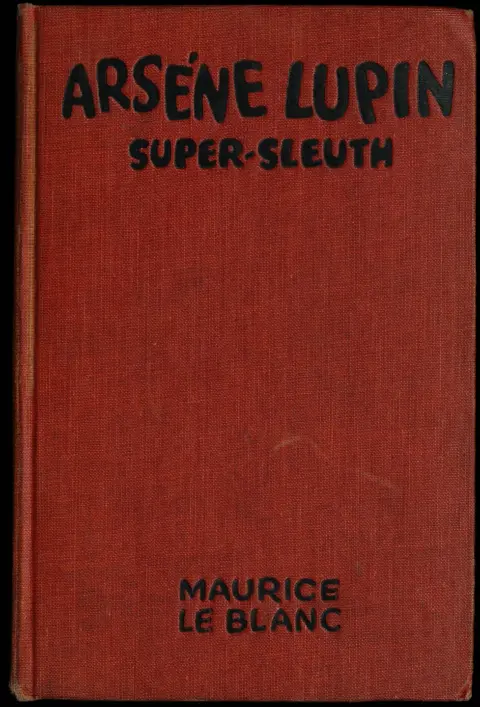
Arsène Lupin, super-sleuth
Maurice Leblanc
THE CLASSIC COLLECTION · 1922
"The Eight Strokes of the Clock" by Maurice Leblanc is a novel written during the early 20th century. This work centers around the enigmatic figure of Prince Rénine and his thrilling encounters with mystery and adventure, often involving themes of love, justice, and the intricacies of human emotion. The narrative unfolds through intriguing situations and complex characters, setting the stage for a series of thrilling escapades. The opening of the novel introduces Hortense Daniel, who contemplates eloping with a man named Rossigny, while navigating complex family dynamics and societal expectations. As she plans to escape her stifling life with Rossigny, an encounter with Prince Rénine adds layers of tension and intrigue. Following a near-assassination attempt on her, Hortense embarks on a journey with Rénine, leading to the mysterious Château de Halingre. Here, the discovery of two skeletons and a hidden telescope unfolds a storyline steeped in crime and deception. This inciting incident hints at the broader mysteries that will challenge both Rénine's skills and Hortense's heart as the plot develops.
Introduction adapted from the source catalogue; source summaries may be automatically generated.
Free to read · English · 62,989 words · No account needed
MAKE TIME FOR A GOOD BOOK
On by default. Untick to stop anonymous reading totals. Each page counts after 10 seconds in view. How this works.
Anonymous counting is on unless you have switched it off.
"His revenge would cost him dear, considering that, according to your statement, Mathias de Gorne was to receive a second sum of sixty thousand francs from you."
"He would receive that sum in another quarter, Mr. Deputy. My examination of the financial position of the de Gorne family revealed to me the fact that the father and son had taken out a life-insurance policy in each other's favour. With the son dead, or passing for dead, the father would receive the insurance-money and indemnify his son."
"You mean to say," asked the deputy, with a smile, "that in all this camouflage, as you call it, M. de Gorne the elder would act as his son's accomplice?"
Renine took up the challenge:
"Just so, Mr. Deputy. The father and son are accomplices.
"Then we shall find the son at the father's?"
"You would have found him there last night."
"What became of him?"
"He took the train at Pompignat."
"That's a mere supposition."
"No, a certainty."
"A moral certainty, perhaps, but you'll admit there's not the slightest
proof."
The deputy did not wait for a reply. He considered that he had displayed an excessive goodwill and that patience has its limits and he put an end to the interview:
"Not the slightest proof," he repeated, taking up his hat. "And, above all, ... above all, there's nothing in what you've said that can contradict in the very least the evidence of that relentless witness, the snow. To go to his father, Mathias de Gorne must have left this house. Which way did he go?"
"Hang it all, M. Vignal told you: by the road which leads from here to his
father's!"
"There are no tracks in the snow."
"Yes, there are."
"But they show him coming here and not going away from here."
"It's the same thing."
"What?"
"Of course it is. There's more than one way of walking. One doesn't always go ahead by following one's nose."
"In what other way can one go ahead?"
"By walking backwards, Mr. Deputy."
These few words, spoken very simply, but in a clear tone which gave full value to every syllable, produced a profound silence. Those present at once grasped their extreme significance and, by adapting it to the actual happenings, perceived in a flash the impenetrable truth, which suddenly appeared to be the most natural thing in the world.
Renine continued his argument. Stepping backwards in the direction of the
window, he said:
"If I want to get to that window, I can of course walk straight up to it; but I can just as easily turn my back to it and walk that way. In either case I reach my goal."
Your reading position is saved on this browser. Take it to another device with a library code. Reading pages adapt to text, rather than matching a printed edition.
Maurice Leblanc
Maurice Leblanc
Maurice Leblanc
Maurice Leblanc
BEHIND THE BOOK
This eBook is for the use of anyone anywhere in the United States and most other parts of the world at no cost and with almost no restrictions whatsoever. You may copy it, give it away or re-use it under the terms of the Project Gutenberg License included with this eBook or online at www.gutenberg.org. If you are not located in the United States, you will have to check the laws of the country where you are located before using this eBook. Read the source licence.
The original source file, including credits and licence, is retained by this library. Request an original-format copy at no charge. Please include the book title and Project Gutenberg identifier #7896.
KEEP YOUR CURIOSITY GOING
Coulson Kernahan

Maurice Baring
Frances Wright
Cécile Tormay

Frederic Jesup Stimson

W. H. P. (William Henry Pope) Jarvis