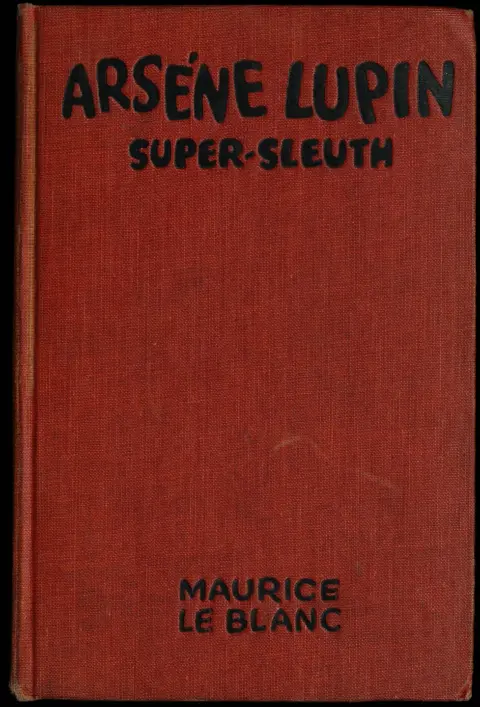
Arsène Lupin, super-sleuth
Maurice Leblanc
THE CLASSIC COLLECTION · 1922
"The Eight Strokes of the Clock" by Maurice Leblanc is a novel written during the early 20th century. This work centers around the enigmatic figure of Prince Rénine and his thrilling encounters with mystery and adventure, often involving themes of love, justice, and the intricacies of human emotion. The narrative unfolds through intriguing situations and complex characters, setting the stage for a series of thrilling escapades. The opening of the novel introduces Hortense Daniel, who contemplates eloping with a man named Rossigny, while navigating complex family dynamics and societal expectations. As she plans to escape her stifling life with Rossigny, an encounter with Prince Rénine adds layers of tension and intrigue. Following a near-assassination attempt on her, Hortense embarks on a journey with Rénine, leading to the mysterious Château de Halingre. Here, the discovery of two skeletons and a hidden telescope unfolds a storyline steeped in crime and deception. This inciting incident hints at the broader mysteries that will challenge both Rénine's skills and Hortense's heart as the plot develops.
Introduction adapted from the source catalogue; source summaries may be automatically generated.
Free to read · English · 62,989 words · No account needed
MAKE TIME FOR A GOOD BOOK
On by default. Untick to stop anonymous reading totals. Each page counts after 10 seconds in view. How this works.
Anonymous counting is on unless you have switched it off.
"As you please. But, until the day when the police are able to make them agree with your statements, you will understand that I am obliged to keep you under arrest."
"And Madame de Gorne?" asked Jerome, greatly distressed.
The deputy did not reply. He exchanged a few words with the commissary of police and then, beckoning to a detective, ordered him to bring up one of the two motor-cars. Then he turned to Natalie:
"Madame, you have heard M. Vignal's evidence. It agrees word for word with your own. M. Vignal declares in particular that you had fainted when he carried you away. But did you remain unconscious all the way?"
It seemed as though Jerome's composure had increased Madame de Gorne's
assurance. She replied:
"I did not come to, monsieur, until I was at the chateau."
"It's most extraordinary. Didn't you hear the three shots which were heard by almost every one in the village?"
"I did not."
"And did you see nothing of what happened beside the well?"
"Nothing did happen. M. Vignal has told you so."
"Then what has become of your husband?"
"I don't know."
"Come, madame, you really must assist the officers of the law and at least tell us what you think. Do you believe that there may have been an accident and that possibly M. de Gorne, who had been to see his father and had more to drink than usual, lost his balance and fell into the well?"
"When my husband came back from seeing his father, he was not in the least
intoxicated."
"His father, however, has stated that he was. His father and he had drunk two or three bottles of wine."
"His father is not telling the truth."
"But the snow tells the truth, madame," said the deputy, irritably. "And the line of his footprints wavers from side to side."
"My husband came in at half-past-eight, monsieur, before the snow had begun
to fall."
The deputy struck the table with his fist:
"But, really, madame, you're going right against the evidence!... That sheet of snow cannot speak false!... I may accept your denial of matters that cannot be verified. But these footprints in the snow ... in the snow...."
He controlled himself.
The motor-car drew up outside the windows. Forming a sudden resolve, he
said to Natalie:
"You will be good enough to hold yourself at the disposal of the authorities, madame, and to remain here, in the manor-house...."
And he made a sign to the sergeant to remove Jerome Vignal in the car.
Your reading position is saved on this browser. Take it to another device with a library code. Reading pages adapt to text, rather than matching a printed edition.
Maurice Leblanc
Maurice Leblanc
Maurice Leblanc
Maurice Leblanc
BEHIND THE BOOK
This eBook is for the use of anyone anywhere in the United States and most other parts of the world at no cost and with almost no restrictions whatsoever. You may copy it, give it away or re-use it under the terms of the Project Gutenberg License included with this eBook or online at www.gutenberg.org. If you are not located in the United States, you will have to check the laws of the country where you are located before using this eBook. Read the source licence.
The original source file, including credits and licence, is retained by this library. Request an original-format copy at no charge. Please include the book title and Project Gutenberg identifier #7896.
KEEP YOUR CURIOSITY GOING
Coulson Kernahan

Maurice Baring
Frances Wright
Cécile Tormay

Frederic Jesup Stimson

W. H. P. (William Henry Pope) Jarvis