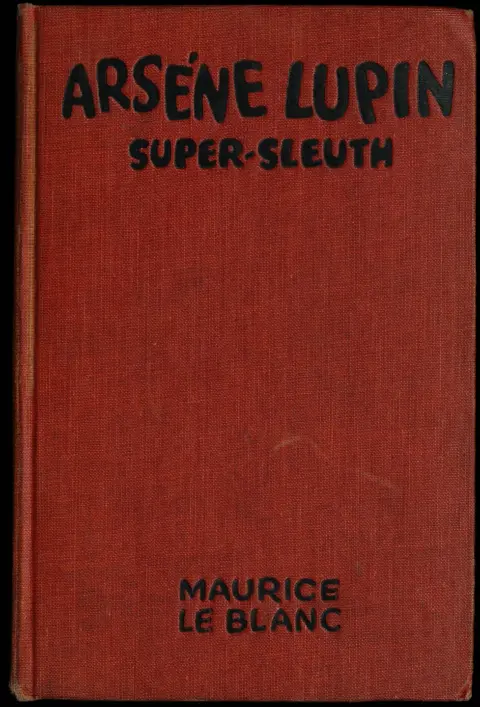
Arsène Lupin, super-sleuth
Maurice Leblanc
THE CLASSIC COLLECTION · 1922
"The Eight Strokes of the Clock" by Maurice Leblanc is a novel written during the early 20th century. This work centers around the enigmatic figure of Prince Rénine and his thrilling encounters with mystery and adventure, often involving themes of love, justice, and the intricacies of human emotion. The narrative unfolds through intriguing situations and complex characters, setting the stage for a series of thrilling escapades. The opening of the novel introduces Hortense Daniel, who contemplates eloping with a man named Rossigny, while navigating complex family dynamics and societal expectations. As she plans to escape her stifling life with Rossigny, an encounter with Prince Rénine adds layers of tension and intrigue. Following a near-assassination attempt on her, Hortense embarks on a journey with Rénine, leading to the mysterious Château de Halingre. Here, the discovery of two skeletons and a hidden telescope unfolds a storyline steeped in crime and deception. This inciting incident hints at the broader mysteries that will challenge both Rénine's skills and Hortense's heart as the plot develops.
Introduction adapted from the source catalogue; source summaries may be automatically generated.
Free to read · English · 62,989 words · No account needed
MAKE TIME FOR A GOOD BOOK
On by default. Untick to stop anonymous reading totals. Each page counts after 10 seconds in view. How this works.
Anonymous counting is on unless you have switched it off.
"Mr. Deputy," Jerome Vignal declared, without heeding the bad effect which his obstinacy was producing, "I am relating things as they were and not as they may be interpreted. But to continue. That clock marked ten minutes to nine when I entered this room. M. de Gorne, believing that he was about to be attacked, had taken down his gun. I placed my revolver on the table, out of reach of my hand, and sat down: 'I want to speak to you, monsieur,' I said. 'Please listen to me.' He did not stir and did not utter a single syllable. So I spoke. And straightway, crudely, without any previous explanations which might have softened the bluntness of my proposal, I spoke the few words which I had prepared beforehand: 'I have spent some months, monsieur,' I said, 'in making careful enquiries into your financial position. You have mortgaged every foot of your land. You have signed bills which will shortly be falling due and which it will be absolutely impossible for you to honour. You have nothing to hope for from your father, whose own affairs are in a very bad condition. So you are ruined. I have come to save you.'... He watched me, still without speaking, and sat down, which I took to mean that my suggestion was not entirely displeasing. Then I took a sheaf of bank-notes from my pocket, placed it before him and continued: 'Here is sixty thousand francs, monsieur. I will buy the Manoir-au-Puits, its lands and dependencies and take over the mortgages. The sum named is exactly twice what they are worth.'... I saw his eyes glittering. He asked my conditions. 'Only one,' I said, 'that you go to America.'... Mr. Deputy, we sat discussing for two hours. It was not that my offer roused his indignation--I should not have risked it if I had not known with whom I was dealing--but he wanted more and haggled greedily, though he refrained from mentioning the name of Madame de Gorne, to whom I myself had not once alluded. We might have been two men engaged in a dispute and seeking an agreement on common ground, whereas it was the happiness and the whole destiny of a woman that were at stake. At last, weary of the discussion, I accepted a compromise and we came to terms, which I resolved to make definite then and there. Two letters were exchanged between us: one in which he made the Manoir-au-Puits over to me for the sum which I had paid him; and one, which he pocketed immediately, by which I was to send him as much more in America on the day on which the decree of divorce was pronounced.... So the affair was settled. I am sure that at that moment he was accepting in good faith. He looked upon me less as an enemy and a rival than as a man who was doing him a service. He even went so far as to give me the key of the little door which opens on the fields, so that I might go home by the short cut. Unfortunately, while I was picking up my cap and greatcoat, I made the mistake of leaving on the table the letter of sale which he had signed. In a moment, Mathias de Gorne had seen the advantage which he could take of my slip: he could keep his property, keep his wife ... and keep the money. Quick as lightning, he tucked away the paper, hit me over the head with the butt-end of his gun, threw the gun on the floor and seized me by the throat with both hands. He had reckoned without his host. I was the stronger of the two; and after a sharp but short struggle, I mastered him and tied him up with a cord which I found lying in a corner ... Mr. Deputy, if my enemy's resolve was sudden, mine was no less so. Since, when all was said, he had accepted the bargain, I would force him to keep it, at least in so far as I was interested. A very few steps brought me to the first floor ... I had not a doubt that Madame de Gorne was there and had heard the sound of our discussion. Switching on the light of my pocket-torch, I looked into three bedrooms. The fourth was locked. I knocked at the door. There was no reply. But this was one of the moments in which a man allows no obstacle to stand in his way. I had seen a hammer in one of the rooms. I picked it up and smashed in the door.... Yes, Natalie was lying there, on the floor, in a dead faint. I took her in my arms, carried her downstairs and went through the kitchen. On seeing the snow outside, I at once realized that my footprints would be easily traced. But what did it matter? Was there any reason why I should put Mathias de Gorne off the scent? Not at all. With the sixty thousand francs in his possession, as well as the paper in which I undertook to pay him a like sum on the day of his divorce, to say nothing of his house and land, he would go away, leaving Natalie de Gorne to me. Nothing was changed between us, except one thing: instead of awaiting his good pleasure, I had at once seized the precious pledge which I coveted. What I feared, therefore, was not so much any subsequent attack on the part of Mathias de Gorne, but rather the indignant reproaches of his wife. What would she say when she realized that she was a prisoner in my hands?... The reasons why I escaped reproach Madame de Gorne has, I believe, had the frankness to tell you. Love calls forth love. That night, in my house, broken by emotion, she confessed her feeling for me. She loved me as I loved her. Our destinies were henceforth mingled. She and I set out at five o'clock this morning ... not foreseeing for an instant that we were amenable to the law."
Your reading position is saved on this browser. Take it to another device with a library code. Reading pages adapt to text, rather than matching a printed edition.
Maurice Leblanc
Maurice Leblanc

Maurice Leblanc
Maurice Leblanc
BEHIND THE BOOK
This eBook is for the use of anyone anywhere in the United States and most other parts of the world at no cost and with almost no restrictions whatsoever. You may copy it, give it away or re-use it under the terms of the Project Gutenberg License included with this eBook or online at www.gutenberg.org. If you are not located in the United States, you will have to check the laws of the country where you are located before using this eBook. Read the source licence.
The original source file, including credits and licence, is retained by this library. Request an original-format copy at no charge. Please include the book title and Project Gutenberg identifier #7896.
KEEP YOUR CURIOSITY GOING
Coulson Kernahan

Maurice Baring
Frances Wright
Cécile Tormay

Frederic Jesup Stimson

W. H. P. (William Henry Pope) Jarvis