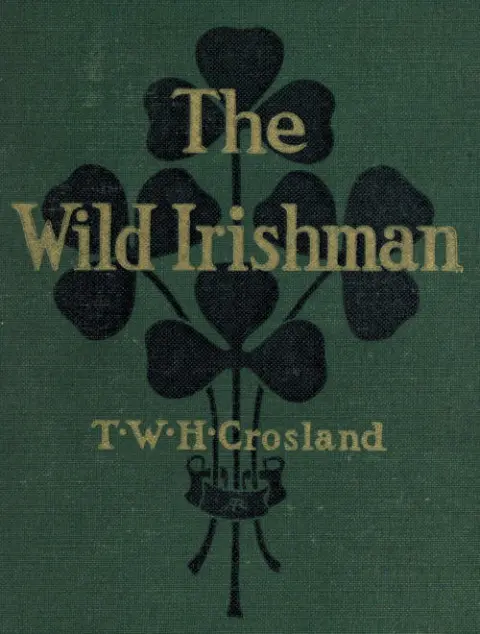
The Wild Irishman
T. W. H. (Thomas William Hodgson) Crosland
THE CLASSIC COLLECTION · 1902
"The Egregious English" by Angus McNeill is a critical examination of English society and its various facets, written in the early 20th century. The work uses a satirical lens to explore themes such as national pride, social class, and cultural values, showcasing the author's disillusionment with the perceived arrogance and shortcomings of the Englishman. McNeill offers a biting commentary on various sectors, including politics, business, military, and the media, ultimately questioning the integrity and competence of English institutions. The opening of the book sets a provocative tone as it critiques the Englishman's self-importance, positing that he believes himself to be the pinnacle of civilization. McNeill outlines a historical context in which the English inhabit a unique identity, marked by an indifference to the perspectives of other nations, particularly those of the Irish and Scots. Highlighting the Englishman's blatant arrogance and complacency, the author references the consequences of the Boer War, suggesting that such pride has led to a decline in competence and honor. Through this incisive approach, McNeill prepares the reader for an in-depth exploration of English society's follies in the subsequent chapters.
Introduction adapted from the source catalogue; source summaries may be automatically generated.
Free to read · English · 35,544 words · No account needed
MAKE TIME FOR A GOOD BOOK
On by default. Untick to stop anonymous reading totals. Each page counts after 10 seconds in view. How this works.
Anonymous counting is on unless you have switched it off.
The amount of interest the Englishman is supposed to take in this amazing assemblage and its doings makes it plain that the Englishman himself is well-nigh as foolish and well-nigh as oblique as the person whom he elects to represent him. Next to royalty itself there is nobody in England who can command so much attention and such a prominent place in the picture as the politician. If he be a Cabinet Minister of any standing, it is impossible for him to walk through the streets either of London or of any of the English provincial towns without being immediately recognised and "respectfully saluted"; whereas, if he happens to have come to any metropolitan district or provincial town on political business bent, he may depend upon being received at the proper point by the local authorities, supported by a guard of honour of the local Volunteers, and he may also depend upon more or less of an ovation on his way to and from the place of meeting.
Year in and year out, too, the illustrated papers of every degree blossom with his latest photograph. Mr. So-and-so in his new motorcar; Mr. So-and-so playing golf; Mr. So-and-so and the King; Mr. So-and-so addressing the mob from the railway train,--these are pictures in which every Englishman has delighted from his youth up, and in which he will always find great artistic and moral satisfaction. As for the journals which live out of the personal paragraph, they must give--or imagine they must give--pride of place to the politician, or perish. Little anecdotes of the sayings and doings of the politically great are always marketable. It is not necessary that they should have the slightest foundation in truth; but they must be neat, reasonably amusing, and flattering to the personage involved.
It is when one turns to the English daily papers, however, that one begins to understand what an extraordinary hold the political interest has upon the English public mind. It is well known that, in the main, the debates in the House of Commons are quite dull, colourless, and somnolent functions. Half of them take place in the presence only of the Speaker and a quorum. That is to say, nine nights out of ten, members spend the greater portion of their time in the smoke-rooms, dining-rooms, and lobbies, and not in the House itself, the simple reason being that, as a rule, the debates are not interesting. When some reputable champion of either party gets on his legs, or when some wag is up, members manage to attend in force; but it is only at these moments that they do so. Yet, if you pick up an English morning newspaper, you will find six columns of that sheet devoted to a report of the proceedings in Parliament; another three columns of descriptive matter bearing on the same proceedings; and, out of four or five leaders, three at least deal with the political question of the moment. Even when Parliament is not sitting, the first leader is never by any chance other than political. From the point of view of the dull English mind, nothing more important than a political happening can happen in this world. Mr. Somebody has called Mr. Somebody else a liar across the floor of the House of Commons. It is essential for the well-being of the country at large that the episode should be reported with a separate subhead and great circumstance in the Parliamentary report; that the scene should be described by the lively and picturesque pen of the writer of the Parliamentary sketch; that the appearance of the gentleman who called the other gentleman a liar should be dwelt upon in the notes; that instances of other gentlemen having called gentlemen liars across the floor of the House should also be given in the notes; and, finally, that a rotund and windy leader should be written, wherein is discussed gravely the general advisability of gentlemen calling other gentlemen liars across the floor of the House; wherein one is assured that, in spite of occasional regrettable instances of the kind, the English Parliament is the most decorous and dignified assemblage under the sun; and wherein we cannot refrain from paying our tribute of respectful admiration to the Right Honourable the Speaker, whose tact, good sense, and gentleman-like spirit, coupled with the firmness, resolution, and knowledge of the procedure of the House becoming to his high position, invariably enable him to still the storm and to repress the angry passions of our heated legislators before any great harm has been done. So that a gentleman who calls another gentleman a liar across the floor of the House of Commons really renders a great service to Englishmen, inasmuch as he provides them with a gratuitous entertainment, about which they may read, talk, and argue for at least twenty-four hours.
Your reading position is saved on this browser. Take it to another device with a library code. Reading pages adapt to text, rather than matching a printed edition.
T. W. H. (Thomas William Hodgson) Crosland
T. W. H. (Thomas William Hodgson) Crosland
T. W. H. (Thomas William Hodgson) Crosland
BEHIND THE BOOK
This eBook is for the use of anyone anywhere in the United States and most other parts of the world at no cost and with almost no restrictions whatsoever. You may copy it, give it away or re-use it under the terms of the Project Gutenberg License included with this eBook or online at www.gutenberg.org. If you are not located in the United States, you will have to check the laws of the country where you are located before using this eBook. Read the source licence.
The original source file, including credits and licence, is retained by this library. Request an original-format copy at no charge. Please include the book title and Project Gutenberg identifier #56453.
KEEP YOUR CURIOSITY GOING

David Patterson (Spirit) Hatch

David Patterson (Spirit) Hatch

David Patterson (Spirit) Hatch

Ralph Waldo Emerson

Maurice Baring

Oscar Wilde & James McNeill Whistler