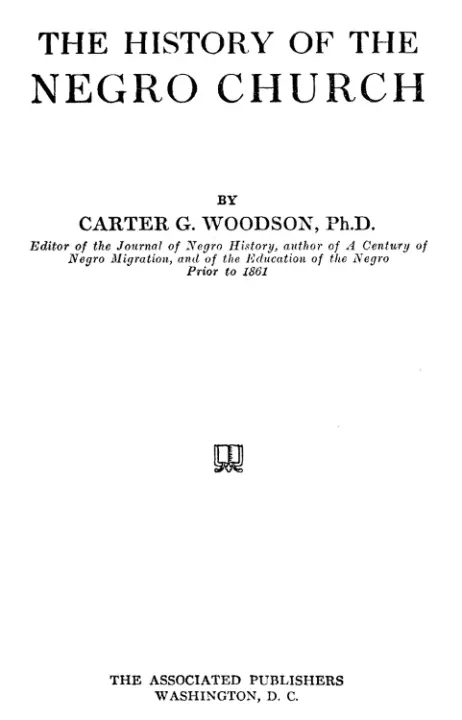
The History of the Negro Church
Carter Godwin Woodson
THE CLASSIC COLLECTION · 1915
"The Education of the Negro Prior to 1861" by Carter Godwin Woodson is a historical account written in the early 20th century. The work explores the comprehensive history of the education of African Americans from the onset of slavery up to the Civil War, analyzing the various challenges and advancements they experienced in their quest for knowledge. At the start of the narrative, Woodson introduces the complex landscape of education for Negroes in the ante-bellum period. He outlines two distinct phases in this history: the initial period when some slaveholders recognized the economic benefits of educating their slaves, and a later period marked by a backlash against such education driven by fear of potential uprisings. Woodson highlights the roles of different societal groups, including sympathetic masters, religious missionaries, and reformers, who endeavored to improve the educational opportunities for slaves and free black individuals, often in defiance of repressive laws. In contrast, he also details the increasingly reactionary measures that sought to restrict and prohibit access to education for African Americans as the institution of slavery evolved. The opening sets a scholarly tone while advocating for a more profound recognition of the intellectual capabilities and rights of the Negro in the broader context of American society.
Introduction adapted from the source catalogue; source summaries may be automatically generated.
Free to read · English · 112,595 words · No account needed
MAKE TIME FOR A GOOD BOOK
On by default. Untick to stop anonymous reading totals. Each page counts after 10 seconds in view. How this works.
Anonymous counting is on unless you have switched it off.
[Footnote 1: Fawcett, Compassionate Address, etc., p. 33.]
[Footnote 2: Fawcett, Compassionate Address, etc., p. 33.]
Still more reliable testimony may be obtained, not from persons particularly interested in the uplift of the blacks, but from slaveholders. Their advertisements in the colonial newspapers furnish unconscious evidence of the intellectual progress of the Negroes during the eighteenth century. "He's an 'artful,'"[1] "plausible,"[2] "smart,"[3] or "sensible fellow,"[4] "delights much in traffic,"[5] and "plays on the fife extremely well,"[6] are some of the statements found in the descriptions of fugitive slaves. Other fugitives were speaking "plainly,"[7] "talking indifferent English,"[8] "remarkably good English,"[9] and "exceedingly good English."[10] In some advertisements we observe such expressions as "he speaks a little French,"[11] "Creole French,"[12] "a few words of High-Dutch,"[13] and "tolerable German."[14] Writing about a fugitive a master would often state that "he can read print,"[15] "can read writing,"[16] "can read and also write a little,"[17] "can read and write,"[18] "can write a pretty hand and has probably forged a pass."[19] These conditions obtained especially in Charleston, South Carolina, where were advertised various fugitives, one of whom spoke French and English fluently, and passed for a doctor among his people,[20] another who spoke Spanish and French intelligibly,[21] and a third who could read, write, and speak both French and Spanish very well.[22]
[Footnote 1: Virginia Herald (Fredericksburg), Jan. 21, 1800; The Maryland Gazette, Feb. 27, 1755; Dunlop's Maryland Gazette and Baltimore Advertiser, July 23, 1776; The State Gazette of South Carolina, May 18, 1786; The State Gazette of North Carolina, July 2, 1789.]
[Footnote 2: The City Gazette and Daily Advertiser (Charleston, S.C.), Sept. 26, 1797, and The Carolina Gazette, June 3, 1802.]
[Footnote 3: The Charleston Courier, June 1, 1804; The State Gazette of South Carolina, Feb. 20, and 27, 1786; and The Maryland Journal and Baltimore Advertiser, Feb. 19, 1793.]
[Footnote 4: South Carolina Weekly Advertiser, Feb. 19 and April 2, 1783; State Gazette of South Carolina, Feb. 20 and May 18, 1786.]
[Footnote 5: The Maryland Journal and Baltimore Advocate, Oct. 17,
1780.]
[Footnote 6: The Virginia Herald (Fredericksburg), Jan. 21, 1800; and The Norfolk and Portsmouth Chronicle, April 24, 1790.]
[Footnote 7: The City Gazette and Daily Advertiser, Jan. 20 and
March 1, 1800; and The South Carolina Weekly Gazette, Oct. 24 to 31,
1759.]
[Footnote 8: The City Gaz. and Daily Adv., Jan. 20 and March 1, 1800; and S.C. Weekly Gaz., Oct. 24 to 31, 1759.]
[Footnote 9: The Newbern Gazette, May 23 and Aug. 15, 1800; The Maryland Journal and Baltimore Advertiser, Feb. 19, 1793; The City Gazette and Daily Advertiser (Charleston, S.C.), Sept. 26, 1797; Oct. 5, 1798; Aug. 23 and Sept. 9, 1799; Aug. 18 and Oct. 3, 1800; and March 7, 1801; and Maryland Gazette, Dec. 30, 1746; and April 4, 1754; South Carolina Weekly Advertiser, Oct. 24 to 31, 1759; and Feb. 19, 1783; The Gazette of the State of South Carolina, Sept. 13 and Nov. 1, 1784; and The Carolina Gazette, Aug. 12, 1802.]
Your reading position is saved on this browser. Take it to another device with a library code. Reading pages adapt to text, rather than matching a printed edition.
Carter Godwin Woodson
Carter Godwin Woodson
BEHIND THE BOOK
This eBook is for the use of anyone anywhere in the United States and most other parts of the world at no cost and with almost no restrictions whatsoever. You may copy it, give it away or re-use it under the terms of the Project Gutenberg License included with this eBook or online at www.gutenberg.org. If you are not located in the United States, you will have to check the laws of the country where you are located before using this eBook. Read the source licence.
The original source file, including credits and licence, is retained by this library. Request an original-format copy at no charge. Please include the book title and Project Gutenberg identifier #11089.
KEEP YOUR CURIOSITY GOING
Cécile Tormay

Moritz Busch
John L. Ransom
Frances Wright
Cécile Tormay

Mabel Potter Daggett