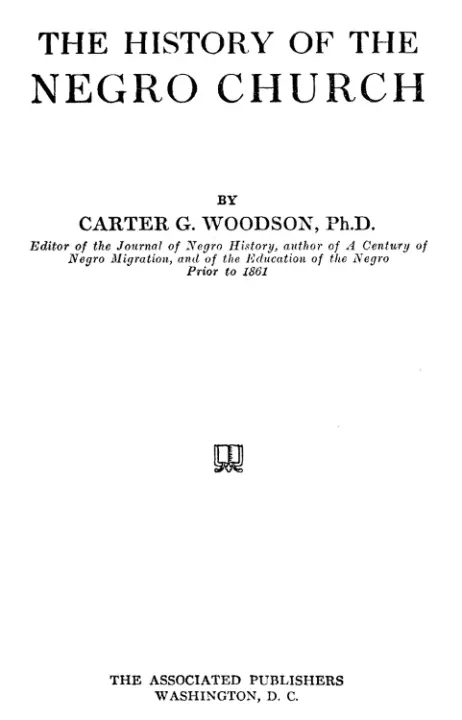
The History of the Negro Church
Carter Godwin Woodson
THE CLASSIC COLLECTION · 1915
"The Education of the Negro Prior to 1861" by Carter Godwin Woodson is a historical account written in the early 20th century. The work explores the comprehensive history of the education of African Americans from the onset of slavery up to the Civil War, analyzing the various challenges and advancements they experienced in their quest for knowledge. At the start of the narrative, Woodson introduces the complex landscape of education for Negroes in the ante-bellum period. He outlines two distinct phases in this history: the initial period when some slaveholders recognized the economic benefits of educating their slaves, and a later period marked by a backlash against such education driven by fear of potential uprisings. Woodson highlights the roles of different societal groups, including sympathetic masters, religious missionaries, and reformers, who endeavored to improve the educational opportunities for slaves and free black individuals, often in defiance of repressive laws. In contrast, he also details the increasingly reactionary measures that sought to restrict and prohibit access to education for African Americans as the institution of slavery evolved. The opening sets a scholarly tone while advocating for a more profound recognition of the intellectual capabilities and rights of the Negro in the broader context of American society.
Introduction adapted from the source catalogue; source summaries may be automatically generated.
Free to read · English · 112,595 words · No account needed
MAKE TIME FOR A GOOD BOOK
On by default. Untick to stop anonymous reading totals. Each page counts after 10 seconds in view. How this works.
Anonymous counting is on unless you have switched it off.
[Footnote 1: Mott, Biographical Sketches, p. 87.]
[Footnote 2: Redpath, Roving Editor, etc., p. 161.]
[Footnote 3: Parsons, Inside View, etc., p. 248.]
[Footnote 4: Burke, Reminiscences of Georgia, p. 85.]
[Footnote 5: Simmons, Men of Mark, p. 126.]
[Footnote 6: Drew, Refugee, p. 152.]
Probably the best example of this class was Harrison Ellis of Alabama. At the age of thirty-five he had acquired a liberal education by his own exertions. Upon examination he proved himself a good Latin and Hebrew scholar and showed still greater proficiency in Greek. His attainments in theology were highly satisfactory. The Eufaula Shield, a newspaper of that State, praised him as a man courteous in manners, polite in conversation, and manly in demeanor. Knowing how useful Ellis would be in a free country, the Presbyterian Synod of Alabama purchased him and his family in 1847 at a cost of $2500 that he might use his talents in elevating his own people in Liberia.[1]
[Footnote 1: Niles Register, vol. lxxi., p. 296.]
Intelligent Negroes secretly communicated to their fellow men what they knew. Henry Banks of Stafford County, Virginia, was taught by his brother-in-law to read, but not write.[1] The father of Benedict Duncan, a slave in Maryland, taught his son the alphabet.[2] M.W. Taylor of Kentucky received his first instruction from his mother. H.O. Wagoner learned from his parents the first principles of the common branches.[3] A mulatto of Richmond taught John H. Smythe when he was between the ages of five and seven.[4] The mother of Dr. C.H. Payne of West Virginia taught him to read at such an early age that he does not remember when he first developed that power.[5] Dr. E.C. Morris, President of the National Baptist Convention, belonged to a Georgia family, all of whom were well instructed by his father.[6]
[Footnote 1: Drew, Refugee, etc., p. 72.]
[Footnote 2: Ibid., p. 110.]
[Footnote 3: Simmons, Men of Mark, p. 679.]
[Footnote 4: Ibid., p. 873.]
[Footnote 5: Ibid., p. 368.]
[Footnote 6: This is his own statement.]
The white parents of Negroes often secured to them the educational facilities then afforded the superior race. The indulgent teacher of J. Morris of North Carolina was his white father, his master.[1] W.J. White acquired his education from his mother, who was a white woman.[2] Martha Martin, a daughter of her master, a Scotch-Irishman of Georgia, was permitted to go to Cincinnati to be educated, while her sister was sent to a southern town to learn the milliner's trade.[3] Then there were cases like that of Josiah Settle's white father. After the passage of the law forbidding free Negroes to remain in the State of Tennessee, he took his children to Hamilton, Ohio, to be educated and there married his actual wife, their colored mother.[4]
Your reading position is saved on this browser. Take it to another device with a library code. Reading pages adapt to text, rather than matching a printed edition.
Carter Godwin Woodson
Carter Godwin Woodson
BEHIND THE BOOK
This eBook is for the use of anyone anywhere in the United States and most other parts of the world at no cost and with almost no restrictions whatsoever. You may copy it, give it away or re-use it under the terms of the Project Gutenberg License included with this eBook or online at www.gutenberg.org. If you are not located in the United States, you will have to check the laws of the country where you are located before using this eBook. Read the source licence.
The original source file, including credits and licence, is retained by this library. Request an original-format copy at no charge. Please include the book title and Project Gutenberg identifier #11089.
KEEP YOUR CURIOSITY GOING
Cécile Tormay

Moritz Busch
John L. Ransom
Frances Wright
Cécile Tormay

Mabel Potter Daggett