THE CLASSIC COLLECTION✦An outlaw’s diary: the CommuneCLASSIC FREE BOOKS
An outlaw’s diary: the Commune
Cécile Tormay
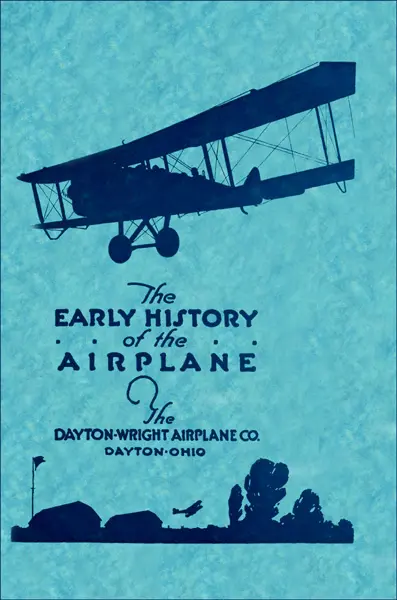
THE CLASSIC COLLECTION · 1922
"The Early History of the Airplane" by Orville Wright and Wilbur Wright is a seminal scientific publication detailing the early efforts and methodologies behind the invention of the airplane during the early 20th century. It chronicles the longstanding quest for human flight, encapsulating the brothers' personal experiences and breakthroughs in aerodynamics and flight mechanics. As an autobiographical technical report co-authored by the pioneering aviators, it serves as both a historical account and a foundational text in the field of aviation. The book provides an in-depth recounting of the Wright brothers' journey to achieving powered flight, beginning with their early inspirations and experiments with kites and gliders. It documents their extensive research into existing theories and the challenges they faced in balancing and controlling flight. Through systematic experimentation with various designs, they elaborated on their innovative approach, including the concept of wing warping for control. The pivotal moment in their narrative culminates with the first powered flight on December 17, 1903, marking a significant milestone in aviation history. Ultimately, the book encapsulates the Wright brothers’ relentless dedication and scientific approach to overcoming the obstacles of flight, establishing the groundwork for future advancements in aeronautics.
Introduction adapted from the source catalogue; source summaries may be automatically generated.
Free to read · English · 14,007 words · No account needed
MAKE TIME FOR A GOOD BOOK
On by default. Untick to stop anonymous reading totals. Each page counts after 10 seconds in view. How this works.
Anonymous counting is on unless you have switched it off.
My own active interest in aeronautical problems dates back to the death of Lilienthal in 1896. The brief notice of his death which appeared in the telegraphic news at that time aroused a passive interest which had existed from my childhood, and led me to take down from the shelves of our home library a book on "Animal Mechanism," by Prof. Marey, which I had already read several times. From this I was led to read more modern works, and as my brother soon became equally interested with myself, we soon passed from the reading to the thinking, and finally to the working stage. It seemed to us that the main reason why the problem had remained so long unsolved was that no one had been able to obtain any adequate practice. We figured that Lilienthal in five years of time had spent only about five hours in actual gliding through the air. The wonder was not that he had done so little, but that he had accomplished so much. It would not be considered at all safe for a bicycle rider to attempt to ride through a crowded city street after only five hours' practice, spread out in bits of ten seconds each over a period of five years; yet Lilienthal with this brief practice was remarkably successful in meeting the fluctuations and eddies of wind gusts. We thought that if some method could be found by which it would be possible to practice by the hour instead of by the second there would be hope of advancing the solution of a very difficult problem. It seemed feasible to do this by building a machine which would be sustained at a speed of 18 miles per hour, and then finding a locality where winds of this velocity were common. With these conditions a rope attached to the machine to keep it from floating backward would answer very nearly the same purpose as a propeller driven by a motor, and it would be possible to practice by the hour, and without any serious danger, as it would not be necessary to rise far from the ground, and the machine would not have any forward motion at all. We found, according to the accepted tables of air pressures on curved surfaces, that a machine spreading 200 square feet of wing surface would be sufficient for our purpose, and that places could easily be found along the Atlantic coast where winds of 16 to 25 miles were not at all uncommon. When the winds were low it was our plan to glide from the tops of sand hills, and when they were sufficiently strong to use a rope for our motor and fly over one spot. Our next work was to draw up the plan for a suitable machine. After much study we finally concluded that tails were a source of trouble rather than of assistance, and therefore we decided to dispense with them altogether. It seemed reasonable that if the body of the operator could be placed in a horizontal position instead of the upright, as in the machines of Lilienthal, Pilcher and Chanute, the wind resistance could be very materially reduced, since only one square foot instead of five would be exposed. As a full half-horse-power could be saved by this change, we arranged to try at least the horizontal position. Then the method of control used by Lilienthal, which consisted in shifting the body, did not seem quite as quick or effective as the case required; so, after long study, we contrived a system consisting of two large surfaces on the Chanute double-deck plan, and a smaller surface placed a short distance in front of the main surfaces in such a position that the action of the wind upon it would counterbalance the effect of the travel of the center of pressure on the main surfaces. Thus changes in the direction and velocity of the wind would have little disturbing effect, and the operator would be required to attend only to the steering of the machine, which was to be effected by curving the forward surface up or down. The lateral equilibrium and the steering to right or left was to be attained by a peculiar torsion of the main surfaces, which was equivalent to presenting one end of the wings at a greater angle than the other. In the main frame a few changes were also made in the details of construction and trussing employed by Mr. Chanute. The most important of these were: (1) The moving of the forward main cross-piece of the frame to the extreme front edge; (2) the encasing in the cloth of all cross-pieces and ribs of the surfaces; (3) a rearrangement of the wires used in trussing the two surfaces together, which rendered it possible to tighten all the wires by simply shortening two of them.
Your reading position is saved on this browser. Take it to another device with a library code. Reading pages adapt to text, rather than matching a printed edition.
BEHIND THE BOOK
This eBook is for the use of anyone anywhere in the United States and most other parts of the world at no cost and with almost no restrictions whatsoever. You may copy it, give it away or re-use it under the terms of the Project Gutenberg License included with this eBook or online at www.gutenberg.org. If you are not located in the United States, you will have to check the laws of the country where you are located before using this eBook. Read the source licence.
The original source file, including credits and licence, is retained by this library. Request an original-format copy at no charge. Please include the book title and Project Gutenberg identifier #25420.
KEEP YOUR CURIOSITY GOING
Cécile Tormay

Moritz Busch
John L. Ransom
Frances Wright
Cécile Tormay

Mabel Potter Daggett