
Fors Clavigera (Volume 5 of 8) Letters to the workmen and labourers of Great Britain
John Ruskin
THE CLASSIC COLLECTION · 1872
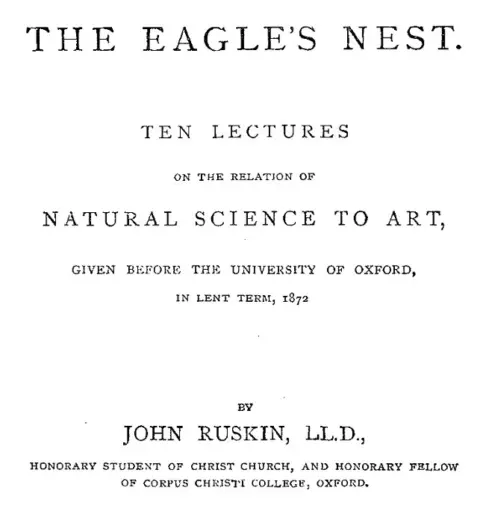
"The Eagle's Nest" by John Ruskin is a collection of lectures on the intersection of natural science and art, delivered in the early 19th century. This work, which consists of ten lectures, discusses the importance of wisdom in both fields, arguing that understanding and emotion are vital to true mastery in art, rather than technical skills alone. Ruskin brings forth concepts such as the virtues of art and science, and he challenges the audience to reflect on how these domains influence human experience and perception. At the start of the work, Ruskin establishes the tone and intent of his lectures, emphasizing the importance of clarity and accessibility in his teaching. He opens by reflecting on how art and science should ideally work together to elevate human understanding and appreciation of beauty. He introduces the concept of "sophia," or wisdom, as a guiding principle that must govern both artistic creation and scientific inquiry. Through various examples, he encourages his audience to pursue knowledge that is unselfish and enriching, setting the stage for his exploration of deeper philosophical ideas throughout the lectures.
Introduction adapted from the source catalogue; source summaries may be automatically generated.
Free to read · English · 58,987 words · No account needed
MAKE TIME FOR A GOOD BOOK
On by default. Untick to stop anonymous reading totals. Each page counts after 10 seconds in view. How this works.
Anonymous counting is on unless you have switched it off.
When you have drawn some of the actual patterns of plume and scale with attention, I believe you will see reason to think that spectra of organic species may be at least as distinct as those of metals or gases; but learn at all events what they are now, and never mind what they have been.
186. Nor need you care for methods of classification any more than for the origin of classes. Leave the physiologists to invent names, and dispute over them; your business is to know the creature, not the name of it momentarily fashionable in scientific circles. What practical service you can get from the order at present adopted, take, without contention; and as far as possible, use English words, or be sure you understand the Latin ones.
187. For instance, the order at present adopted in arranging the species of birds, is, as you know, founded only on their ways of using their feet.
Some catch or snatch their prey, and are called "Snatchers"--RAPTORES.
Some perch on branches, and are called "In-sitters," or
"Upon-sitters"--INSESSORES.
Some climb and cling on branches, and are called "Climbers"--SCANSORES.
Some scratch the ground, and are called "Scratchers"--RASORES.
Some stand or wade in shallow water, and, having long legs, are called "Stilt-walkers"--GRALLATORES.
Some float, and make oars of their feet, and are called
"Swimmers"--NATATORES.
188. This classification is unscholarly, because there are many snatchers and scratchers who perch as well as the sitters; and many of the swimmers sit, when ashore, more neatly than the sitters themselves; and are most grave insessors, in long rows, on rock or sand: also, 'insessor' does not mean properly a sitter, but a besieger; and it is awkward to call a bird a 'Rasor.' Still, the use of the feet is (on the whole) characteristic, and convenient for first rough arrangement; only, in general reference, it will be better to use plain English words than those stiff Latin ones, or their ugly translations. Linnæus, for all his classes except the stilt-walkers, used the name of the particular birds which were the best types of their class; he called the snatchers "hawks" (Accipitres), the swimmers, geese, (Anseres), the scratchers, fowls, (Gallinae), and the perchers, sparrows, (Passeres). He has no class of climbers; but he has one since omitted by Cuvier, "pies," which, for certain mythological reasons presently to be noted, I will ask you to keep. This will give you seven orders, altogether, to be remembered; and for each of these we will take the name of its most representative bird. The hawk has best right undoubtedly to stand for the snatchers; we will have his adversary, the heron, for the stilt-walkers; you will find this very advisable, no less than convenient; because some of the beaks of the stilt-walkers turn down, and some turn up; but the heron's is straight, and so he stands well as a pure middle type. Then, certainly, gulls will better represent the swimmers than geese; and pheasants are a prettier kind of scratchers than fowls. We will take parrots for the climbers, magpies for the pies, and sparrows for the perchers. Then take them in this order: Hawks, parrots, pies, sparrows, pheasants, gulls, herons; and you can then easily remember them. For you have hawks at one end, the herons at the other, and sparrows in the middle, with pies on one side and pheasants opposite, for which arrangement you will find there is good reason; then the parrots necessarily go beside the hawks, and the gulls beside the herons.
Your reading position is saved on this browser. Take it to another device with a library code. Reading pages adapt to text, rather than matching a printed edition.
John Ruskin

John Ruskin

John Ruskin

John Ruskin
BEHIND THE BOOK
This eBook is for the use of anyone anywhere in the United States and most other parts of the world at no cost and with almost no restrictions whatsoever. You may copy it, give it away or re-use it under the terms of the Project Gutenberg License included with this eBook or online at www.gutenberg.org. If you are not located in the United States, you will have to check the laws of the country where you are located before using this eBook. Read the source licence.
The original source file, including credits and licence, is retained by this library. Request an original-format copy at no charge. Please include the book title and Project Gutenberg identifier #42917.
KEEP YOUR CURIOSITY GOING

David Patterson (Spirit) Hatch

David Patterson (Spirit) Hatch

David Patterson (Spirit) Hatch
Coulson Kernahan

Ralph Waldo Emerson

Maurice Baring