
Fors Clavigera (Volume 5 of 8) Letters to the workmen and labourers of Great Britain
John Ruskin
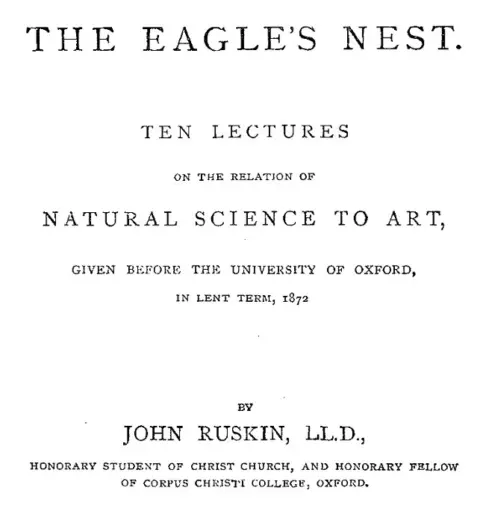
THE CLASSIC COLLECTION · 1872
"The Eagle's Nest" by John Ruskin is a collection of lectures on the intersection of natural science and art, delivered in the early 19th century. This work, which consists of ten lectures, discusses the importance of wisdom in both fields, arguing that understanding and emotion are vital to true mastery in art, rather than technical skills alone. Ruskin brings forth concepts such as the virtues of art and science, and he challenges the audience to reflect on how these domains influence human experience and perception. At the start of the work, Ruskin establishes the tone and intent of his lectures, emphasizing the importance of clarity and accessibility in his teaching. He opens by reflecting on how art and science should ideally work together to elevate human understanding and appreciation of beauty. He introduces the concept of "sophia," or wisdom, as a guiding principle that must govern both artistic creation and scientific inquiry. Through various examples, he encourages his audience to pursue knowledge that is unselfish and enriching, setting the stage for his exploration of deeper philosophical ideas throughout the lectures.
Introduction adapted from the source catalogue; source summaries may be automatically generated.
Free to read · English · 58,987 words · No account needed
MAKE TIME FOR A GOOD BOOK
On by default. Untick to stop anonymous reading totals. Each page counts after 10 seconds in view. How this works.
Anonymous counting is on unless you have switched it off.
[B] Educational Series, No. 8, E.
8. You come, therefore, to this University, I repeat once again, that you may learn how to form conceptions of proper range or grasp, and proper dignity, or worthiness. Keeping then the ideas of a separate school of art, and separate school of science, what have you to learn in these? You would learn in the school of art, the due range and dignity of deeds; or doings--(I prefer the word to "makings," as more general), and in the school of science, you would have to learn the range and dignity of knowledges.
Now be quite clear about this: be sure whether you really agree with me
or not.
You come to the School of Literature, I say, to learn the range and
dignity of conceptions.
To the School of Art, to learn the range and dignity of deeds.
To the School of Science, to learn the range and dignity of knowledges.
Do you agree to that, or not? I will assume that you admit my triple division; but do you think, in opposition to me, that a school of science is still a school of science, whatever sort of knowledge it teaches; and a school of art still a school of art, whatever sort of deed it teaches; and a school of literature still a school of literature, whatever sort of notion it teaches?
Do you think that? for observe, my statement denies that. My statement is, that a school of literature teaches you to have one sort of conception, not another sort; a school of art to do a particular sort of deed, not another sort; a school of science to possess a particular sort of knowledge, not another sort.
9. I assume that you differ with me on this point;--some of you certainly will. Well then, let me go back a step. You will all go thus far with me, that--now taking the Greek words--the school of literature teaches you to have νοῧς, or conception of things, instead of ἄνοια,--no conception of things; that the school of art teaches you τέχνη of things, instead of ἀτεχνία; and the school of science ἐπιστήμη, instead of ἄγνοια or 'ignorantia.' But, you recollect, Aristotle names two other faculties with these three,--φρόνησις, namely, and σοφίa. He has altogether five, τέχνη, ἐπιστήμη, φρόνησις, σοφίa, νοῦς; that is to say, in simplest English,--art, science, sense, wisdom, and wit. We have got our art, science, and wit, set over their three domains; and we old people send you young ones to those three schools, that you may not remain artless, scienceless, nor witless. But how of the sense, and the wisdom? What domains belong to these? Do you think our trefoil division should become cinquefoil, and that we ought to have two additional schools; one of Philosophia, and one of Philophronesia? If Aristotle's division were right it would be so. But his division is wrong, and he presently shows it is; for he tells you in the next page, (in the sentence I have so often quoted to you,) that "the virtue of art is the wisdom which consists in the wit of what is honourable." Now that is perfectly true; but it of course vitiates his division altogether. He divides his entire subject into A, B, C, D, and E; and then he tells you that the virtue of A is the B which consists in C. Now you will continually find, in this way, that Aristotle's assertions are right, but his divisions illogical. It is quite true that the virtue of art is the wisdom which consists in the wit of what is honourable; but also the virtue of science is the wit of what is honourable, and in the same sense, the virtue of νοῦς, or wit itself, consists in its being the wit or conception of what is honourable. Σοφία, therefore, is not only the ἀρετή τέχνης, but, in exactly the same sense, the ἀρετή ἐπιστήμης, and in this sense, it is the ἀρετή νόου. And if not governed by σοφίa, each school will teach the vicious condition of its own special faculty. As σοφία is the ἀρετή of all three, so μωρία will be the κακία of all three.
Your reading position is saved on this browser. Take it to another device with a library code. Reading pages adapt to text, rather than matching a printed edition.
John Ruskin

John Ruskin

John Ruskin

John Ruskin
BEHIND THE BOOK
This eBook is for the use of anyone anywhere in the United States and most other parts of the world at no cost and with almost no restrictions whatsoever. You may copy it, give it away or re-use it under the terms of the Project Gutenberg License included with this eBook or online at www.gutenberg.org. If you are not located in the United States, you will have to check the laws of the country where you are located before using this eBook. Read the source licence.
The original source file, including credits and licence, is retained by this library. Request an original-format copy at no charge. Please include the book title and Project Gutenberg identifier #42917.
KEEP YOUR CURIOSITY GOING

David Patterson (Spirit) Hatch

David Patterson (Spirit) Hatch

David Patterson (Spirit) Hatch
Coulson Kernahan

Ralph Waldo Emerson

Maurice Baring