
Fors Clavigera (Volume 5 of 8) Letters to the workmen and labourers of Great Britain
John Ruskin
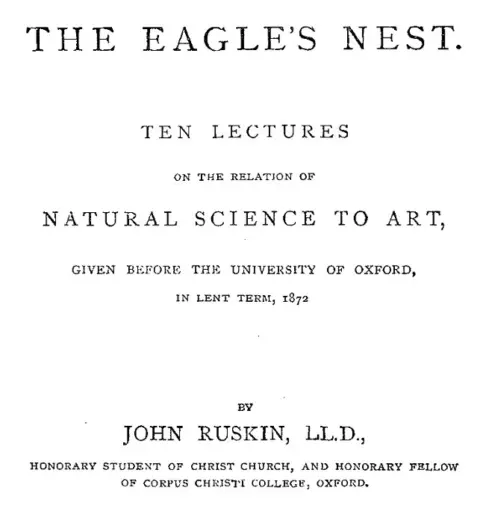
THE CLASSIC COLLECTION · 1872
"The Eagle's Nest" by John Ruskin is a collection of lectures on the intersection of natural science and art, delivered in the early 19th century. This work, which consists of ten lectures, discusses the importance of wisdom in both fields, arguing that understanding and emotion are vital to true mastery in art, rather than technical skills alone. Ruskin brings forth concepts such as the virtues of art and science, and he challenges the audience to reflect on how these domains influence human experience and perception. At the start of the work, Ruskin establishes the tone and intent of his lectures, emphasizing the importance of clarity and accessibility in his teaching. He opens by reflecting on how art and science should ideally work together to elevate human understanding and appreciation of beauty. He introduces the concept of "sophia," or wisdom, as a guiding principle that must govern both artistic creation and scientific inquiry. Through various examples, he encourages his audience to pursue knowledge that is unselfish and enriching, setting the stage for his exploration of deeper philosophical ideas throughout the lectures.
Introduction adapted from the source catalogue; source summaries may be automatically generated.
Free to read · English · 58,987 words · No account needed
MAKE TIME FOR A GOOD BOOK
On by default. Untick to stop anonymous reading totals. Each page counts after 10 seconds in view. How this works.
Anonymous counting is on unless you have switched it off.
Sophia, or σοφίa, Lect. I.
" Aristotle's definition of, 9 seq., 90.
" eternal and universal, 23.
" faculty of recognition and choice, 30.
" higher forms of, 27-28.
" modesty of true, 30-31.
" prudence, and contrasted, 26.
" ruling spirit, 20.
" sway over wise art and science, 37.
" unselfishness of true, 29, 31.
Sophocles' Trachiniæ, 199.
σωφροσύνη, 68, 90.
Sovereign, English (coin) and St. George, 117.
" heraldry of art (1870-1880), 235.
Spain, chivalry of, led by the Cid, 240.
Sparrow, the "percher" of birds, 188.
Spear, proper form of a, 224.
Species, modern theories on, 34.
Sport, English ideas of, 178.
Sport, continued:--
" love of killing birds, its meaning, 175.
Squire, derivation of word, 230.
Stars, their value to artist and scientist, 124.
Star-gazing, probable conditions of, by two girls, 26.
"Stones of Venice," statement as to anatomy in, withdrawn, 159.
Strasburg, architecture of, 202.
" art in, 82.
" drawing of house in, by Prout, 86.
Street, E., 50.
Strozzi, child and dog, Titian's, 151.
Subjects in art, natural subjects of national art, 95.
Success, one's own, and others', 31.
" effect of, on author, 31.
Sun, power of the, 100.
" modern efforts to dispense with, 104.
" should "rule the day," 104.
Swine, symbol of the herd of, 69.
Swiss châlet, education needed to build, 202.
Switzerland and Greece, two districts of, compared, 199.
" the Heracles of, 199.
" the history of, its lessons, 21.
Sympathy, essential to learning, 236.
Tabernacle, Jewish, 226.
Talking, doing, and knowing, 2, 3, 4.
τεχνὴ, 8.
Tees," Turner's "Greta and, 70.
Telescopes and eyes, 99.
Tell, William, legendary, 215.
Temper, trials of, 69.
" success, influence on, 31.
Temperance, true, in recognition of work, 81.
Temptations of knowledge, 79.
" Ulysses, their meanings, 74-5.
Tenderness the basis of skill and knowledge, 77.
Thales, 23.
"Theologia," Raphael's, 46.
Theology, more perfectly expressed by art than by literature, 46.
Theology, of art, only recently recognised, 46.
" of more value than anatomy to art, 168.
" science and, 67.
Thermopylæ, blue waters of, 199.
Theseus, Phidias', 39.
Thirst, man's best, for what, 212.
Thought, the peace of beautiful, 205.
" right, the end of literature, 3, 206.
Throne, a Greek word, 7.
Titian, use of red by, 226.
Titian's Strozzi Princess and dog, 151.
Titmouse, a new specimen of the, 66.
Tintoret, use of red by, 226.
" speed of, 139.
Toy, useless, at Crystal Palace, 93.
Trachiniæ, Sophocles', 190.
Trachis, king of, 190.
Tressure, the heraldic, 235.
Truth, completely given by science and art together, 58.
Turner, J. W. M., drawing of seen and known facts by, 125. " early patronage of, 199. " pines, drawing of Scotch and stone, confused, 133. " truth of, proved by author, 128. " works of-- " engraving of a cloud (Educ. Series, 8 E.), 7. " Greta and Tees, its quietude, 69-70. " Val. Plymouth, drawing of (anecdote), 125. " Valley of Chamouni, 147.
Tydides, 168.
Tyndall, Prof., "Palæontology," quoted, 100.
Ulysses of Dante and of Homer, 74-5.
Unity of feeling in great art, 93.
University, aim of its teaching, 4, 5, 6, 18.
" definition of a, 5.
" its function only to examine! 120.
" See s. Cambridge, Oxford.
Unselfishness in art, 31.
" of high forms of faculties, 29.
Unwise, man meant to be, 31.
Van Eyck's grace and severity, 218.
Vases, Greek, 139.
Vatican, frescoes, 226.
Varie, meaning of (heraldic), 225.
Venetian glass, 139.
Your reading position is saved on this browser. Take it to another device with a library code. Reading pages adapt to text, rather than matching a printed edition.
John Ruskin

John Ruskin

John Ruskin

John Ruskin
BEHIND THE BOOK
This eBook is for the use of anyone anywhere in the United States and most other parts of the world at no cost and with almost no restrictions whatsoever. You may copy it, give it away or re-use it under the terms of the Project Gutenberg License included with this eBook or online at www.gutenberg.org. If you are not located in the United States, you will have to check the laws of the country where you are located before using this eBook. Read the source licence.
The original source file, including credits and licence, is retained by this library. Request an original-format copy at no charge. Please include the book title and Project Gutenberg identifier #42917.
KEEP YOUR CURIOSITY GOING

David Patterson (Spirit) Hatch

David Patterson (Spirit) Hatch

David Patterson (Spirit) Hatch
Coulson Kernahan

Ralph Waldo Emerson

Maurice Baring