
Fors Clavigera (Volume 5 of 8) Letters to the workmen and labourers of Great Britain
John Ruskin
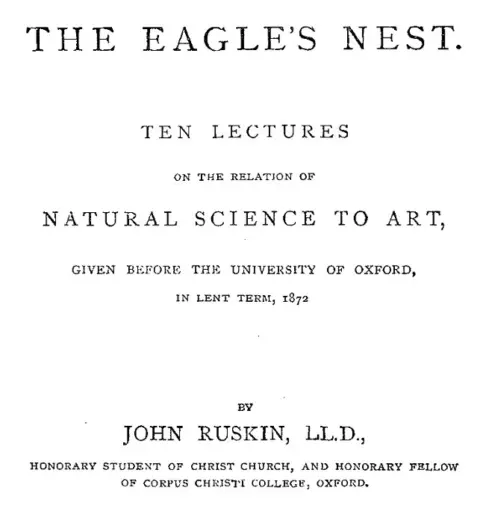
THE CLASSIC COLLECTION · 1872
"The Eagle's Nest" by John Ruskin is a collection of lectures on the intersection of natural science and art, delivered in the early 19th century. This work, which consists of ten lectures, discusses the importance of wisdom in both fields, arguing that understanding and emotion are vital to true mastery in art, rather than technical skills alone. Ruskin brings forth concepts such as the virtues of art and science, and he challenges the audience to reflect on how these domains influence human experience and perception. At the start of the work, Ruskin establishes the tone and intent of his lectures, emphasizing the importance of clarity and accessibility in his teaching. He opens by reflecting on how art and science should ideally work together to elevate human understanding and appreciation of beauty. He introduces the concept of "sophia," or wisdom, as a guiding principle that must govern both artistic creation and scientific inquiry. Through various examples, he encourages his audience to pursue knowledge that is unselfish and enriching, setting the stage for his exploration of deeper philosophical ideas throughout the lectures.
Introduction adapted from the source catalogue; source summaries may be automatically generated.
Free to read · English · 58,987 words · No account needed
MAKE TIME FOR A GOOD BOOK
On by default. Untick to stop anonymous reading totals. Each page counts after 10 seconds in view. How this works.
Anonymous counting is on unless you have switched it off.
Birds, builders and singers, 48. " classifications of (raptores, rasores, &c.), 187-9. " English temper towards, illustrated 174-5. " praising God, 61. " rare, becoming extinct, 34. " shooting them, the first idea of English gentlemen, 178. See s. Æthuia, Bullfinch, Clematis, Cuvier, Egret, Gould, Gull, Halcyon, Hawk, Heron, Kingfisher, Laros, Nest, Nightingale, Ornithology, Peacock, Pheasant, Skylark.
Blake, Wm., as painter and as poet, 21.
" quoted, "The Book of Thel," "Doth the eagle know," &c., 21,
22, 63.
Blindness of mind and body, 106.
Boat race, 212.
Boats, loved by all boys, 41.
Books, children's, 61.
Botanic gardens at Oxford, 160.
Botticelli, as an engraver, pref. vii.
" his study of face and limb, pref. viii.
Bottle, science of the formation of a, 135.
Brutes, man's relation to the, 30. See s. Animals.
Briareus, 183.
British Museum, Greek Vase, "Anacreon and his dog" at, 151.
Bruges, 93.
Bubble, soap, unexplained, 132, 134.
Bullfinch's nest, 48.
Bustle, Dr. Acland's dog, author's delight in, 151, 154.
California, 70.
Camarina, 229.
Cambridge wranglers, value of art to, 96.
Canton, the heraldic, 235.
Carlyle, T., "Shooting Niagara," 70.
Carrion and game, choice of, 11, 36.
Cassell's Educator, 202.
Cassiopeia, 124.
Cat, its power and use of sight, 110.
" "may look at a king," ib.
Ceyx, son of the Morning Star, 198.
Chærephon, in Lucian's dialogue on the Halcyon, 194.
Châlet, education needed to build a Swiss, 202.
Chamouni, Turner's drawing of, 147.
Chance, and design in nature, 182, seq.
Change, and living change, how wrought, 208-9.
Chapel, attendance at, in Oxford, 169.
Character, evidenced by dress, 220.
Chariot, use of Greek, 231.
Charity, true, more reverent than pitiful, 211.
Charlemagne's treaty with Scotland, 235.
Chartism, story of a Chartist herald (Sir A. Helps, quoted), 208.
Charybdis, 75.
Chaucer, quoted, "Cuckoo and Nightingale," 37 (motto), 56.
Chemistry, a modern God, 202.
" modern progress in, 33.
" of little use to art, 96.
Cherwell, the, 179.
Chevron, the heraldic, 235.
Chiefe, the heraldic, 235.
Child and dog, pictures by Titian and Reynolds, 151.
Childhood, pleasures and retrospect of, 82.
Children's books, 61.
Chivalry, Christian and Greek, 219.
" " history of, to be learnt by gentlemen, 216.
" conception of, as an influence in education, 239.
" European, its basis, 236.
" leaders of, 240.
Christ, heraldic symbol of, in Italy, 229.
Christian chivalry. See s. Chivalry.
Christianity, early traces of in heathen literature (Lucian), 194. " idea of God as Light, 116. " its statements of mental health, 69.
Chromo-lithotints, style of, 69-71.
Church of England, 73.
Cid, The, 240.
Civilization, false, 94.
Civil Service, the, and Orissa, 35.
Classification, scientific, 186-7.
Cleanliness and art, 95.
Clematis, a bird's nest of, 48.
Clouds, 129-30.
" effect of storm-clouds on scientist, artist, and scholar, 7.
" forms of, unexplained by science, 131.
Coins, English "angels," 117.
" engravings of, 157. See s. Angels, Sovereign.
Colonization, Englishmen likely to be colonists, 94.
Colour, connection of with health, 113.
" design in, on Gothic shields, 233.
" gloomy, in art, 69.
" in dress, originates in the skins of animals, 226-7.
" love of light, 113, 116, 117.
" perception of, a spiritual and moral power, 122.
" pure, delight in, 113, 115.
" school of shade and of crystalline colour, 114.
" temperance of, 71.
Common-sense in the English, 24, 25. See s. Aristotle.
Competition in art, 88.
" in education, 177, 212.
Your reading position is saved on this browser. Take it to another device with a library code. Reading pages adapt to text, rather than matching a printed edition.
John Ruskin

John Ruskin

John Ruskin

John Ruskin
BEHIND THE BOOK
This eBook is for the use of anyone anywhere in the United States and most other parts of the world at no cost and with almost no restrictions whatsoever. You may copy it, give it away or re-use it under the terms of the Project Gutenberg License included with this eBook or online at www.gutenberg.org. If you are not located in the United States, you will have to check the laws of the country where you are located before using this eBook. Read the source licence.
The original source file, including credits and licence, is retained by this library. Request an original-format copy at no charge. Please include the book title and Project Gutenberg identifier #42917.
KEEP YOUR CURIOSITY GOING

David Patterson (Spirit) Hatch

David Patterson (Spirit) Hatch

David Patterson (Spirit) Hatch
Coulson Kernahan

Ralph Waldo Emerson

Maurice Baring