
Fors Clavigera (Volume 5 of 8) Letters to the workmen and labourers of Great Britain
John Ruskin
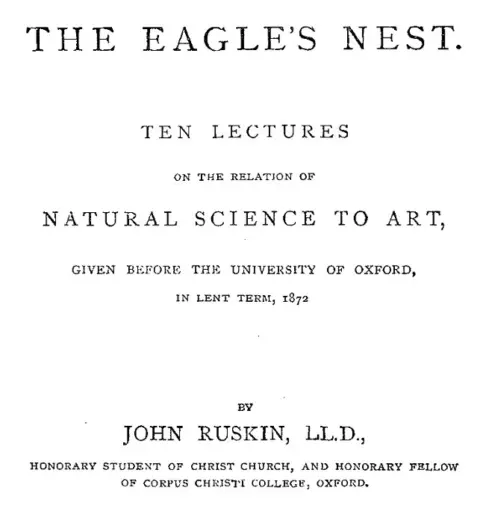
THE CLASSIC COLLECTION · 1872
"The Eagle's Nest" by John Ruskin is a collection of lectures on the intersection of natural science and art, delivered in the early 19th century. This work, which consists of ten lectures, discusses the importance of wisdom in both fields, arguing that understanding and emotion are vital to true mastery in art, rather than technical skills alone. Ruskin brings forth concepts such as the virtues of art and science, and he challenges the audience to reflect on how these domains influence human experience and perception. At the start of the work, Ruskin establishes the tone and intent of his lectures, emphasizing the importance of clarity and accessibility in his teaching. He opens by reflecting on how art and science should ideally work together to elevate human understanding and appreciation of beauty. He introduces the concept of "sophia," or wisdom, as a guiding principle that must govern both artistic creation and scientific inquiry. Through various examples, he encourages his audience to pursue knowledge that is unselfish and enriching, setting the stage for his exploration of deeper philosophical ideas throughout the lectures.
Introduction adapted from the source catalogue; source summaries may be automatically generated.
Free to read · English · 58,987 words · No account needed
MAKE TIME FOR A GOOD BOOK
On by default. Untick to stop anonymous reading totals. Each page counts after 10 seconds in view. How this works.
Anonymous counting is on unless you have switched it off.
Art--
aim of what it should be, 3, 76.
anatomy, fatal to, pref. vii.
characteristics of:--
eagle eyes, 36.
love of nature, 41.
modesty, Lect. iv., 74.
" of wise appreciation, 172.
originality, to what extent, 32, 33.
refinement and rudeness, 90-91.
sight before knowledge, 125-26.
simplicity before skill, 40.
temperance, 90.
unconsciousness, 53-54.
unity of feeling, 93.
unselfishness as essential to wisdom, 76, 172.
wisdom and folly in Lect. i.
definition of great:--
it begins rightly, ends beautifully, 146.
it needs no addition, bears no taking away, 147.
See below s. Meaning.
difference between good and bad, 71.
education in:--
generally, 94.
the teacher need not talk much, 2.
ethics and, 18.
the science of right conduct essential to it, 161.
imitative, Shakespeare quoted on, 39.
influenced by:--
local surroundings, 91.
love of death, esp., modern, 69.
meaning of, 38.
national art, proper subjects of, 95.
" ignorance of art, 16.
nature and:--
art less beautiful than reality, 172.
general knowledge of organic nature essential to art, 149.
science and:--
art above science, but must comply with it, 145.
" does not teach science, 160.
" the handmaid and shadow of science, 47, 68, 76, 172.
highest sciences need art most, 45, 96.
simplest art the most useful to, 127.
subjects of art and, the same, 43.
the masters of art, beyond all science, 136.
wise art and wise, Lect. iii. See s. Nature, Use,
Science.
self-sufficiency of. See above s. Characteristics.
subject of, appearances rather than facts, 149.
theology of, only recently recognised, 46.
truth complete given by art and science, 58. See s. Artist.
use and value of,
as a means of record, 38-9,
as expressing nature, 41.
practical, 206.
to history and physiology, 38-39, 47, 207 seq.
to religion, 46. [See above s. Science.
See s. Æstheticism, Affectation, Anatomy, Animals,
Architecture, Author, Beauty, Chromo-lithotint,
Cleanliness, Colour, Competition, Death, Decency,
Drawing, Dress, Folly, French, Gothic, History,
Indolence, Invention, κακία, Knowledge, Lindsay,
Madonna, Nature, Nude, Photography, Royal Academy,
Science.
Artemisium, 199.
Artist-- modesty of, 31. modesty about, enjoyment in, and feeling as to their own work, 52. science needed by an, 124-25, 133. he must know as well as see, 123. subjects of, not invisible structures, though often invisible things, 172-3. See s. Angelico, Barry, Bellini, Botticelli, Copley Fielding, Correggio, Dürer, Ghirlandajo, Giotto, Holbein, Hunt (A.), Hunt (Holman), Leonardo, Lippi, Luini, Mantegna, M. Angelo, Mulready, Raphael, Reynolds, Robson, Titian, Tintoret, Turner, Van Eyck.
Artistic affectation in England, 201.
Aspis and apsis, 230.
Associations, local, to be cherished, 94.
Astronomy--
how far valuable discovery yet possible in, 66.
two young ladies studying, 26. See s. Stars.
ἀτεχνία, 8.
Atheism, modern, 202.
" " tries to dispense with the sun, 104.
Athena, power of, 196, and n.
" protects Ulysses, 75.
" typical of what, 224.
Atlantic, Ulysses in the, 75.
αὐταρχεία, 80.
Author: (1) Generally, (2) Teaching, (3) Books, &c.
Your reading position is saved on this browser. Take it to another device with a library code. Reading pages adapt to text, rather than matching a printed edition.
John Ruskin

John Ruskin

John Ruskin

John Ruskin
BEHIND THE BOOK
This eBook is for the use of anyone anywhere in the United States and most other parts of the world at no cost and with almost no restrictions whatsoever. You may copy it, give it away or re-use it under the terms of the Project Gutenberg License included with this eBook or online at www.gutenberg.org. If you are not located in the United States, you will have to check the laws of the country where you are located before using this eBook. Read the source licence.
The original source file, including credits and licence, is retained by this library. Request an original-format copy at no charge. Please include the book title and Project Gutenberg identifier #42917.
KEEP YOUR CURIOSITY GOING

David Patterson (Spirit) Hatch

David Patterson (Spirit) Hatch

David Patterson (Spirit) Hatch
Coulson Kernahan

Ralph Waldo Emerson

Maurice Baring