
Fors Clavigera (Volume 5 of 8) Letters to the workmen and labourers of Great Britain
John Ruskin
THE CLASSIC COLLECTION · 1872
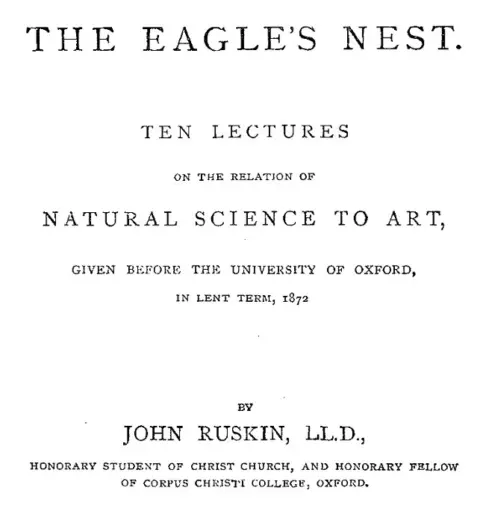
"The Eagle's Nest" by John Ruskin is a collection of lectures on the intersection of natural science and art, delivered in the early 19th century. This work, which consists of ten lectures, discusses the importance of wisdom in both fields, arguing that understanding and emotion are vital to true mastery in art, rather than technical skills alone. Ruskin brings forth concepts such as the virtues of art and science, and he challenges the audience to reflect on how these domains influence human experience and perception. At the start of the work, Ruskin establishes the tone and intent of his lectures, emphasizing the importance of clarity and accessibility in his teaching. He opens by reflecting on how art and science should ideally work together to elevate human understanding and appreciation of beauty. He introduces the concept of "sophia," or wisdom, as a guiding principle that must govern both artistic creation and scientific inquiry. Through various examples, he encourages his audience to pursue knowledge that is unselfish and enriching, setting the stage for his exploration of deeper philosophical ideas throughout the lectures.
Introduction adapted from the source catalogue; source summaries may be automatically generated.
Free to read · English · 58,987 words · No account needed
MAKE TIME FOR A GOOD BOOK
On by default. Untick to stop anonymous reading totals. Each page counts after 10 seconds in view. How this works.
Anonymous counting is on unless you have switched it off.
I have kept to the last Lucian's dialogue, "the Halcyon," to show you how the tone of Christian thought, and tradition of Christ's walking on the sea, began to steal into heathen literature.
194. "Chaerephon. What cry is that, Socrates, which came to us from the beach? how sweet it was; what can it be? the things that live in the sea are all mute.
"Socrates. Yet it is a sea-creature, Chaerephon; the bird called Halcyon, concerning which the old fable runs that she was the daughter of Æolus, and, mourning in her youth for her lost husband, was winged by divine power, and now flies over the sea, seeking him whom she could not find, sought throughout the earth.
"Chaerephon. And is that indeed the Halcyon's cry? I never heard it yet; and in truth it is very pitiful. How large is the bird, Socrates?
"Socrates. Not great; but it has received great honour from the Gods, because of its lovingness; for while it is making its nest, all the world has the happy days which it calls halcyonidæ, excelling all others in their calmness, though in the midst of storm; of which you see this very day is one, if ever there was. Look, how clear the sky is, and the sea waveless and calm, like a mirror!
"Chaerephon. You say truly, and yesterday was just such another. But in the name of the Gods, Socrates, how is one to believe those old sayings, that birds were ever changed into women, or women into birds, for nothing could seem more impossible?
195. "Socrates. Ah, dear Chaerephon, it is likely that we are poor and blunt judges of what is possible and not: for we judge by comparing to human power a power unknown to us, unimaginable, and unseen. Many things, therefore, that are easy, seem to us difficult; and many things unattainable that may be attained; being thus thought of, some through the inexperience, and some through the infantine folly, of our minds. For in very deed every man may be thought of as a child--even the oldest of us,--since the full time of life is little, and as a baby's compared to universal time. And what should we have to say, my good friend, who know nothing of the power of gods or of the spirits of Nature, whether any of such things are possible or not? You saw, Chaerephon, what a storm there was, the day before yesterday; it makes one tremble even to think of it again;--that lightning, and thunder, and sudden tempest, so great that one would have thought all the earth falling to ruin; and yet, in a little while, came the wonderful establishing of calm, which has remained even till now. Whether, then, do you think it the greater work, to bring such a calm out of that tormenting whirlwind, and reduce the universe to peace, or to change the form of a woman into that of a bird? For indeed we see how very little children, who know how to knead clay, do something like this also; often out of one lump they will make form after form, of different natures: and surely to the spirit-powers of Nature, being in vast and inconjecturable excess beyond ours, all such things must be in their hands easy. Or how much do you think heaven greater than thyself--can you say, perchance?
Your reading position is saved on this browser. Take it to another device with a library code. Reading pages adapt to text, rather than matching a printed edition.
John Ruskin

John Ruskin

John Ruskin

John Ruskin
BEHIND THE BOOK
This eBook is for the use of anyone anywhere in the United States and most other parts of the world at no cost and with almost no restrictions whatsoever. You may copy it, give it away or re-use it under the terms of the Project Gutenberg License included with this eBook or online at www.gutenberg.org. If you are not located in the United States, you will have to check the laws of the country where you are located before using this eBook. Read the source licence.
The original source file, including credits and licence, is retained by this library. Request an original-format copy at no charge. Please include the book title and Project Gutenberg identifier #42917.
KEEP YOUR CURIOSITY GOING

David Patterson (Spirit) Hatch

David Patterson (Spirit) Hatch

David Patterson (Spirit) Hatch
Coulson Kernahan

Ralph Waldo Emerson

Maurice Baring