THE CLASSIC COLLECTION✦Letters to Persons Who Are Engaged in Domestic ServiceCLASSIC FREE BOOKS
Letters to Persons Who Are Engaged in Domestic Service
Catharine Esther Beecher
THE CLASSIC COLLECTION · 1845
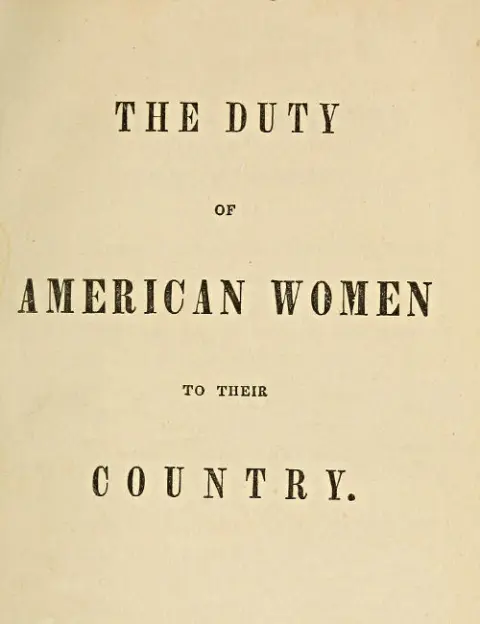
"The Duty of American Women to Their Country" by Catharine Esther Beecher is a social commentary written in the mid-19th century. The book discusses the crucial role of women in promoting education and morality in society, arguing that the civic responsibility of women extends to ensuring the intellectual and virtuous upbringing of American children. Beecher warns against the dangers of ignorance and lack of moral training, drawing parallels with historical disasters like the French Revolution to stress the importance of women's influence in nurturing future generations. The opening of the work makes a strong case for reason and virtue as essential for a functioning democracy, framing the text as a call-to-action for women to engage in educational reform. Beecher paints a dire picture of potential societal collapse if women do not take up the mantle of educating the youth and instilling a sense of moral responsibility. By citing examples of violence and chaos from contemporary France, she underscores her argument, urging women to become proactive educators and moral guides to safeguard the future of their nation. This foundational premise sets the stage for a deeper exploration of the role of women in education and public life as the text unfolds.
Introduction adapted from the source catalogue; source summaries may be automatically generated.
Free to read · English · 37,447 words · No account needed
MAKE TIME FOR A GOOD BOOK
On by default. Untick to stop anonymous reading totals. Each page counts after 10 seconds in view. How this works.
Anonymous counting is on unless you have switched it off.
“In regard to some voluntary organization to secure popular education, if it were worked with a truly liberal and Christian spirit, it could, and would, do us great good in this state: first, by collecting statistics of our wants, and calling attention (by the press, and by public lectures all over the state) to these wants, and to what has been accomplished in other states and countries.
2. By supporting, at least in part, model schools in different parts of the state, to show, by example, what good schools are.
3. By bringing public sentiment to bear on the Legislature, especially in reference to our school fund. It is now nearly two millions, and is yearly increasing. Now, its whole management is left to the unregulated action of the Legislature, without a single mind devoted to acquiring and disseminating knowledge as to the proper mode of using it. Whether, any one year, there shall be even one intelligent friend of education in our Legislature, is a matter of chance. If some plan be not devised for leading the Legislature to wise views, the object of this fund will be lost. It will a little diminish the expense for each child, but add nothing towards getting better schools.”
President Sturtevant’s account of the deplorable state of their schools, and of the public apathy on the subject, is mournful.
From the Rev. Henry Beecher, of Indianapolis, Indiana.
Much can be done in Indiana, much ought to be done, and speedily; for,
1. It will be a more densely-populated state than Ohio or Illinois, because its land is uniformly good.
2. It has been grievously neglected. Its settlers were originally from Kentucky, North Carolina, and Pennsylvania. Such do better for flocks and farms than for mental and moral improvement.
3. We have a good system of common school education, which, for purposes of Church and State ambition, some sectarians are disposed to break down; and they are of the dominant sect in the state. Those sects that foster education are in the minority, and struggling up through many embarrassments.
4. We have a school fund of more than two millions, which is in such neglect as threatens its entire loss.
An agent should be supported to lecture through the state, in every county town, to secure workers to defend our school system, to protect our school fund from depredators, to secure an annual Education Convention, and otherwise exert influence. The right man for such an agent I know. It is a Dr. Cornett, of Versailles, Ripley Co., Ia. He is a member of our Senate, and chairman of their Committee on Education: a man prudent, cool, sagacious, interested in the cause, and of great weight in the community.
Your reading position is saved on this browser. Take it to another device with a library code. Reading pages adapt to text, rather than matching a printed edition.
Catharine Esther Beecher

Catharine Esther Beecher
Catharine Esther Beecher

Catharine Esther Beecher
BEHIND THE BOOK
This eBook is for the use of anyone anywhere in the United States and most other parts of the world at no cost and with almost no restrictions whatsoever. You may copy it, give it away or re-use it under the terms of the Project Gutenberg License included with this eBook or online at www.gutenberg.org. If you are not located in the United States, you will have to check the laws of the country where you are located before using this eBook. Read the source licence.
The original source file, including credits and licence, is retained by this library. Request an original-format copy at no charge. Please include the book title and Project Gutenberg identifier #53739.
KEEP YOUR CURIOSITY GOING

David Patterson (Spirit) Hatch

David Patterson (Spirit) Hatch

David Patterson (Spirit) Hatch
Cécile Tormay

Moritz Busch
John L. Ransom