THE CLASSIC COLLECTION✦Letters to Persons Who Are Engaged in Domestic ServiceCLASSIC FREE BOOKS
Letters to Persons Who Are Engaged in Domestic Service
Catharine Esther Beecher
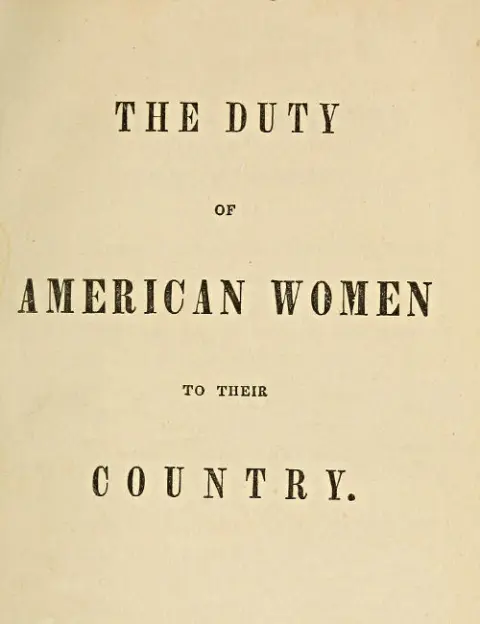
THE CLASSIC COLLECTION · 1845
"The Duty of American Women to Their Country" by Catharine Esther Beecher is a social commentary written in the mid-19th century. The book discusses the crucial role of women in promoting education and morality in society, arguing that the civic responsibility of women extends to ensuring the intellectual and virtuous upbringing of American children. Beecher warns against the dangers of ignorance and lack of moral training, drawing parallels with historical disasters like the French Revolution to stress the importance of women's influence in nurturing future generations. The opening of the work makes a strong case for reason and virtue as essential for a functioning democracy, framing the text as a call-to-action for women to engage in educational reform. Beecher paints a dire picture of potential societal collapse if women do not take up the mantle of educating the youth and instilling a sense of moral responsibility. By citing examples of violence and chaos from contemporary France, she underscores her argument, urging women to become proactive educators and moral guides to safeguard the future of their nation. This foundational premise sets the stage for a deeper exploration of the role of women in education and public life as the text unfolds.
Introduction adapted from the source catalogue; source summaries may be automatically generated.
Free to read · English · 37,447 words · No account needed
MAKE TIME FOR A GOOD BOOK
On by default. Untick to stop anonymous reading totals. Each page counts after 10 seconds in view. How this works.
Anonymous counting is on unless you have switched it off.
In the Catholic Church, a wisdom is shown on this subject, which Protestants as yet have not exhibited. In that Church, if a lady of wealth and family is led to devote herself to benevolent enterprises, a post is immediately found for her as Lady Abbess, or Lady Patroness, or Lady Superior, where she secures the power, consideration, and rank, which even ambition might covet. There is now a Catholic institution in one of our principal western cities, known to the writer, which is superintended by a lady of rank and family from Belgium, and which is only a branch of a still larger institution in Belgium, over which another titled lady presides. And there are several other ladies of family and fortune from Europe, who are spending their time and wealth in gathering American children into the Catholic Church. Meantime, all women of humbler station have places provided, as Nuns or Sisters of Charity, where they can spend their benevolent energies in honoured activity. The clergy, having no families to occupy their time, devote their whole attention to the extension of their faith by schools as well as by planting churches. To these instrumentalities are added the Jesuit establishment in this country, expressly devoted to the interests of education, with the head Jesuit for the West stationed in Cincinnati, to supervise and promote all plans for education. He is a man of winning manners, great policy, untiring industry, and, so far as human eye can see, honestly and sincerely devoted to the cause he has espoused. Under his watchful eye, no energy, or benevolence, or skill is ever lost, but all is husbanded and skilfully directed.
But among Protestants there is no system or organization instituted, thus to secure and employ the benevolent energies of the female sex in the cause of education. If a woman finds it in her heart to turn missionary and go away from her country to instruct the heathen, in most cases, every facility is provided, and public sentiment urges and encourages her efforts, and she knows to whom to apply for support and encouragement. But let a woman become interested in her own country, and earnestly desire to labour for destitute American children, and no such means, or facilities exist as make it suitable, or practicable to undertake. Among Catholics, let a woman of family and fortune talk of going to the West to teach, and she instantly is lauded as a saint; bishops, priests, and Jesuits are at her side to encourage and aid, and honour in life and canonization at death are her sure reward. But let a Protestant woman of wealth and high standing express a wish and intention to go to the West to teach, and it would be regarded by most of her friends and associates as a mark of oddity--a deficiency of good sense. Family friends would oppose, acquaintances would sneer, a few would faintly approve, no individual and no body of men could be found, whose appropriate business it is to aid, and so many obstacles would oppose, that, in most cases, it would really be Quixotic to encounter them. And women in humbler circumstances find almost as insurmountable obstacles; they know of no place where they can go, it is the business of no one to aid them, they know of no one to whom to apply for assistance, and thus it is that hundreds and hundreds of women, abundantly competent to act as missionary teachers, are pining in secret over wasted energies, which they are longing to spend in the most appropriate duty of women, the training of young minds for usefulness and for Heaven. It may be replied, that in the Catholic Church women take vows of celibacy, which alone can enable them thus to act for the cause of education, and that no such efficient action for education can be anticipated from Protestant women, whose religious faith opposes rather than encourages this sequestration from domestic alliances. A few facts will serve to show the fallacy of this impression. A lady of New-England, who for a number of years conducted a large female institution, furnishes this as the result of her experience. During nine years, four hundred teachers went out from this institution. Of these, eighty-eight went to the West and South. At the end of these nine years, of the eighty-eight who went to the West and South, sixty-four (which is more than three fourths) continued as teachers. Twelve of these continued teachers after marriage. During three years of this time, a society connected with this institution was in operation to aid young women in educating themselves to be teachers. This assistance was in the form of a loan, which at no time was to exceed two hundred dollars to any one individual, and this loan was to be returned whenever it was practicable. The society remitted the debt in cases where it was not. Means were also provided for the appropriate protection and location of these teachers. The number who in three years received aid was forty-three, and the sum of $4340,00 was loaned for this purpose. Twenty-four of these, in the space of eight years from the first loans, refunded from their own earnings all that was loaned. Eight refunded in part. The remainder did not refund within the eight years, but all who were not sick or dead were expecting and aiming so to do.
Your reading position is saved on this browser. Take it to another device with a library code. Reading pages adapt to text, rather than matching a printed edition.
Catharine Esther Beecher

Catharine Esther Beecher
Catharine Esther Beecher

Catharine Esther Beecher
BEHIND THE BOOK
This eBook is for the use of anyone anywhere in the United States and most other parts of the world at no cost and with almost no restrictions whatsoever. You may copy it, give it away or re-use it under the terms of the Project Gutenberg License included with this eBook or online at www.gutenberg.org. If you are not located in the United States, you will have to check the laws of the country where you are located before using this eBook. Read the source licence.
The original source file, including credits and licence, is retained by this library. Request an original-format copy at no charge. Please include the book title and Project Gutenberg identifier #53739.
KEEP YOUR CURIOSITY GOING

David Patterson (Spirit) Hatch

David Patterson (Spirit) Hatch

David Patterson (Spirit) Hatch
Cécile Tormay

Moritz Busch
John L. Ransom