THE CLASSIC COLLECTION✦Letters to Persons Who Are Engaged in Domestic ServiceCLASSIC FREE BOOKS
Letters to Persons Who Are Engaged in Domestic Service
Catharine Esther Beecher
THE CLASSIC COLLECTION · 1845
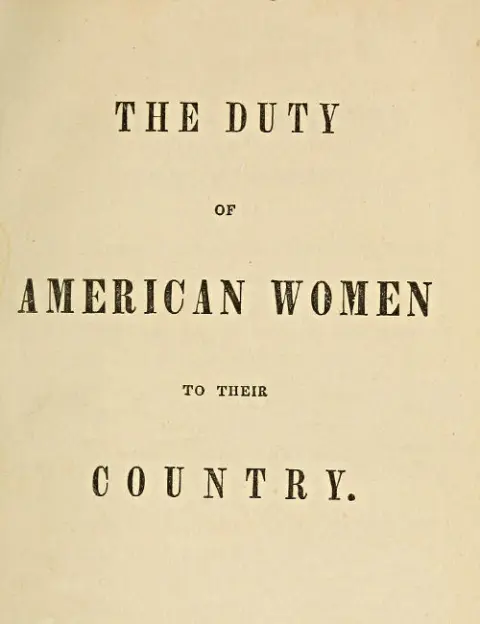
"The Duty of American Women to Their Country" by Catharine Esther Beecher is a social commentary written in the mid-19th century. The book discusses the crucial role of women in promoting education and morality in society, arguing that the civic responsibility of women extends to ensuring the intellectual and virtuous upbringing of American children. Beecher warns against the dangers of ignorance and lack of moral training, drawing parallels with historical disasters like the French Revolution to stress the importance of women's influence in nurturing future generations. The opening of the work makes a strong case for reason and virtue as essential for a functioning democracy, framing the text as a call-to-action for women to engage in educational reform. Beecher paints a dire picture of potential societal collapse if women do not take up the mantle of educating the youth and instilling a sense of moral responsibility. By citing examples of violence and chaos from contemporary France, she underscores her argument, urging women to become proactive educators and moral guides to safeguard the future of their nation. This foundational premise sets the stage for a deeper exploration of the role of women in education and public life as the text unfolds.
Introduction adapted from the source catalogue; source summaries may be automatically generated.
Free to read · English · 37,447 words · No account needed
MAKE TIME FOR A GOOD BOOK
On by default. Untick to stop anonymous reading totals. Each page counts after 10 seconds in view. How this works.
Anonymous counting is on unless you have switched it off.
And it is the pride and honour of our country, that woman holds a commanding influence in the domestic and social circle, which is accorded to the sex in no other nation, and such as will make her wishes and efforts, if united for a benevolent and patriotic object, almost omnipotent.
To you, then, American women, are brought these two millions of suffering and destitute children; these “despised little ones,” of whom is written, “their angels do always behold the face of our Father in heaven;” who are loved and cared for by the good Shepherd above, so that it were better for any of us, that we were thrown with a millstone about our necks into the sea, than that, through our guilty neglect, even one of these little ones should perish.
To you, my countrywomen, these little children call, with voices soft as the young ravens’ cry, yet multitudinous as the murmuring ocean waves. To you they complain of the filth, and the weariness, and the aching muscles, and the throbbing head, and the tortured eyes. To you they lament the degrading scenes and fatal influences, that wither all that is pure, and sweet, and lovely in childhood and youth. Of you they ask relief from suffering, and all those blessed ministries that will lead their young feet to usefulness and happiness on earth, and to glory, honour, and immortality on high. Ah, surely their supplications will be heard, and speedy relief will be found!
How, then, can American women act for these children, and thus for the salvation of their country, in an emergency like this?
Before answering this question, it is needful to consider that the education demanded for the American people is not merely to be taught to read and write. In communities where it is the universal fashion to read, and where books and papers are multitudinous as the flakes of heaven, it might, perhaps, suffice to teach a child to read, so far as intellect is concerned. But if the tastes and principles are not formed aright, the probability is, that blank ignorance would be better than the poisonous food, which a mind, thus sent forth to seek its own supplies, would inevitably select. But in those sections of our country that are most deficient in schools, there are neither books, nor the desire, or the taste for reading them. And among those who are taught to read, thousands go from the portals of knowledge to daily toil, or to vicious indulgences, leaving the mind as empty and stupid as if no such ability were gained. And how many there are, who have sharpened their faculties only as edged tools for greater mischief! No; the American people are to be educated for their high duties. The children who, ere long, are to decide whether we shall have tariff or no tariff, bank or no bank, slavery or no slavery, naturalization laws or no such laws, must be trained so that they cannot be duped and excited by demagogues, and thus led on to the ruin that overwhelmed the people of France. They must be trained to read, and think, and decide intelligently on all matters where they are to act as legislators, judges, jury, and executive. The children who, ere long, are to be thrown into the heats and passion of political strife and sectional jealousy, must be trained to rule their passions, and to control themselves by reason, religion, and law. The young daughters of this nation, too, must be trained to become the educators of all the future statesmen, legislators, judges, juries, and magistrates of this land. For to them are to be committed the minds and habits of every future child, at the time when every impression is indelible, and every influence efficient. What, then, can American women do in forwarding an enterprise so vast and so important?
Your reading position is saved on this browser. Take it to another device with a library code. Reading pages adapt to text, rather than matching a printed edition.
Catharine Esther Beecher

Catharine Esther Beecher
Catharine Esther Beecher

Catharine Esther Beecher
BEHIND THE BOOK
This eBook is for the use of anyone anywhere in the United States and most other parts of the world at no cost and with almost no restrictions whatsoever. You may copy it, give it away or re-use it under the terms of the Project Gutenberg License included with this eBook or online at www.gutenberg.org. If you are not located in the United States, you will have to check the laws of the country where you are located before using this eBook. Read the source licence.
The original source file, including credits and licence, is retained by this library. Request an original-format copy at no charge. Please include the book title and Project Gutenberg identifier #53739.
KEEP YOUR CURIOSITY GOING

David Patterson (Spirit) Hatch

David Patterson (Spirit) Hatch

David Patterson (Spirit) Hatch
Cécile Tormay

Moritz Busch
John L. Ransom