THE CLASSIC COLLECTION✦The SocialistCLASSIC FREE BOOKS
The Socialist
Guy Thorne

THE CLASSIC COLLECTION · 1911
"The Drunkard" by Guy Thorne is a novel written in the early 20th century. The book explores themes of alcoholism and its impacts on individuals and society, primarily through the character of Dr. Morton Sims, who is deeply involved in the study of inebriety and its psychological effects. It portrays the stark realities of life intertwined with the nuances of human behavior, reflecting on the tragic consequences of addiction. The opening of the novel sets an atmospheric tone, beginning with a prologue that introduces Dr. Morton Sims in his London home, contemplating a murder case that is connected to his research on alcoholism. The scene quickly shifts to his dining room, where he prepares to welcome his sister and a friend, Mrs. Daly, discussing their roles in the temperance movement. The narrative captures Sims’ complex emotional landscape as he receives an urgent letter about a convicted murderer, Hancock, who is to be executed the next morning. The chapter closes with Sims revealing his precarious balance of professional duty and personal morality as he prepares to visit Hancock, suggesting a deeper exploration of the themes of guilt, redemption, and the psychological underpinnings of addiction in the chapters that follow.
Introduction adapted from the source catalogue; source summaries may be automatically generated.
Free to read · English · 121,344 words · No account needed
MAKE TIME FOR A GOOD BOOK
On by default. Untick to stop anonymous reading totals. Each page counts after 10 seconds in view. How this works.
Anonymous counting is on unless you have switched it off.
But the saltings were given over to the night and the things of the
night.
The plovers called, "'Tis dark and late." "'Tis late and dark."
The wind sobbed coldly; wan clouds sped to hood the moon with darkness. Brown hares crouched among the coarse marrum grasses, the dun owls were afloat upon the air, sounding their oboe notes, and always the high unseen flight of whistling ducks went on all over the desolate majesty of the marshes.
And beyond it all, through it all, could be heard the hollow organs of
the sea.
Lothian was walking rapidly. His breathing was heavy and muffled. He skirted the marsh and did not go upon it, passing along the grass slope of foreshore which even a full marsh tide never conquered; going back upon his own trail, parallel to the village.
There were sharp pricking pains in his knees and ankles. Hot sweat clotted his clothes to his body and rained down his face. But he was unaware of this. His alarming physical condition was as nothing.
He went on through the dark, hurriedly, like a man in ambush.
Now and then he stumbled at inequalities of the ground or caught his foot in furze roots. Obscene words escaped him when this happened. They burst from between the hot cracked lips, mechanical and thin. The weak complaints of some poor filthy-minded ghost!
He knew nothing of what he said.
But with knife-winds upon his face, thin needles in his joints; sodden flesh quivering with nervous tremors and wet with warm brine, he went onwards with purpose.
He was in the Amnesic Dream-phase.
Every foul and bestial impulse which is hidden in the nature of man was
riotous and awake.
The troglodytes showed themselves at last.
All the unnameable, unthinkable things that lie deep below the soul, far below the conscience, in the lowest and sealed cellars of personality, had burst from their hidden prisons.
The Temple of the Holy Ghost was full of the squeaking, gibbering Powers of utmost, nethermost Hell.
--These are similes which endeavour to hint at the frightful Truth.
Science sums it up in a simple statement. Lothian was now in "The
Amnesic dream-phase."
He came to where a grass road bounded by high hedges led down to the
foreshore.
Crouching under the sentinel hedge of the road's end, he lit a match
and looked at his watch.
It was fifteen minutes past ten o'clock.
Old Phoebe Hannett and her daughter, the servants of Morton Sims at the "Haven," would now be fast in slumber. Christopher, the doctor's personal servant, was in Paris with his master.
The Person who walked in a Dream turned up the unused grass-grown road.
Your reading position is saved on this browser. Take it to another device with a library code. Reading pages adapt to text, rather than matching a printed edition.
Guy Thorne
Guy Thorne
Guy Thorne
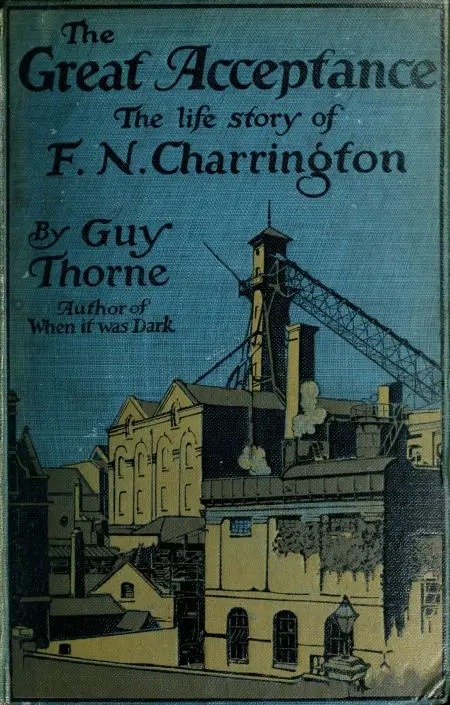
Guy Thorne
BEHIND THE BOOK
This eBook is for the use of anyone anywhere in the United States and most other parts of the world at no cost and with almost no restrictions whatsoever. You may copy it, give it away or re-use it under the terms of the Project Gutenberg License included with this eBook or online at www.gutenberg.org. If you are not located in the United States, you will have to check the laws of the country where you are located before using this eBook. Read the source licence.
The original source file, including credits and licence, is retained by this library. Request an original-format copy at no charge. Please include the book title and Project Gutenberg identifier #41139.
KEEP YOUR CURIOSITY GOING
Coulson Kernahan

Maurice Baring
Frances Wright
Cécile Tormay

Frederic Jesup Stimson

W. H. P. (William Henry Pope) Jarvis