THE CLASSIC COLLECTION✦The SocialistCLASSIC FREE BOOKS
The Socialist
Guy Thorne

THE CLASSIC COLLECTION · 1911
"The Drunkard" by Guy Thorne is a novel written in the early 20th century. The book explores themes of alcoholism and its impacts on individuals and society, primarily through the character of Dr. Morton Sims, who is deeply involved in the study of inebriety and its psychological effects. It portrays the stark realities of life intertwined with the nuances of human behavior, reflecting on the tragic consequences of addiction. The opening of the novel sets an atmospheric tone, beginning with a prologue that introduces Dr. Morton Sims in his London home, contemplating a murder case that is connected to his research on alcoholism. The scene quickly shifts to his dining room, where he prepares to welcome his sister and a friend, Mrs. Daly, discussing their roles in the temperance movement. The narrative captures Sims’ complex emotional landscape as he receives an urgent letter about a convicted murderer, Hancock, who is to be executed the next morning. The chapter closes with Sims revealing his precarious balance of professional duty and personal morality as he prepares to visit Hancock, suggesting a deeper exploration of the themes of guilt, redemption, and the psychological underpinnings of addiction in the chapters that follow.
Introduction adapted from the source catalogue; source summaries may be automatically generated.
Free to read · English · 121,344 words · No account needed
MAKE TIME FOR A GOOD BOOK
On by default. Untick to stop anonymous reading totals. Each page counts after 10 seconds in view. How this works.
Anonymous counting is on unless you have switched it off.
The man and the girl who had just entered were both in a state of nervous tension. They were physically exhausted, one by fierce indulgence in poison, the other by three weeks of light and feverish pleasure.
And more than this.
Each, in several degree, knew that they were doing wrong, that they had progressed far down the primrose path led by the false flute-players.
"I couldn't have conceived it was so, so unnerving, Gilbert," Rita
said, shrinking close to him.
"It is pretty beastly," Lothian answered. "It's simply a dictionary of crime though, that's all--rather too well illustrated."
"I don't want to know of these horrors. One sees them in the papers, but it means little or nothing. How dreadful life is though, under the surface!"
Gilbert felt a sudden pang of pity for her, so young and fair, so
frightened now.--Ah! he knew well how dreadful life was--under
the surface!
For a moment, in that tomb-like place a vision came to him, sunlit and splendid, calm and beautiful.
He saw his life as it might be--as doubtless God meant it to be, a favoured, fortunate and happy life, for God does not, in His inscrutable wisdom chastise all men. Well-to-do, brilliant of mind, with trained capacity to exact every drop of noble joy from life; blessed with a sweet and beautiful woman to watch over him and complement him; did ever a man have a fairer prospect, a luckier chance?
His Hell was so real. Heaven was so near. He had but to say, "I will not," and the sun would rise again upon his life. To the end he would walk dignified, famous, happy, loving and deeply-loved--if only he could say those words.
A turn of the hand would banish the Fiend Alcohol for ever and ever!
But even as the exaltation of the thought animated him, the dominant false Ego, crushed momentarily by heavenly inspiration, growled and fought for life.
Immediately the longing for alcohol burned within him. They had been nearly an hour among the figures. Lothian longed for drink, to satisfy no mere physical craving, but to keep the Fiend within quiescent.
He had come to that alternating state--the author of "Dr. Jekyll and Mr. Hyde" has etched it upon the plate for all time--when he must drug the devil in order to have a little license in which to speak the words and think the thoughts of a clean man leading a Christian life.
So the vision of what might be faded and went. The present asserted itself, and asserted itself merely as a brutish desire for poison.
All these mental changes and re-adjustments took place in a mere second
of time.
Your reading position is saved on this browser. Take it to another device with a library code. Reading pages adapt to text, rather than matching a printed edition.
Guy Thorne
Guy Thorne
Guy Thorne
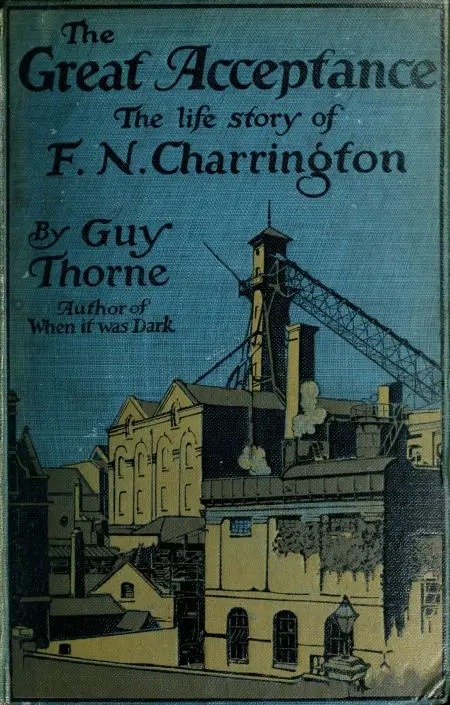
Guy Thorne
BEHIND THE BOOK
This eBook is for the use of anyone anywhere in the United States and most other parts of the world at no cost and with almost no restrictions whatsoever. You may copy it, give it away or re-use it under the terms of the Project Gutenberg License included with this eBook or online at www.gutenberg.org. If you are not located in the United States, you will have to check the laws of the country where you are located before using this eBook. Read the source licence.
The original source file, including credits and licence, is retained by this library. Request an original-format copy at no charge. Please include the book title and Project Gutenberg identifier #41139.
KEEP YOUR CURIOSITY GOING
Coulson Kernahan

Maurice Baring
Frances Wright
Cécile Tormay

Frederic Jesup Stimson

W. H. P. (William Henry Pope) Jarvis