THE CLASSIC COLLECTION✦Peeps at People Being Certain Papers from the Writings of Anne Warrington WitherupCLASSIC FREE BOOKS
Peeps at People Being Certain Papers from the Writings of Anne Warrington Witherup
John Kendrick Bangs
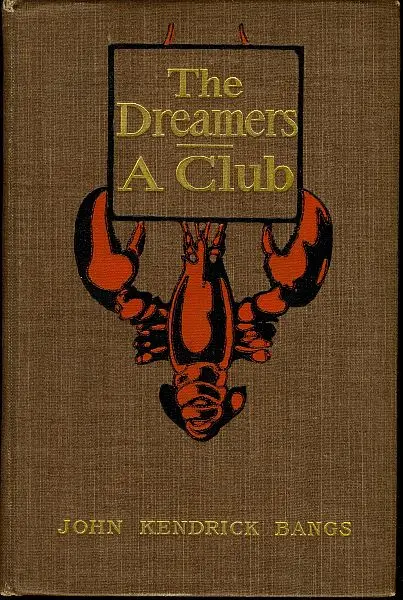
THE CLASSIC COLLECTION · 1899
"The Dreamers: A Club" by John Kendrick Bangs is a humorous fiction work written in the late 19th century. The narrative follows a group of eccentric characters, including Bedford Parke and Tenafly Paterson, as they form a literary club called "The Dreamers," wherein they explore creative writing through shared storytelling inspired by their dreams. The club is designed to build camaraderie and literary prowess among its members, who each bring their quirks and aspirations to the gathering. At the start of the book, the concept of the club is introduced through a lively discussion among the characters, who are eager to bring their literary ambitions to fruition. They decide that their gatherings will involve a dinner where they will indulge in foods that supposedly inspire dreams, leading to tales that they'll share at subsequent meetings. The opening section sets the comedic tone as various members express their ideas about literature, while also poking fun at their own pretensions and ambitions. Through witty dialogue and relatable musings on writing and creativity, the reader is drawn into the absurd yet charming world of the Dreamers as they embark on their unique literary journey.
Introduction adapted from the source catalogue; source summaries may be automatically generated.
Free to read · English · 29,071 words · No account needed
MAKE TIME FOR A GOOD BOOK
On by default. Untick to stop anonymous reading totals. Each page counts after 10 seconds in view. How this works.
Anonymous counting is on unless you have switched it off.
I gasped, and Holmes, cracking a walnut, gazed into the fire for a
moment.
"It all comes down, then," I said, "to the question, who are the
people?"
Holmes smiled grimly. "All men," he replied, shortly; "and when I say all men, I mean all creatures who can reason."
"Does that include women?" I asked.
"Certainly," he said. "Indubitably. The fact that women don't reason does not prove that they can't. I can go up in a balloon if I wish to, but I don't. I can read an American newspaper comic supplement, but I don't. So it is with women. Women can reason, and therefore they have a right to be included in the classification whether they do or don't."
"Quite so," was all I could think of to say at the moment. The extraordinary logic of the man staggered me, and I again began to believe that the famous mathematician who said that if Sherlock Holmes attempted to prove that five apples plus three peaches made four pears, he would not venture to dispute his conclusions, was wise. (This was the famous Professor Zoggenhoffer, of the Leipsic School of Moral Philosophy and Stenography.--ED.)
"Now you agree, my dear Watson," he said, "that I have proved that we
see everything?"
"Well--" I began.
"Whether we are conscious of it or not?" he added, lighting the gas-log, for the cold was becoming intense.
"From that point of view, I suppose so--yes," I replied, desperately.
"Well, then, this being granted, consciousness is all that is needed to make us fully informed on any point."
"No," I said, with some positiveness. "The American people are very conscious, but I can't say that generally they are well-informed."
I had an idea this would knock him out, as the Bostonians say, but counted without my host. He merely laughed.
"The American is only self-conscious. Therefore he is well-informed only
as to self," he said.
"You've proved your point, Sherlock," I said. "Go on. What else have you
proved?"
"That it is the little things that tell," he replied. "Which all men would realize in a moment if they could see the little things--and when I say 'if they could see,' I of course mean if they could be conscious of them."
"Very true," said I.
"And I have the gift of consciousness," he added.
I thought he had, and I said so. "But," I added, "give me a concrete example." It had been some weeks since I had listened to any of his detective stories, and I was athirst for another.
He rose up and walked over to his pigeon-holes, each labelled with a letter, in alphabetical sequence.
Your reading position is saved on this browser. Take it to another device with a library code. Reading pages adapt to text, rather than matching a printed edition.
John Kendrick Bangs
John Kendrick Bangs
John Kendrick Bangs
John Kendrick Bangs
BEHIND THE BOOK
This eBook is for the use of anyone anywhere in the United States and most other parts of the world at no cost and with almost no restrictions whatsoever. You may copy it, give it away or re-use it under the terms of the Project Gutenberg License included with this eBook or online at www.gutenberg.org. If you are not located in the United States, you will have to check the laws of the country where you are located before using this eBook. Read the source licence.
The original source file, including credits and licence, is retained by this library. Request an original-format copy at no charge. Please include the book title and Project Gutenberg identifier #35374.
KEEP YOUR CURIOSITY GOING
Coulson Kernahan

Maurice Baring
Frances Wright
Cécile Tormay

Frederic Jesup Stimson

W. H. P. (William Henry Pope) Jarvis