THE CLASSIC COLLECTION✦The ocean wireless boys of the iceberg patrolCLASSIC FREE BOOKS
The ocean wireless boys of the iceberg patrol
John Henry Goldfrap
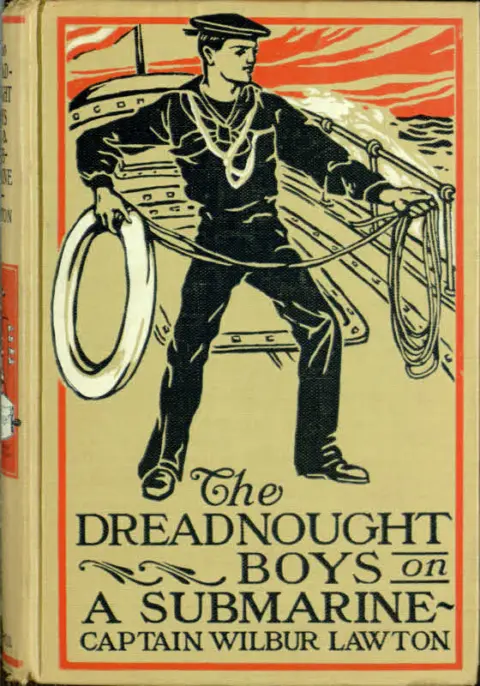
THE CLASSIC COLLECTION · 1911
"The Dreadnought Boys on a Submarine" by John Henry Goldfrap is an adventure novel written in the early 20th century. This book follows the young inventor Channing Lockyer, who is set to launch his revolutionary submarine while facing opposition from individuals who seek to sabotage his efforts. Lockyer is joined by the daring "Dreadnought Boys," specifically Ned Strong and Herc Taylor, as they navigate the treacherous waters of invention, deceit, and espionage. At the start of the story, we are introduced to Channing Lockyer as he firmly rejects an offer from Jasper Ferriss to sell his submarine design to a foreign power, emphasizing his loyalty to his country. As the tension builds surrounding the imminent government tests on the submarine, the narrative shifts to the arrival of the young naval recruits, Ned and Herc, who are excited about their new assignment to test Lockyer’s creation. However, lurking dangers manifest as the disgruntled ex-foreman, Anderson, and a conspirator named Gradbarr plot to undermine Lockyer’s efforts by sabotaging the submarine. Their plot unravels amidst the mounting excitement leading up to the submarine's launch, setting the stage for thrilling escapades and unexpected twists.
Introduction adapted from the source catalogue; source summaries may be automatically generated.
Free to read · English · 52,757 words · No account needed
MAKE TIME FOR A GOOD BOOK
On by default. Untick to stop anonymous reading totals. Each page counts after 10 seconds in view. How this works.
Anonymous counting is on unless you have switched it off.
“How’s the engine?” asked Lieutenant Parry, pausing by Andy Bowler, as he bent above the shining, moving bits of mechanism, each sliding and flashing in and out at its own appointed time.
“Running sweet as a baby’s sleep, sir,” was the whimsical response; “we’ve got her well doused with oil, and there’s not a bearing that’s even warm.”
“Pretty good for a new engine, eh, Mr. Parry?” smiled Channing Lockyer.
“It is, indeed, sir,” was the response; “I must say, that from what I have seen, that your compressed-air engine has an electric one beaten fifteen ways for submarine use.”
“Well, there’s only one thing left to complete this part of the programme,” said the lieutenant, as they sank down on the comfortable leather-upholstered seats in the cabin.
“And that is?” asked Midshipman Stark.
“To rise again, to be sure,” struck in the inventor.
Up in the conning-tower the boys could hear the conversation below
distinctly.
“Hammocks and humming birds!” gasped Herc, “blessed if I hadn’t quite forgotten about the rising part of it.”
“It’s quite important, though,” said Ned, with a dry smile.
“Above there!” came a sudden hail from below in Lieutenant Parry’s
voice.
“Aye, aye, sir!” bawled back Ned.
“Do you understand how to work the air-changing device?”
“Aye, aye, sir.”
“Then set it in motion, please. We wish to test how quickly we can get
a fresh supply.”
Ned reached above his head, and turned a valve, which, by an ingeniously simple arrangement, opened the exhaust valve by which the bad air was driven out and admitted a fresh supply at the same time.
“I did begin to notice the air getting a little stale,” commented Herc; as he did so, “Ah-h-h-h-h!” he exclaimed the next instant, throwing out his chest and inflating his lungs with the fresh air which, as if by magic, flooded the place, “that’s as good as a sea breeze.”
And so they all agreed. The air had been getting fouler than they had
really noticed in their intense concentration on the running of the
boat.
“Well,” said the lieutenant below, “there’s no doubt about that device working as well as everything else about the Lockyer. And now let us see about getting to the surface. We must, according to my calculations, be not far off the light by this time.”
“Very well, then,” said Mr. Lockyer, with a confident smile. “It’s ho! for the surface. And here, gentlemen,” he said, producing a long, shiny bit of metal with a slot on one end, “is the means by which we are to get there.”
Your reading position is saved on this browser. Take it to another device with a library code. Reading pages adapt to text, rather than matching a printed edition.
John Henry Goldfrap
John Henry Goldfrap
John Henry Goldfrap
John Henry Goldfrap
BEHIND THE BOOK
This eBook is for the use of anyone anywhere in the United States and most other parts of the world at no cost and with almost no restrictions whatsoever. You may copy it, give it away or re-use it under the terms of the Project Gutenberg License included with this eBook or online at www.gutenberg.org. If you are not located in the United States, you will have to check the laws of the country where you are located before using this eBook. Read the source licence.
The original source file, including credits and licence, is retained by this library. Request an original-format copy at no charge. Please include the book title and Project Gutenberg identifier #58013.
KEEP YOUR CURIOSITY GOING
Coulson Kernahan

Maurice Baring
Frances Wright
Cécile Tormay

Frederic Jesup Stimson

W. H. P. (William Henry Pope) Jarvis