THE CLASSIC COLLECTION✦The ocean wireless boys of the iceberg patrolCLASSIC FREE BOOKS
The ocean wireless boys of the iceberg patrol
John Henry Goldfrap
THE CLASSIC COLLECTION · 1911
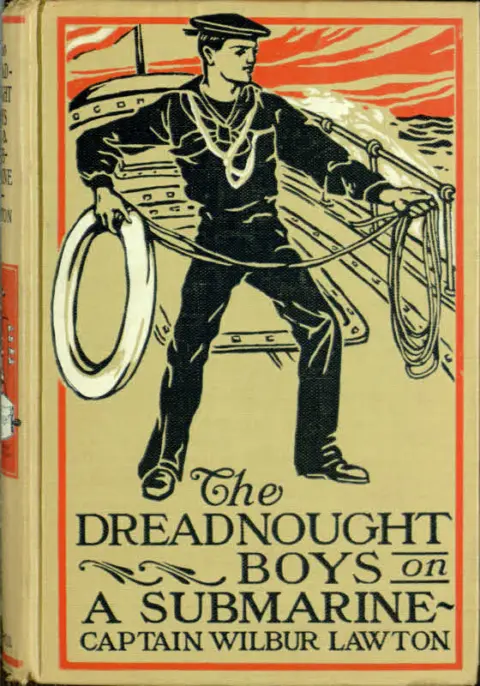
"The Dreadnought Boys on a Submarine" by John Henry Goldfrap is an adventure novel written in the early 20th century. This book follows the young inventor Channing Lockyer, who is set to launch his revolutionary submarine while facing opposition from individuals who seek to sabotage his efforts. Lockyer is joined by the daring "Dreadnought Boys," specifically Ned Strong and Herc Taylor, as they navigate the treacherous waters of invention, deceit, and espionage. At the start of the story, we are introduced to Channing Lockyer as he firmly rejects an offer from Jasper Ferriss to sell his submarine design to a foreign power, emphasizing his loyalty to his country. As the tension builds surrounding the imminent government tests on the submarine, the narrative shifts to the arrival of the young naval recruits, Ned and Herc, who are excited about their new assignment to test Lockyer’s creation. However, lurking dangers manifest as the disgruntled ex-foreman, Anderson, and a conspirator named Gradbarr plot to undermine Lockyer’s efforts by sabotaging the submarine. Their plot unravels amidst the mounting excitement leading up to the submarine's launch, setting the stage for thrilling escapades and unexpected twists.
Introduction adapted from the source catalogue; source summaries may be automatically generated.
Free to read · English · 52,757 words · No account needed
MAKE TIME FOR A GOOD BOOK
On by default. Untick to stop anonymous reading totals. Each page counts after 10 seconds in view. How this works.
Anonymous counting is on unless you have switched it off.
The officer and Ned’s mates were at his side in an instant. In spite of the crouching fellows’ kicks and protests, they soon had them hauled out and on the decks. They tried to hide their faces, but they were remorselessly switched round and made to face the light.
“Tom Gradbarr!” exclaimed Ned, recognizing his captive.
“Zeb Anderson, by the big snapping turtle of the South Pole!” yelled Herc, as he made a similar discovery that his prisoner was not unknown to him.
As neither of the rascals would utter a word, Lieutenant Parry decided to go aft at once after they had been secured, and try to get an explanation of how they came to be in the yacht’s crew. As the party reached the after deck they found old Mr. Pangloss in the midst of a long explanation of how the trouble had come about. They had sailed from Narragansett the evening before. He meant to cruise down to Southern waters.
“But the mutiny, sir? What started it?” broke in Captain McGill impatiently, as the apostle of peace rambled along.
“Why, sir, I believe they must have been after my daughter’s jewelry. She has $150,000 worth on board.”
“Permit me to say, sir, then, that I think that you have used very little judgment in taking such valuables to sea with you.”
“Just what I told papa,” put in the girl, who had been standing by the rail with Channing Lockyer, and seemed to have lost all interest in mutinies, or anything else.
“B-b-b-but they were in a safe,” stuttered Mr. Pangloss, looking red
and abashed.
“As if that would act as an obstacle, sir,” said Captain McGill impatiently; “but your captain, where was he during all this trouble?”
“Why, sir, he left me at Narragansett,” rejoined Mr. Pangloss. “He objected to my refusing to allow him to put two unruly members of the crew in irons. I decided to navigate the craft myself down to New York, where I would ship another skipper.”
“Had you no other officers?”
“Oh, yes, a first mate named Gradbarr, and a second officer named
Anderson.”
Channing Lockyer started forward as he heard the names.
“Those rascals! Where are they? How did you get them on board?”
“Why, they applied for berths when we sailed from New York” rejoined Mr. Pangloss, “and--”
“They are both in irons forward,” Lieutenant Parry finished for him.
“Thank goodness, they are captured,” breathed Mr. Lockyer; “while they were at large I should never have drawn an easy breath. I always feared they would, in some way, harm the submarine.”
Your reading position is saved on this browser. Take it to another device with a library code. Reading pages adapt to text, rather than matching a printed edition.
John Henry Goldfrap
John Henry Goldfrap
John Henry Goldfrap

John Henry Goldfrap
BEHIND THE BOOK
This eBook is for the use of anyone anywhere in the United States and most other parts of the world at no cost and with almost no restrictions whatsoever. You may copy it, give it away or re-use it under the terms of the Project Gutenberg License included with this eBook or online at www.gutenberg.org. If you are not located in the United States, you will have to check the laws of the country where you are located before using this eBook. Read the source licence.
The original source file, including credits and licence, is retained by this library. Request an original-format copy at no charge. Please include the book title and Project Gutenberg identifier #58013.
KEEP YOUR CURIOSITY GOING
Coulson Kernahan

Maurice Baring
Frances Wright
Cécile Tormay

Frederic Jesup Stimson

W. H. P. (William Henry Pope) Jarvis