THE CLASSIC COLLECTION✦The ocean wireless boys of the iceberg patrolCLASSIC FREE BOOKS
The ocean wireless boys of the iceberg patrol
John Henry Goldfrap
THE CLASSIC COLLECTION · 1911
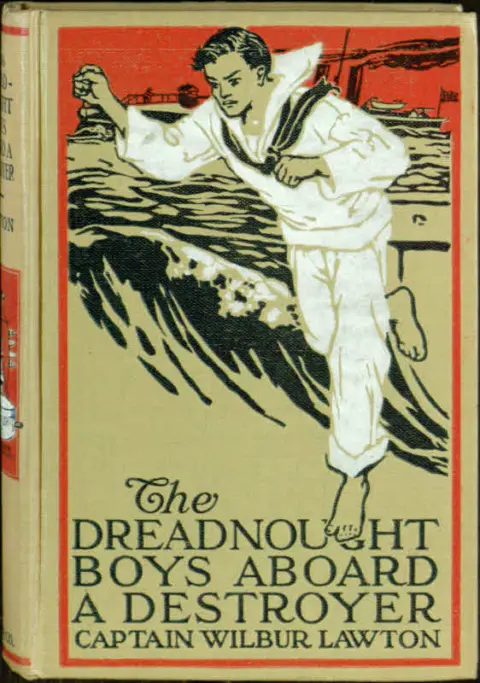
"The Dreadnought Boys Aboard a Destroyer" by John Henry Goldfrap is a naval adventure novel written in the early 20th century. The story centers around two courageous young sailors, Ned Strong and Herc Taylor, as they embark on a mission aboard the destroyer "Beale" to safeguard American interests during a South American revolution. The book explores themes of bravery, loyalty, and danger in the face of geopolitical tension. At the start of the novel, the two boys, recently celebrated for their heroics, are approached by a foreign agent in the Brooklyn Navy Yard who attempts to recruit them for espionage against their own country. Instead, the boys reject the agent's proposition, highlighting their strong sense of loyalty and integrity. The narrative quickly transitions to their departure on the destroyer "Beale", setting up an impending voyage that involves danger on the high seas, as well as the tensions of revolution brewing in the Republic of Costaveza. The opening emphasizes not only their spirit and camaraderie but also foreshadows the moral dilemmas and action-filled adventure that lies ahead.
Introduction adapted from the source catalogue; source summaries may be automatically generated.
Free to read · English · 50,438 words · No account needed
MAKE TIME FOR A GOOD BOOK
On by default. Untick to stop anonymous reading totals. Each page counts after 10 seconds in view. How this works.
Anonymous counting is on unless you have switched it off.
What the mob in its fury might next have attempted will never be known, for at that moment Gifford’s friends, who had become separated from him before the row started, hove in sight. With a shout they charged, as had the boys just before, at the sight of the white uniforms in the midst of a hostile crowd. It was the end. With shouts of hate and fury, but prudently taking to their heels nevertheless, the mob scattered.
“How did it all happen?” asked Ned, as Gifford began mopping his face. Of the mob only a few curious small boys remained.
“Why, I saw a fellow pulling down an American flag from a small photo gallery up the street,” said Gifford, “and I just naturally waded in.”
“And----” said Ned, a smile hovering about his lips.
“Told him not to.”
“What happened then?”
“Why, then the nasty dago spat at me. I punched him, and before I knew it the whole mob was around me. I didn’t mind the stones so much, but, oh! those rotten bananas and those ancient eggs--phew!”
“Well, it’s a good thing no bones are broken,” said Ned. “Come on, let’s get down to the boat before those fellows gather again. You want to get cleaned up.”
“You haven’t much on you,” grinned Gifford, looking at Ned’s face, blood-stained, where the stone had struck him.
Ned burst into a laugh.
“I guess not. Say, fellows, we’d better not say anything to the lieutenant about this. He might think we’d been rioting or something.”
“I guess you’re right,” agreed Stanley, “but in that case we want to look all right when he shows up.”
With his handkerchief dipped in sea-water Ned soon removed the dirt and grime from his face, as did the others. When the lieutenant, therefore, came down to the boat, he found a demure-looking crew seated, ready to put the oars over at the word of command. Perhaps he may have noticed one or two angry-looking bruises on the men’s faces, but naval officers learn not to see a great deal--sometimes.
“The feeling in the town is distinctly anti-American, the consul tells me,” Ned, who pulled stroke, heard Lieutenant Timmons remark to Ensign Conkling, as they gave way.
“But about the revolutionists’ arms, sir?”
“That’s the mystery. They are getting them somehow, and plenty of them. I wish we could solve it.”
“So do I,” thought Ned to himself, as he bent to his oar. He resolved as he tugged away that if he got the chance, the delivery of the munitions of war to the enemies of his country would cease abruptly.
Your reading position is saved on this browser. Take it to another device with a library code. Reading pages adapt to text, rather than matching a printed edition.
John Henry Goldfrap
John Henry Goldfrap
John Henry Goldfrap

John Henry Goldfrap
BEHIND THE BOOK
This eBook is for the use of anyone anywhere in the United States and most other parts of the world at no cost and with almost no restrictions whatsoever. You may copy it, give it away or re-use it under the terms of the Project Gutenberg License included with this eBook or online at www.gutenberg.org. If you are not located in the United States, you will have to check the laws of the country where you are located before using this eBook. Read the source licence.
The original source file, including credits and licence, is retained by this library. Request an original-format copy at no charge. Please include the book title and Project Gutenberg identifier #57396.
KEEP YOUR CURIOSITY GOING
Coulson Kernahan

Maurice Baring
Frances Wright
Cécile Tormay

Frederic Jesup Stimson

W. H. P. (William Henry Pope) Jarvis