THE CLASSIC COLLECTION✦The ocean wireless boys of the iceberg patrolCLASSIC FREE BOOKS
The ocean wireless boys of the iceberg patrol
John Henry Goldfrap
THE CLASSIC COLLECTION · 1911
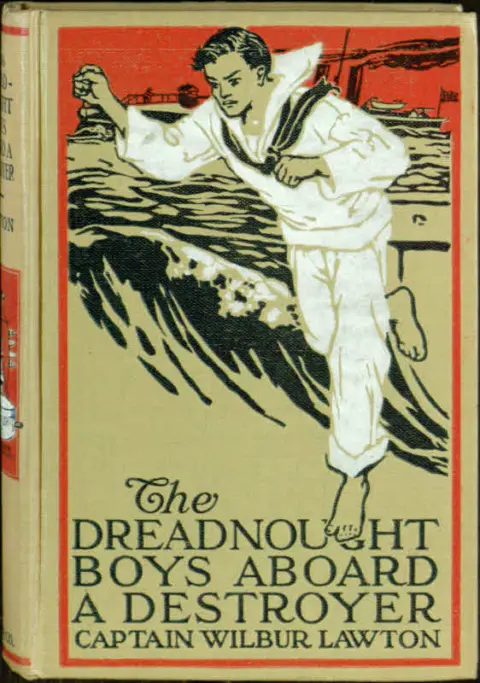
"The Dreadnought Boys Aboard a Destroyer" by John Henry Goldfrap is a naval adventure novel written in the early 20th century. The story centers around two courageous young sailors, Ned Strong and Herc Taylor, as they embark on a mission aboard the destroyer "Beale" to safeguard American interests during a South American revolution. The book explores themes of bravery, loyalty, and danger in the face of geopolitical tension. At the start of the novel, the two boys, recently celebrated for their heroics, are approached by a foreign agent in the Brooklyn Navy Yard who attempts to recruit them for espionage against their own country. Instead, the boys reject the agent's proposition, highlighting their strong sense of loyalty and integrity. The narrative quickly transitions to their departure on the destroyer "Beale", setting up an impending voyage that involves danger on the high seas, as well as the tensions of revolution brewing in the Republic of Costaveza. The opening emphasizes not only their spirit and camaraderie but also foreshadows the moral dilemmas and action-filled adventure that lies ahead.
Introduction adapted from the source catalogue; source summaries may be automatically generated.
Free to read · English · 50,438 words · No account needed
MAKE TIME FOR A GOOD BOOK
On by default. Untick to stop anonymous reading totals. Each page counts after 10 seconds in view. How this works.
Anonymous counting is on unless you have switched it off.
“Might as well take that, too,” said Herc, taking it from the rack. “Zan-go!” he cried suddenly, “look here--no, here down in this corner--what does that printing say?”
“‘The Villa Espenza, Bernardo Guzman, Proprietor,’” read Ned. “Wow!”
“And he overheard that whole talk of ours, I’ll bet a lemon!” cried
Herc.
“Right you are,” responded Stanley gloomily. “And his name’s Guzman--no wonder he was interested.”
To avoid attracting attention from the owner of the store, who was
gazing curiously at them, the boys bought the post-card and left the
place.
“See the way that fellow in there was glaring at us?” grinned Herc. “They sure do love Americans down here--not!”
“That’s a good way to tell a revolutionary sympathizer,” said Stanley. “The government party are all friendly to Americans. They realize the good they have done the country and the capital they have brought into it. The revolutionists, on the other hand, all want to see all foreigners out of here, and be able to run the place for themselves--and their pockets.”
“I don’t see why our government should interfere,” said Herc, as they made their way down the street, pursued sometimes by approving and sometimes by unfriendly glances.
“She’s not interfering,” rejoined Stanley; “that’s just it. If she could she’d mighty soon show these revolutionists where they stand. Not that the United States doesn’t believe in every one having a square deal, mind you, but at Washington they think these things should be decided by the ballot box, and not by fighting and squabbling.”
By this time they had drawn near the wharf, had turned and were headed for it, when a sudden chorus of shouts and yells rapidly drawing nearer attracted their attention. At the same instant round the corner of one of the dark, narrow streets leading to the water front burst a strange group--or rather, from their exciting actions and cries, mob would be a better term.
“Hullo!” shouted Ned suddenly, “there’s some of our fellows among them.”
“By the great turret gun, so there are!” echoed Stanley, starting
forward.
In the midst of a howling, yelling crowd of townsmen there had suddenly flashed into view for an instant the white uniform of a man-of-war’s man. Evidently he was having a desperate fight against heavy odds. As the Dreadnought Boys and Stanley rushed toward the scene of action, they could see stones and filth, both of which were plentiful in the streets, flying from all directions at the Yankee sailor.
“It’s Gifford!” shouted Herc, recognizing the centre of the group, who, though putting up a plucky fight, was overwhelmingly outnumbered.
Your reading position is saved on this browser. Take it to another device with a library code. Reading pages adapt to text, rather than matching a printed edition.
John Henry Goldfrap
John Henry Goldfrap
John Henry Goldfrap
John Henry Goldfrap
BEHIND THE BOOK
This eBook is for the use of anyone anywhere in the United States and most other parts of the world at no cost and with almost no restrictions whatsoever. You may copy it, give it away or re-use it under the terms of the Project Gutenberg License included with this eBook or online at www.gutenberg.org. If you are not located in the United States, you will have to check the laws of the country where you are located before using this eBook. Read the source licence.
The original source file, including credits and licence, is retained by this library. Request an original-format copy at no charge. Please include the book title and Project Gutenberg identifier #57396.
KEEP YOUR CURIOSITY GOING
Coulson Kernahan

Maurice Baring
Frances Wright
Cécile Tormay

Frederic Jesup Stimson

W. H. P. (William Henry Pope) Jarvis