THE CLASSIC COLLECTION✦Towards democracyCLASSIC FREE BOOKS
Towards democracy
Edward Carpenter
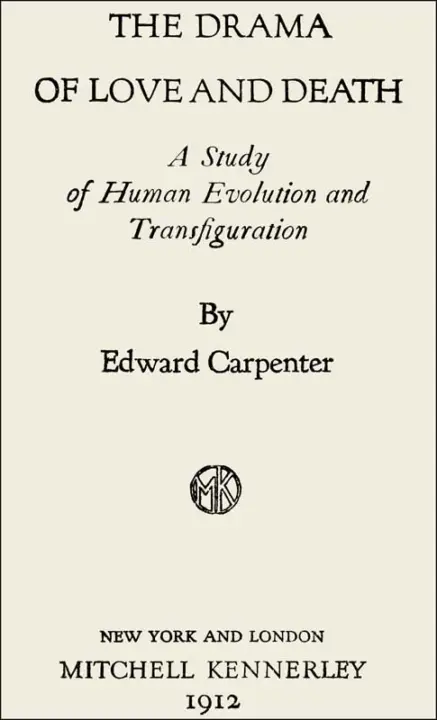
THE CLASSIC COLLECTION · 1912
"The Drama of Love and Death: A Study of Human Evolution and Transfiguration" by Edward Carpenter is a philosophical exploration written in the early 20th century. This work delves into the profound influences of love and death on human existence, framing them as central forces in our evolution and transformation. Carpenter seeks to illuminate the intertwined nature of these concepts, examining how they shape our experiences and relationships throughout life. The opening of the book establishes love and death as formidable and omnipresent dualities that dominate human experience. Carpenter articulates the struggle faced by humanity in understanding and navigating these forces, positing that true growth lies in embracing both love and death. He emphasizes the need for society to confront these realities openly, suggesting that an understanding of their interplay can lead to liberation from their seemingly tyrannical grasp. The chapter introduces these themes with philosophical musings and a call to action, urging readers to reflect on their own relationships with love and the inevitability of death.
Introduction adapted from the source catalogue; source summaries may be automatically generated.
Free to read · English · 71,795 words · No account needed
MAKE TIME FOR A GOOD BOOK
On by default. Untick to stop anonymous reading totals. Each page counts after 10 seconds in view. How this works.
Anonymous counting is on unless you have switched it off.
[72] It is impossible, for instance, to read slowly and in detail such works as A. R. Wallace’s Miracles and Modern Spiritualism, William Crookes’ Researches into Spiritualism, C. Lombroso’s Fenomeni ipnotici e spiritici, and to note the care and exactness with which in each case experiments were conducted, tests devised, and results recorded, without being persuaded that in the mass the conclusions (confirmed in the first two instances by the authors themselves after an interval of twenty or thirty years) are correct. Already a long list of scientific and responsible men, like Charles Richet (professor of physiology at Paris), Camille Flammarion (the well-known astronomer), Professor Zöllner of the Observatory at Leipzig, C. F. Varley the electrician, Sir Oliver Lodge of Birmingham, have made important contributions to the evidence; while others, like Professor De Morgan the mathematician, Professor Challis the astronomer, Sergeant Cox the lawyer, and Professor William James the psychologist, have signified their general adhesion.
[73] For references see supra, ch. vi. p. 92, footnote.
[74] See Phantasms of the Living, vol. ii. p. 289, also the experience of Mrs. A., given in Footfalls on the Boundary of Another World, by R. Dale Owen, 1881, p. 256 et seq. This latter book, which is a mine of well-authenticated information, has suffered somewhat from its rather sensational title. The author, however, was an able, distinguished, and reliable man, son of Robert Owen of Lanark, Member of Congress in the United States, and U. S. Minister at Naples.
[75] See R. Dale Owen, The Debatable Land (1871), pp. 385–400.
[76] See Crookes’ Researches in Spiritualism, pp. 104 et seq. See also the book New Light on Immortality, by Fournier d’Albe, pp. 218 et seq., where the evidence is given in great detail.
[77] See Phénomènes de la Ville Carmen, avec documents nouveaux;
Paris, 1902.
[78] C. Lombroso, Fenomeni ipnotici e spiritici, p. 193.
[79] See Shadow-land (1906).
[80] See pamphlet Materializations, by Mme. D’Espérance (Light
Publishing Co.).
[81] See, for instance, the account of the haunted mill at Willington, given at some length by Mr. W. T. Stead in the Review of Reviews for Jan., 1892; also the Memoirs of the Wesley Family, vol. i, pp. 253–60; and Whitehead’s Lives of the Wesleys, vol. ii, pp. 120–66; also Footfalls, b; R. Dale Owen, book iii, ch. ii.
[82] See Myers, op cit., p. 154. As many writers have remarked, the term “superconscious” might often be more applicable than “subconscious.”
Your reading position is saved on this browser. Take it to another device with a library code. Reading pages adapt to text, rather than matching a printed edition.
Edward Carpenter
Edward Carpenter
Edward Carpenter
Edward Carpenter
BEHIND THE BOOK
This eBook is for the use of anyone anywhere in the United States and most other parts of the world at no cost and with almost no restrictions whatsoever. You may copy it, give it away or re-use it under the terms of the Project Gutenberg License included with this eBook or online at www.gutenberg.org. If you are not located in the United States, you will have to check the laws of the country where you are located before using this eBook. Read the source licence.
The original source file, including credits and licence, is retained by this library. Request an original-format copy at no charge. Please include the book title and Project Gutenberg identifier #44883.
KEEP YOUR CURIOSITY GOING

David Patterson (Spirit) Hatch
Coulson Kernahan

Ralph Waldo Emerson
Frances Wright

Edwin Abbott Abbott

Joseph Droz