The Truth About Lynching and the Negro in the South In Which the Author Pleads That the South Be Made Safe for the White Race
Winfield H. (Winfield Hazlitt) Collins

THE CLASSIC COLLECTION · 1904
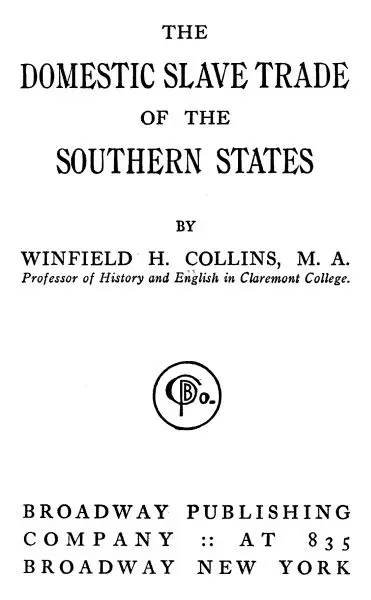
"The Domestic Slave Trade of the Southern States" by Winfield H. Collins is a historical account written in the early 20th century. This work delves into the intricacies and dynamics of the domestic slave trade in the southern United States, chronicling its origins, development, and the various economic, social, and legislative factors that influenced it. Collins aims to provide an accurate portrayal of this complex subject through comprehensive research and extensive use of primary sources. At the start of the book, Collins sets the stage by discussing the historical background of the slave trade, tracing its roots from the European involvement in the African slave trade to its evolution into domestic trade within the United States. He outlines how various states began to engage in trading slaves, motivated by economic gains and shifting agricultural needs. The narrative highlights key moments in the trade's history, including the rise of cotton cultivation in the southern states, the impact of legislative actions, and the realities of human commodification, making clear the delicate interplay of economics and human rights that characterized this dark chapter in American history.
Introduction adapted from the source catalogue; source summaries may be automatically generated.
Free to read · English · 27,978 words · No account needed
MAKE TIME FOR A GOOD BOOK
On by default. Untick to stop anonymous reading totals. Each page counts after 10 seconds in view. How this works.
Anonymous counting is on unless you have switched it off.
[Footnote 279: Ashworth: A Tour in the U.S., Cuba and Canada, p. 81; also Sequel to Mrs. Kemble's Journal, p. 8 in (Y.) Sl. Pamp., Vol. XVII.
(Ingraham): The Southwest, Vol. II., p. 201.]
[Footnote 280: (Ingraham): The Southwest, Vol. II., p. 201.]
[Footnote 281: Christian Freeman: April 10, 1845.
Christian Citizen, Nov. 23, 1844.]
[Footnote 282: Shaffner: The War in America, p. 293.]
[Footnote 283: Tower: Slavery Unmasked, p. 127-8.
Andrews: Sl. and Domestic Slave Trade, p. 105.]
[Footnote 284: Andrews: Slavery and Domestic Sl. Trade, p. 164.]
[Footnote 285: Liberator, May 6, 1853.
Sequel to Mrs. Kemble's Journal, p. 11, in (Yale) Sl. Pamp., Vol. XVII.]
[Footnote 286: Adams: Southern View of Slavery, p. 72.]
[Footnote 287: (Ingraham): The Southwest, Vol. II., p. 201.]
[Footnote 288: (Paulding): Letters from the South, Vol. I., p. 126;
(Ed. 1817).
Torrey: A Portraiture of Domestic Slavery in U.S., p. 145.]
[Footnote 289: Olmsted: Cotton Kingdom, Vol. I., p. 336.]
[Footnote 290: Andrews: Slavery and Domestic Sl. Trade, p. 118.]
[Footnote 291: Candler: A Summary View of Am., p. 276.
Liberator, June 18, 1847.
(Blane): Excursion Through the U.S., p. 209.
Tower: Slavery Unmasked, p. 304-7.]
[Footnote 292: Stowe: Key to Uncle Tom's Cabin, p. 169.]
[Footnote 293: Liberator, July 7, 1837.]
[Footnote 294: Quarterly Anti-Slavery Magazine, Vol. II., p. 409, July,
1837.]
[Footnote 295: (Ingraham): The Southwest, Vol. II., p. 245.]
[Footnote 296: Andrews: Slavery and the Domestic Slave Trade, pp. 136,
150.
Note:--It is interesting to compare Featherstonhaugh's characterization of Armfield, which is: "I looked steadily at the fellow, and recollecting him, found no longer any difficulty in accounting for such a compound of everything vulgar and revolting and totally without education. I had now a key to his manner and the expression of his countenance."--Featherstonhaugh: Excursion Through the Slave States, Vol. I., p. 167.]
[Footnote 297: Andrews: Sl. and Domestic Sl. Trade, p. 150.]
[Footnote 298: Featherstonhaugh: Excursion Through the Slave States,
Vol. I., p. 128.]
[Footnote 299: Finch: Travels in the U.S. and Canada, p. 241.]
[Footnote 300: Adams: Southern View of Slavery, p. 77.]
Your reading position is saved on this browser. Take it to another device with a library code. Reading pages adapt to text, rather than matching a printed edition.
Winfield H. (Winfield Hazlitt) Collins
BEHIND THE BOOK
This eBook is for the use of anyone anywhere in the United States and most other parts of the world at no cost and with almost no restrictions whatsoever. You may copy it, give it away or re-use it under the terms of the Project Gutenberg License included with this eBook or online at www.gutenberg.org. If you are not located in the United States, you will have to check the laws of the country where you are located before using this eBook. Read the source licence.
The original source file, including credits and licence, is retained by this library. Request an original-format copy at no charge. Please include the book title and Project Gutenberg identifier #61977.
KEEP YOUR CURIOSITY GOING
Cécile Tormay

Moritz Busch
John L. Ransom
Frances Wright
Cécile Tormay

Mabel Potter Daggett

