The clammer
William John Hopkins
THE CLASSIC COLLECTION · 1914
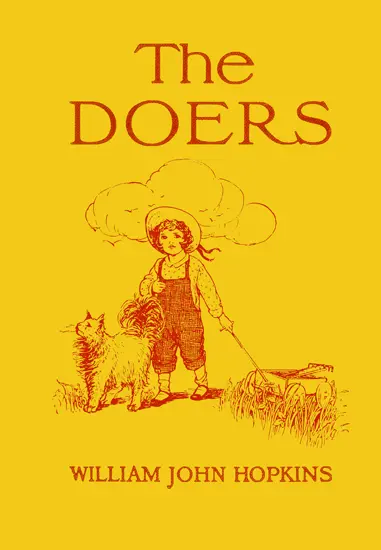
"The Doers" by William John Hopkins is a children's book written in the early 20th century. This charming work follows a young boy named David, who is almost five years old, as he explores the construction site of a new house next to his home. With the constant presence of his cat and his trusty cart, the boy engages with various workmen, learning about the different trades involved in building a house, including digging, masonry, plumbing, and painting. The opening of the book introduces readers to David's playful spirit and curiosity about the world around him. One day, David wanders to a nearby construction site, where he observes men digging a cellar for the house. As he interacts with the workers, he expresses a desire to help and learns about the tools and tasks they perform. The narrative captures David's innocence and excitement, using simple language to describe his adventures, offering a whimsical portrayal of childhood exploration and the value of labor.
Introduction adapted from the source catalogue; source summaries may be automatically generated.
Free to read · English · 27,127 words · No account needed
MAKE TIME FOR A GOOD BOOK
On by default. Untick to stop anonymous reading totals. Each page counts after 10 seconds in view. How this works.
Anonymous counting is on unless you have switched it off.
And where it did not fit well enough, they put in thin, flat pieces that they picked up from the ground.
The man who knelt on one knee at the edge of the cellar told the little boy about it as the men worked.
And, when the men had put in the little flat pieces of stone, one of them looked up and smiled at the little boy and said that they called the thin, flat pieces "chocks."
"Not woodchucks," he said, "but just chocks."
The little boy smiled and nodded. He had never seen a woodchuck, but there was a picture of one in his animal-book. It wasn't a very good picture.
"I guess," he said, "that they are stone-chucks."
All the men who heard him laughed. And they went to work again, and the little boy turned to the man who was holding him.
"I've got to go now," he said, "and play in that pile of sand."
"All right," said the man. "You play there just as long as you want
to."
So the little boy went over to the man who was hoeing the white stuff. It wasn't so white as it had been and it was thicker, just about like nice mud.
And his cat came up from somewhere. The little boy didn't know where she had been, but he didn't pay any attention to her. He just stood and watched the man.
"What are you making?" he asked at last.
"I'm making mortar," the man said. "They put it in the cracks of the
wall, to hold it together."
"Oh," said the little boy. "Well, would you like to have me help you?"
"You might bring me a load of sand," said the man, "if you want to. I shall have to put in more sand."
So the little boy went to his cart, and he threw out his hoe. He
wasn't careful where he threw it, and the handle of the hoe hit the
cat.
And the cat ran home as fast as she could go. But the little boy
didn't know it, he was so busy.
And he backed the cart up to the sand-pile, and he took his shovel and shoveled sand into the cart until the man said that was enough.
Then he took hold of the handle and pulled. It was heavier than he thought it would be, but he pulled it over to the box of mortar. It was only a few steps.
Then the man told him to shovel it in, a little at a time.
And the little boy shoveled it in slowly, and he felt very proud, for he was helping to make real mortar.
Your reading position is saved on this browser. Take it to another device with a library code. Reading pages adapt to text, rather than matching a printed edition.
William John Hopkins
William John Hopkins
William John Hopkins
William John Hopkins
BEHIND THE BOOK
This eBook is for the use of anyone anywhere in the United States and most other parts of the world at no cost and with almost no restrictions whatsoever. You may copy it, give it away or re-use it under the terms of the Project Gutenberg License included with this eBook or online at www.gutenberg.org. If you are not located in the United States, you will have to check the laws of the country where you are located before using this eBook. Read the source licence.
The original source file, including credits and licence, is retained by this library. Request an original-format copy at no charge. Please include the book title and Project Gutenberg identifier #27650.
KEEP YOUR CURIOSITY GOING

Abby Morton Diaz
Helen Hunt Jackson
Mary Frances Blaisdell
Stuart Dodgson Collingwood

Kate Douglas Smith Wiggin
Hesba Stretton