THE CLASSIC COLLECTION✦My diaries, being a personal narrative of events 1888-1914, Part 2 (1900-1914)CLASSIC FREE BOOKS
My diaries, being a personal narrative of events 1888-1914, Part 2 (1900-1914)
Wilfrid Scawen Blunt
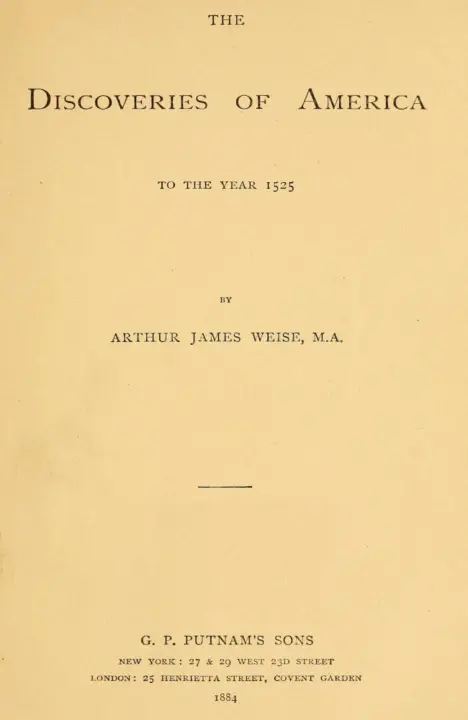
THE CLASSIC COLLECTION · 1884
"The Discoveries of America to the Year 1525" by Arthur James Weise is a historical account written in the late 19th century. This work delves into the early explorations of the American continent, focusing on the significant discoveries made before 1525, particularly by Columbus and other European explorers. The book aims to clarify various narratives about the discovery of America, critically examining the contributions of different explorers and offering insights into the civilizations that existed before European contact. The opening of the book presents a preface that establishes the historical context of America's early discovery and the inhabitants of the continent. Weise discusses the skepticism faced by Columbus and how earlier records, including Egyptian and Greek accounts, hint at a rich and complex civilization in the Americas long before European contact. Additionally, he highlights the contrasting views regarding the supposed discoveries made by the Northmen and other explorers, laying a foundation for the detailed accounts to follow. Overall, the opening sets the stage for a comprehensive exploration of the different narratives surrounding the discovery of America, emphasizing the blend of myth and historical fact.
Introduction adapted from the source catalogue; source summaries may be automatically generated.
Free to read · English · 127,443 words · No account needed
MAKE TIME FOR A GOOD BOOK
On by default. Untick to stop anonymous reading totals. Each page counts after 10 seconds in view. How this works.
Anonymous counting is on unless you have switched it off.
While Columbus was exploring the coast of Cuba, near the island of Evangelista, on the twelfth of June, it is said that he, for the purpose of furnishing indisputable evidence that he had reached the dominions of the Grand Khan, sent Fernando Perez de Luna, his notary, with four attesting witnesses, to the vessels, and had each person on board to make a declaration under oath that he was convinced that the land he saw was a part of the continent of Asia, and that he believed any one could go from it by land to Spain.[180] The notary, when taking the depositions, it is said, informed each person giving this testimony, that should he for any malicious purpose afterward assert a different opinion, he would, if an officer, be made to pay a penalty of ten thousand maravedis for such an offence, and if a person of lower rank, he would receive a hundred lashes and have his tongue cut out.[181] Strange as it seems, it was Columbus’s belief that this watery expanse was really the gulf of the Ganges.[182]
Departing from the island of Evangelista, Columbus returned along the coast of Cuba to Cabo de Santa Cruz, from which he steered to the island of Jamaica. After leaving it, he discovered the two islands lying off the east coast of Española, called respectively by the Indians Adamanai and Mona. On the twenty-ninth of September, 1494, he returned to Isabela.
The people of the island of Española having acquired some knowledge of the Spanish language, were able at this time to give Columbus considerable information respecting their religion. From his conversations with them he was enabled to write the following account of their peculiar image-worship: “I could discover neither idolatry nor any sect among them, though each one of their kings, who are very many, as well in Española as on all the other islands and continent, has a house apart from the town, in which there is nothing but some carved, wooden images that are called cemies. There is nothing done in these houses but what is for the service of the cemies, to which they repair to perform certain ceremonies, and pray there, as we do in our churches. In these houses they have a handsome, round table, made like a dish, on which is some powder, which they lay on the heads of the cemies with a certain ceremony. Then through a cane, that has two branches, held to their own nostrils they snuff up this powder. The words they use none of our people understand. The powder intoxicates them, and they act as if they were drunk. They also give the image a name, and I believe it is that of their father or grandfather, or both; for they have more than one, and some more than ten, all in memory of their forefathers, as I have already said. I have heard them praise one more than another, and have observed them to have more devotion, and show more respect to one than another, as we do in processions in time of want; and the people and the caciques boast among themselves of having the best cemies. When they go to these cemies they shun the Christians, and will not permit them to enter these houses. If they suspect that they will come, they take their cemies and hide them in the woods for fear that they should be deprived of them. What is most ridiculous, they have the habit of stealing one another’s cemies. It happened once that the Christians suddenly rushed into a house with them, and the cemi cried out, speaking in their language, which showed that it was artificially made. The cemi being hollow, they had attached a tube to it, which tube extended to a dark corner of the house, where a man was concealed with boughs and leaves who had spoken through the tube the words which the cacique had commanded him. The Spaniards, suspecting something of the kind, kicked down the cemi, and discovered that which has been related. The cacique seeing that his deception was known to the Spaniards, earnestly begged them not to speak of it to his subjects or to the other Indians, because he made them obedient by this artifice.... Three large stones are also in the possession of almost all the caciques, which are highly venerated by them and their people. The one they say makes the corn and the grain to grow, the second helps women in travail, and the third procures rain or fair weather, whenever they desire to be benefited in any one of these ways. I sent your highnesses three of these stones by Antonio de Torres, and have three more to bring with me.
Your reading position is saved on this browser. Take it to another device with a library code. Reading pages adapt to text, rather than matching a printed edition.
BEHIND THE BOOK
This eBook is for the use of anyone anywhere in the United States and most other parts of the world at no cost and with almost no restrictions whatsoever. You may copy it, give it away or re-use it under the terms of the Project Gutenberg License included with this eBook or online at www.gutenberg.org. If you are not located in the United States, you will have to check the laws of the country where you are located before using this eBook. Read the source licence.
The original source file, including credits and licence, is retained by this library. Request an original-format copy at no charge. Please include the book title and Project Gutenberg identifier #67766.
KEEP YOUR CURIOSITY GOING
Wilfrid Scawen Blunt
Wilfrid Scawen Blunt

E. W. (Edgar Watson) Howe
Cécile Tormay

Moritz Busch
John L. Ransom