THE CLASSIC COLLECTION✦My diaries, being a personal narrative of events 1888-1914, Part 2 (1900-1914)CLASSIC FREE BOOKS
My diaries, being a personal narrative of events 1888-1914, Part 2 (1900-1914)
Wilfrid Scawen Blunt
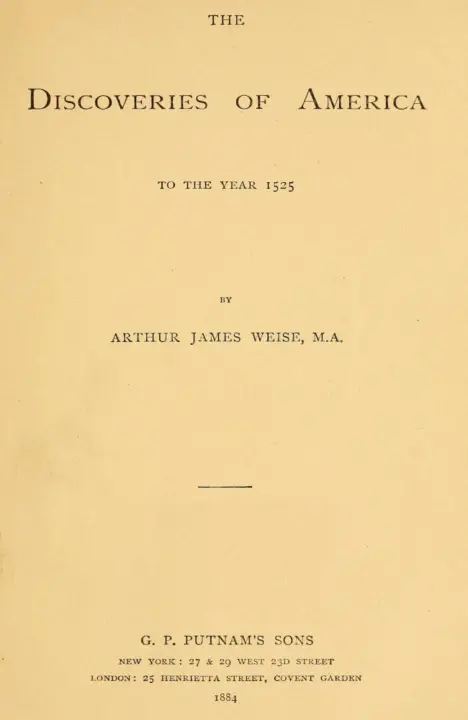
THE CLASSIC COLLECTION · 1884
"The Discoveries of America to the Year 1525" by Arthur James Weise is a historical account written in the late 19th century. This work delves into the early explorations of the American continent, focusing on the significant discoveries made before 1525, particularly by Columbus and other European explorers. The book aims to clarify various narratives about the discovery of America, critically examining the contributions of different explorers and offering insights into the civilizations that existed before European contact. The opening of the book presents a preface that establishes the historical context of America's early discovery and the inhabitants of the continent. Weise discusses the skepticism faced by Columbus and how earlier records, including Egyptian and Greek accounts, hint at a rich and complex civilization in the Americas long before European contact. Additionally, he highlights the contrasting views regarding the supposed discoveries made by the Northmen and other explorers, laying a foundation for the detailed accounts to follow. Overall, the opening sets the stage for a comprehensive exploration of the different narratives surrounding the discovery of America, emphasizing the blend of myth and historical fact.
Introduction adapted from the source catalogue; source summaries may be automatically generated.
Free to read · English · 127,443 words · No account needed
MAKE TIME FOR A GOOD BOOK
On by default. Untick to stop anonymous reading totals. Each page counts after 10 seconds in view. How this works.
Anonymous counting is on unless you have switched it off.
It is further related, in the saga, concerning Vinland, that “the days are more equal there than in Greenland or Iceland; there the sun sets at eykt time (eyktar-stad, 3:30 P.M.), and rises at day-meal time (dagmála-stad, breakfast-time), on the shortest day.”[52]
As there is no reliable information to indicate that the Northmen of the tenth century had any instruments by which they could accurately measure the changing spaces of day and night, or that their observations of the sun gave them the knowledge of astronomical time, an attempt to elucidate the exact duration of the shortest day in Vinland from the vague signification of the words eyktar-stad and dágmála-stad would consequently be futile and unsatisfactory. Nevertheless a number of scholars have attempted to determine the length of the shortest day at the place where the Northmen built their winter-quarters. Some have given the day a measurement of six hours, others seven, eight, and nine hours.[53] These different lengths of the day involve the inference that Vinland was somewhere between the forty-first and sixty-first parallels of north latitude.
It is related in another saga or legend that Vinland was visited in the eleventh century by other Northmen.[54] Among the number were Thorfinn Karlsefne, Snorro Thorbrandson, Bjarni Grimolfson, and Thorhall Gamlason. It is said that the three ships which departed from the western settlement, in the spring of 1007, had on board one hundred and forty men (40 manna ok hundrad). After sailing two days southward from Bjanneyjar they reached Helluland. “Thence they sailed two days, and turned from the south to the southeast,” and came to Markland.
When the Northmen departed from Markland, it is said in the saga that “they then sailed far to the southward along the coast and came to a promontory. The land lay on the right and had a long sandy beach. They rowed to it and found on a tongue of land the keel of a ship. They called this point of land Kjalarnes (Keel cape), and the beach Furdustrandir (Long Strand), for it took a long time to sail by it. Then the coast became sinuous. They then steered the ship into an inlet. King Olaf Tryggvason had given Leif two Scotch people, a man named Haki and a woman named Hekja. They were swifter than animals. These persons were in the ship with Karlsefne. When they had sailed past Furdustrandir they put these Scots ashore and ordered them to run to the south of the country and explore it, and return within three days.... They were absent the designated time. When they returned, one brought a bunch of wine-berries (vinberja köngul), the other an ear of wheat (hveitiax nysaid).[55] When they were taken on board, the ship sailed farther. They came into a bay, where there was an island around which flowed rapid currents that suggested the name which they gave it, Straumey (Stream island). There were so many eider ducks on the island that one could hardly walk about without stepping on their eggs. They called this place Straumfjörd (Stream inlet). They took the cargo from the ship and made preparations to remain there. They had with them different kinds of cattle. They undertook nothing but the exploration of the land. Without having provided food beforehand they sustained themselves there during the winter. In the summer the fishing was not good and they were in want of provisions. Thorhall the hunter disappeared. They had previously prayed to God to give them food, but they were not supplied as quickly as they thought their hunger demanded. They searched for Thorhall for three days. At last they found him lying on the top of a rock, looking up at the sky, gasping and muttering. They asked him why he was there. He said that his presence there should not trouble them. They prevailed on him to return home with them. A whale was stranded there, and they found it and cut it up. No one knew what kind of a whale it was, and when the cook prepared a part of it for them, they ate it and all were made sick. Then Thorhall said: ‘The red-bearded [Thor, the god of thunder,] was more helpful than your Christ; this [the whale meat] I have received for my hymns which I sing of Thor, my protector; seldom has he deserted me.’ When they heard this assertion, they cast the remainder of the whale into the sea and resigned themselves to the care of God. Then the weather favored them so that they were able to row out to fish, and thereafter they were not in want of food, for wild game was caught on land and fish in the sea, and eggs were collected on the island....
Your reading position is saved on this browser. Take it to another device with a library code. Reading pages adapt to text, rather than matching a printed edition.
BEHIND THE BOOK
This eBook is for the use of anyone anywhere in the United States and most other parts of the world at no cost and with almost no restrictions whatsoever. You may copy it, give it away or re-use it under the terms of the Project Gutenberg License included with this eBook or online at www.gutenberg.org. If you are not located in the United States, you will have to check the laws of the country where you are located before using this eBook. Read the source licence.
The original source file, including credits and licence, is retained by this library. Request an original-format copy at no charge. Please include the book title and Project Gutenberg identifier #67766.
KEEP YOUR CURIOSITY GOING
Wilfrid Scawen Blunt
Wilfrid Scawen Blunt

E. W. (Edgar Watson) Howe
Cécile Tormay

Moritz Busch
John L. Ransom