THE CLASSIC COLLECTION✦My diaries, being a personal narrative of events 1888-1914, Part 2 (1900-1914)CLASSIC FREE BOOKS
My diaries, being a personal narrative of events 1888-1914, Part 2 (1900-1914)
Wilfrid Scawen Blunt
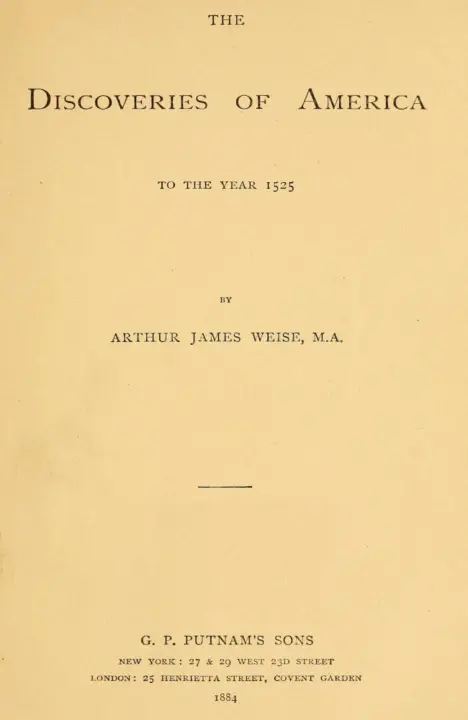
THE CLASSIC COLLECTION · 1884
"The Discoveries of America to the Year 1525" by Arthur James Weise is a historical account written in the late 19th century. This work delves into the early explorations of the American continent, focusing on the significant discoveries made before 1525, particularly by Columbus and other European explorers. The book aims to clarify various narratives about the discovery of America, critically examining the contributions of different explorers and offering insights into the civilizations that existed before European contact. The opening of the book presents a preface that establishes the historical context of America's early discovery and the inhabitants of the continent. Weise discusses the skepticism faced by Columbus and how earlier records, including Egyptian and Greek accounts, hint at a rich and complex civilization in the Americas long before European contact. Additionally, he highlights the contrasting views regarding the supposed discoveries made by the Northmen and other explorers, laying a foundation for the detailed accounts to follow. Overall, the opening sets the stage for a comprehensive exploration of the different narratives surrounding the discovery of America, emphasizing the blend of myth and historical fact.
Introduction adapted from the source catalogue; source summaries may be automatically generated.
Free to read · English · 127,443 words · No account needed
MAKE TIME FOR A GOOD BOOK
On by default. Untick to stop anonymous reading totals. Each page counts after 10 seconds in view. How this works.
Anonymous counting is on unless you have switched it off.
“In the spelling of the names of Indian chiefs, the townships, and of the provinces, we have mostly followed Torquemada, who is considered more correct on this point, for he lived fifty years in New Spain.”—The memoirs of the conquistador. Lockhart. Preface. vol. i. p. vi.
[328] This name, says Diaz, was given to Cortes “because our interpreter, Doña Marina, was always near him, particularly when embassadors arrived, and in our negotiations with the different caciques she interpreted for both parties. They therefore called him the captain of Marina, and contracted that appellation into the word Malinche.”
[329] It is said that the slimy substance mentioned by Diaz was called tecuitlatl, the excrement of stone. It was variously fashioned, and dried in the sun.
[330] Xiquipiles, according to Torquemada, expressed the number of
8,000 of any thing.
[331] Cacao-beans were used by the Mexicans in lieu of small coin.
[332] Historia verdadera de la conquista de la Nueva España. Diaz. cap. xxxix-clix.—Vide The memoirs of the conquistador. Lockhart. chap. xxxix-clix.
[333] Historia verdadera de la conquista de la Nueva España. Diaz. cap. lx, clxii.—Vide The memoirs of the conquistador. Lockhart. chap. lx, clxii.
[334] Tratado, que compõs e nobre & notauel capitão Antonio Galuão.
[335] In June, 1523, Francisco de Garay sailed with a fleet and a large number of troops from Jamaica to take possession of the province of Panuco, of which he had been appointed governor. He failed to accomplish his purpose, and died in the city of Mexico, at the end of December, 1523. Historia verdadera de la conquista de la Nueva España. cap. cxxxiii, clxii. Vide The memoirs of the conquistador. Lockhart. chap. cxxxiii, clxii.
[336] Coleccion de los viages y descubrimientos. Navarrete. tom. iii. pp.
64-69; 147-153.
[337] The situation of certain places along the coast of the present states of Florida, Alabama, Mississippi, Louisiana, and Texas, is thus described by Gomara: “From Santa Elena to Rio Seco, in 31°, are other forty leagues, and thence to La Cruz are twenty, and thence to Cañaveral, forty; and from Punta Cañaveral, in 28°, are other forty to Punta de la Florida (the peninsula of Florida).... This is in 25°, which is twenty leagues in length, and from it are a hundred or more leagues to Ancon bajo, which is fifty leagues from Rio Seco, from east to west, across Florida. From Ancon bajo they estimate it to be a hundred leagues to Rio de Nieves, and thence to that of Flores more than twenty, from which river it is seventy leagues to the Bay of the Holy Spirit (Baya del Espiritu Sancto), called by another name, La Culata (the breech of a gun), which river flows out into the ocean thirty leagues, and is in 29°, and thence it is more than seventy to Rio de Pescadores. From Rio de Pescadores, in 28° 30´, are a hundred leagues to Rio de las Palmas, near which crosses the tropic of Cancer; thence to Rio Panuco are more than thirty leagues; and thence to Villa Rica or Vera Cruz, seventy leagues.”—Primera y segunda parte de la historia general de las Indias. Gomara. cap. xii.
Your reading position is saved on this browser. Take it to another device with a library code. Reading pages adapt to text, rather than matching a printed edition.
BEHIND THE BOOK
This eBook is for the use of anyone anywhere in the United States and most other parts of the world at no cost and with almost no restrictions whatsoever. You may copy it, give it away or re-use it under the terms of the Project Gutenberg License included with this eBook or online at www.gutenberg.org. If you are not located in the United States, you will have to check the laws of the country where you are located before using this eBook. Read the source licence.
The original source file, including credits and licence, is retained by this library. Request an original-format copy at no charge. Please include the book title and Project Gutenberg identifier #67766.
KEEP YOUR CURIOSITY GOING
Wilfrid Scawen Blunt
Wilfrid Scawen Blunt

E. W. (Edgar Watson) Howe
Cécile Tormay

Moritz Busch
John L. Ransom