THE CLASSIC COLLECTION✦My diaries, being a personal narrative of events 1888-1914, Part 2 (1900-1914)CLASSIC FREE BOOKS
My diaries, being a personal narrative of events 1888-1914, Part 2 (1900-1914)
Wilfrid Scawen Blunt
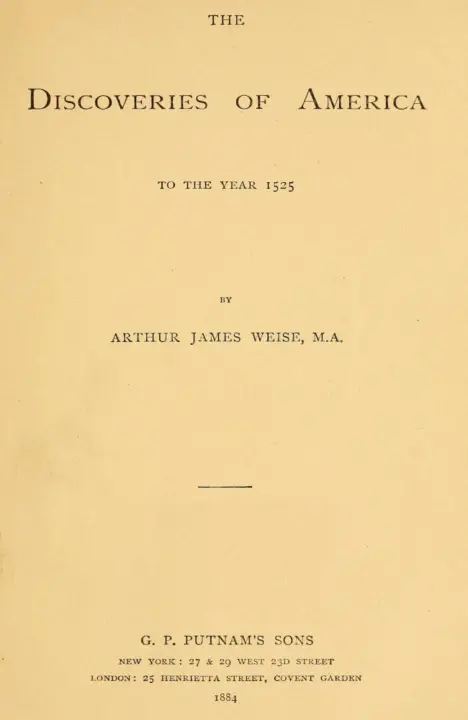
THE CLASSIC COLLECTION · 1884
"The Discoveries of America to the Year 1525" by Arthur James Weise is a historical account written in the late 19th century. This work delves into the early explorations of the American continent, focusing on the significant discoveries made before 1525, particularly by Columbus and other European explorers. The book aims to clarify various narratives about the discovery of America, critically examining the contributions of different explorers and offering insights into the civilizations that existed before European contact. The opening of the book presents a preface that establishes the historical context of America's early discovery and the inhabitants of the continent. Weise discusses the skepticism faced by Columbus and how earlier records, including Egyptian and Greek accounts, hint at a rich and complex civilization in the Americas long before European contact. Additionally, he highlights the contrasting views regarding the supposed discoveries made by the Northmen and other explorers, laying a foundation for the detailed accounts to follow. Overall, the opening sets the stage for a comprehensive exploration of the different narratives surrounding the discovery of America, emphasizing the blend of myth and historical fact.
Introduction adapted from the source catalogue; source summaries may be automatically generated.
Free to read · English · 127,443 words · No account needed
MAKE TIME FOR A GOOD BOOK
On by default. Untick to stop anonymous reading totals. Each page counts after 10 seconds in view. How this works.
Anonymous counting is on unless you have switched it off.
In Italy the different points of the compass were designated by the winds: North, tramontana; northeast, greco; east, levante; southeast, sirocco; south, ostro; southwest, libeccio; west, ponente; northwest, maestro or maestrale.
[194] Evidently the Gulf of Coquibacoa, called shortly afterward by the Spaniards the Gulf of Venezuela—the Gulf of Little Venice.—Vide Juan de la Cosa’s map in the cover-pocket.
[195] “Questa terra sta dentro del la torrida zona giuntamente, o di basso del paralello, che descriue el tropico di cancer: doue alza el polo dello orizonte 23 gradi nel fine del secondo clyma.”
[196] “Tanto che corremo dessa 870 leghe tutta uerso el maestrale.”
The end of the second climate was at 8° 25´ north latitude. Ptolemy, the geographer, divided the surface of the globe, from the equator to the sixty-sixth parallel, into zones, called climates, to represent the successive increase of fifteen minutes in the length of a mid-summer day. The first climate extended to 4° 15´, on the north side of the equator; the second, from 4° 15´ to 8° 25´; and the third, to 12° 30´.
[197] “Noi alsi facemo uela p, Spagna con 222 prigioni schiaui: & giugnemo nel porto di Calis adi 15 doctobre 1498.”
[198] Lettera di Amerigo Vespucci delle isole nuouamente trouate in quattro suoi viaggi. Primo viaggio.
Vide Amerigo Vespucci. Varnhagen. pp. 34-48. Bibliotheca Americana Vetustissima. [Harrisse.] pp. 55-68, 149, 150.
[199] Vide Memorials of Columbus. pp. 96, 97.
[200] At this time, says Ferdinand Columbus, “in order that Don Diego, my brother, and I, who had served as pages to Prince Juan, who was now dead, might not suffer by his delays or be absent from court until the time of his departure, he [the admiral] sent us, on the second of November, 1497, from Seville, to serve as pages to her majesty, Queen Isabella.”
[201] Historie del S. D. Fernando Colombo. cap. lxv.
[202] Although, according to Ferdinand Columbus’s statement, his father called the firm land (or rather an island) at the mouths of the Orinoco River, Isla Santa (Holy Island), Columbus really called the continent, La Tierra de Gracia (Land of Grace).
[203] Letter from the island of Española.—Vide Select letters of Christopher Columbus, with other original documents relating to his four voyages to the New World. Translated and edited by R. H. Major. London, 1870. Second edition. Hakluyt Society pub.
[204] Historie del S. D. Fernando Colombo. cap. lxv-lxxiii.
[205] Historie del S. D. Fernando Colombo. cap. lxxiv-lxxxvii.
[206] Lettera di Amerigo Vespucci. Secundo viaggio.—Vide Historie del S. D. Fernando Colombo. cap. lxxxiv. Coleccion de los viages y descubrimientos. Navarrete. tom. iii. pp. 4-9; 543-545.
Your reading position is saved on this browser. Take it to another device with a library code. Reading pages adapt to text, rather than matching a printed edition.
BEHIND THE BOOK
This eBook is for the use of anyone anywhere in the United States and most other parts of the world at no cost and with almost no restrictions whatsoever. You may copy it, give it away or re-use it under the terms of the Project Gutenberg License included with this eBook or online at www.gutenberg.org. If you are not located in the United States, you will have to check the laws of the country where you are located before using this eBook. Read the source licence.
The original source file, including credits and licence, is retained by this library. Request an original-format copy at no charge. Please include the book title and Project Gutenberg identifier #67766.
KEEP YOUR CURIOSITY GOING
Wilfrid Scawen Blunt
Wilfrid Scawen Blunt

E. W. (Edgar Watson) Howe
Cécile Tormay

Moritz Busch
John L. Ransom