THE CLASSIC COLLECTION✦My diaries, being a personal narrative of events 1888-1914, Part 2 (1900-1914)CLASSIC FREE BOOKS
My diaries, being a personal narrative of events 1888-1914, Part 2 (1900-1914)
Wilfrid Scawen Blunt
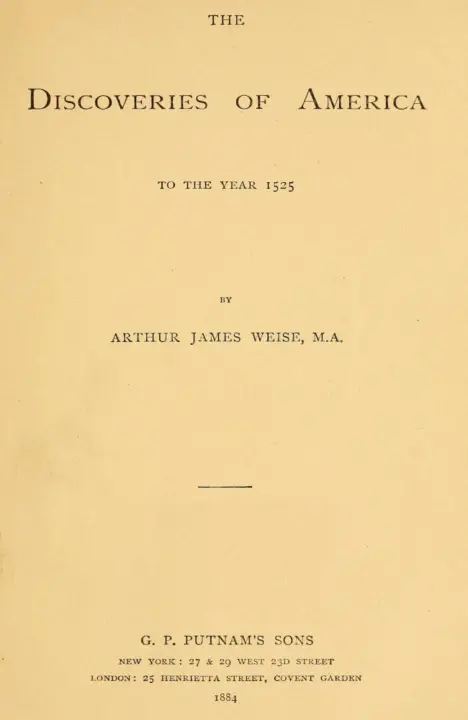
THE CLASSIC COLLECTION · 1884
"The Discoveries of America to the Year 1525" by Arthur James Weise is a historical account written in the late 19th century. This work delves into the early explorations of the American continent, focusing on the significant discoveries made before 1525, particularly by Columbus and other European explorers. The book aims to clarify various narratives about the discovery of America, critically examining the contributions of different explorers and offering insights into the civilizations that existed before European contact. The opening of the book presents a preface that establishes the historical context of America's early discovery and the inhabitants of the continent. Weise discusses the skepticism faced by Columbus and how earlier records, including Egyptian and Greek accounts, hint at a rich and complex civilization in the Americas long before European contact. Additionally, he highlights the contrasting views regarding the supposed discoveries made by the Northmen and other explorers, laying a foundation for the detailed accounts to follow. Overall, the opening sets the stage for a comprehensive exploration of the different narratives surrounding the discovery of America, emphasizing the blend of myth and historical fact.
Introduction adapted from the source catalogue; source summaries may be automatically generated.
Free to read · English · 127,443 words · No account needed
MAKE TIME FOR A GOOD BOOK
On by default. Untick to stop anonymous reading totals. Each page counts after 10 seconds in view. How this works.
Anonymous counting is on unless you have switched it off.
[162] Ferdinand Columbus says the admiral called the island of Cuba, Juana, in honor of Prince Juan, heir of Castile.—Vide Histoire del S. D. Fernando Colombo. cap. xxvi.
[163] The island of Española, which the natives called Haiti, lies between 17° 36´ and 19° 59´ north latitude, and 68° 20´ and 74° 38´ west longitude. It is about fifty miles east-southeast of Cuba and about seventy-five west-northwest of Porto Rico. It is now called Hayti or San Domingo.
[164] Apparently the original name of Jamaica. The island of Jamaica is about eighty-five miles from Cuba.
[165] On the twenty-first of November, 1492, Martin Alonso Pinzon, in the Pinta, had left the other vessels and remained away from them until the sixth of January, 1493.
[166] MS. of Las Casas.—Vide Personal narrative of the first voyage of Columbus to America. [Kettell.] pp. 86-205.
[167] Columbus’s letter to Rafael Sanchez.
[168] Columbus’s letter to Rafael Sanchez.
[169] MS. of Las Casas.—Vide Personal narrative of the first voyage of Columbus to America. [Kettell.] pp. 215-222.
[170] Martin Alonso Pinzon had previously arrived in Galicia.
[171] Historie del S. D. Fernando Colombo. cap. xli, xlii.
[172] Epistola Christofori Colom: cui etas nostra multu debit: de Insulis Indie supra Gangem nuper inuētis. Ad quas perqrendas octauo antea mense auspicies & ere invictissimor’ Fernãdi & Helisabet Hispaniar’ Regu missus fuerat: ad magnificum dum Gabrielem Sanchis eorundē Serenissimor’ Regum Tesaurariu missa: quiā nobilis ac literatus vir Leander de Cosco ab Hispano ideomate in latinum cōuertit tertio kal’s Maii m.cccc.xciii Pontificatus Alexandri Sexti anno primo.
A letter of Christopher Columbus, to whom our age is greatly indebted, respecting the islands of India lately found beyond the Ganges. In search of which he was sent eight months ago under the auspices and at the expense of the most invincible Ferdinand and Isabella, sovereigns of Spain. Sent to the magnificent lord, Gabriel Sanchez, treasurer of the same most serene king, and which the noble and learned man, Leander de Cosco, translated from the Spanish idiom into Latin. The third day of the calends of May, 1493. Pontificate of Alexander VI., first year.
[173] Historie del S. D. Fernando Colombo. cap. xlii.
[174] Tratado, que compōs o nobre & notauel capitão Antonio Galuão.
[175] Historie del S. D. Fernando Colombo. cap. xlvi.
[176] Historie del S. D. Fernando Colombo. cap. xlvi, xlvii.
[177] Historie del S. D. Fernando Colombo. cap. l.
[178] Historie del S. D. Fernando Colombo. cap. li.
[179] Historie del S. D. Fernando Colombo. cap. liii-lviii.
[180] “Que esta tierra de Cuba fuesa la tierra firme al comienzo de las Indias y fin á quien en estas partes quisiere venir de España por tierra.”
[181] Informacion del escribano publico. Fernando Perez de Luna. Coleccion de los viages y descubrimientos de los Espagñoles. tom. ii. pp. 143, 149.
Your reading position is saved on this browser. Take it to another device with a library code. Reading pages adapt to text, rather than matching a printed edition.
BEHIND THE BOOK
This eBook is for the use of anyone anywhere in the United States and most other parts of the world at no cost and with almost no restrictions whatsoever. You may copy it, give it away or re-use it under the terms of the Project Gutenberg License included with this eBook or online at www.gutenberg.org. If you are not located in the United States, you will have to check the laws of the country where you are located before using this eBook. Read the source licence.
The original source file, including credits and licence, is retained by this library. Request an original-format copy at no charge. Please include the book title and Project Gutenberg identifier #67766.
KEEP YOUR CURIOSITY GOING
Wilfrid Scawen Blunt
Wilfrid Scawen Blunt

E. W. (Edgar Watson) Howe
Cécile Tormay

Moritz Busch
John L. Ransom