THE CLASSIC COLLECTION✦My diaries, being a personal narrative of events 1888-1914, Part 2 (1900-1914)CLASSIC FREE BOOKS
My diaries, being a personal narrative of events 1888-1914, Part 2 (1900-1914)
Wilfrid Scawen Blunt
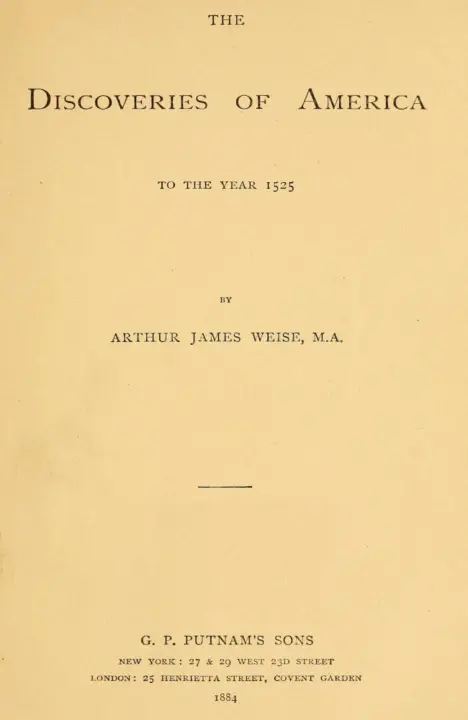
THE CLASSIC COLLECTION · 1884
"The Discoveries of America to the Year 1525" by Arthur James Weise is a historical account written in the late 19th century. This work delves into the early explorations of the American continent, focusing on the significant discoveries made before 1525, particularly by Columbus and other European explorers. The book aims to clarify various narratives about the discovery of America, critically examining the contributions of different explorers and offering insights into the civilizations that existed before European contact. The opening of the book presents a preface that establishes the historical context of America's early discovery and the inhabitants of the continent. Weise discusses the skepticism faced by Columbus and how earlier records, including Egyptian and Greek accounts, hint at a rich and complex civilization in the Americas long before European contact. Additionally, he highlights the contrasting views regarding the supposed discoveries made by the Northmen and other explorers, laying a foundation for the detailed accounts to follow. Overall, the opening sets the stage for a comprehensive exploration of the different narratives surrounding the discovery of America, emphasizing the blend of myth and historical fact.
Introduction adapted from the source catalogue; source summaries may be automatically generated.
Free to read · English · 127,443 words · No account needed
MAKE TIME FOR A GOOD BOOK
On by default. Untick to stop anonymous reading totals. Each page counts after 10 seconds in view. How this works.
Anonymous counting is on unless you have switched it off.
[79] Ser Marco Polo. Yule. Second ed. vol. i. pp. 103, 104.
[80] “I John Maundevylle, knight, alle be it I be not worthi, that was born in England, in the Town of Seynt Albones, passed the See, in the zeer of our Lord Jesu Crist mcccxxii, in the Day of Seynt Michelle; and hidre to have ben long tyme over the See, and have seyn and gon thorghe manye dyverse Londes, and many Provynces and Kingdomes and Iles, and have passed thorghe Tartarye, Percye, Ermonye, the litylle and the grete; thorghe Lybye, Caldee, and a gret partie of Ethiope; thorghe Amazoyne, Inde the lasse and the more, a gret partie; and thorghe out many othere Iles, that ben abouten Inde.... And zee schulle undirstonde, that I have put this Boke out of Latyn into Frensche and translated it azen out of Frensche into Englyssche, that every Man of my Nacioun may undirstonde it.”—MS. in Cottonian library, marked Titus. c. xvi. The Voiage and Travaile of Sir John Maundevile, Kt. By J. O. Halliwell. London, 1849. Prologue. pp. 4, 5.
[81] Herodotus: Melpomene xlii.
[82] Caius Plinius Secundus, a Roman writer, born A. D. 23, and died A. D. 79. Hanno’s expedition was undertaken about 570 B. C.
[83] Eudoxus of Cyzicus, a Greek navigator, lived about 130 B. C. Ptolemy Lathyrus began his reign B. C. 117. Cornelius Nepos flourished in the century before the Christian era.
[84] Supposed to have been in the year of the building of Rome, 691.
[85] Suevi, the ancient inhabitants of that part of Germany between the Danube and the Baltic Sea.
[86] Historia Naturalis. lib. ii. cap. lxvii.
[87] “In Christian Europe the earliest mention of the use of the magnetic needle occurs in the politico-satirical poem, called La Bible, by Guyot, of Provence, in 1190, and in the description of Palestine by Jacobus, of Vitry, Bishop of Ptolemais, between 1204 and 1215. Dante (in his Parad. xii., 29) refers, in a simile, to the needle (ago) ‘which points to the star.’”
“Navarrete, in his Discurso histórico sobre los progresos del Arte de Navegar en España, 1802, p. 28, recalls a remarkable passage in the Spanish Leyes de las Partidas (II. tit. ix., ley 28), of the middle of the thirteenth century: ‘The needle, which guides the seaman in the dark night, and shows him, both in good and bad weather, how to direct his course, is the intermediary agent (medianera) between the loadstone (la piedra) and the north star.’ ... See the passage in Las Siete Partidas del sabio Rey Don Alonso el ix. (according to the usually adopted chronological order, Alonso the Xth). Madrid, 1829. t. i. p. 473.”—Humboldt: Cosmos. Otté’s trans. vol. ii. p. 629, and note.
Your reading position is saved on this browser. Take it to another device with a library code. Reading pages adapt to text, rather than matching a printed edition.
BEHIND THE BOOK
This eBook is for the use of anyone anywhere in the United States and most other parts of the world at no cost and with almost no restrictions whatsoever. You may copy it, give it away or re-use it under the terms of the Project Gutenberg License included with this eBook or online at www.gutenberg.org. If you are not located in the United States, you will have to check the laws of the country where you are located before using this eBook. Read the source licence.
The original source file, including credits and licence, is retained by this library. Request an original-format copy at no charge. Please include the book title and Project Gutenberg identifier #67766.
KEEP YOUR CURIOSITY GOING
Wilfrid Scawen Blunt
Wilfrid Scawen Blunt

E. W. (Edgar Watson) Howe
Cécile Tormay

Moritz Busch
John L. Ransom