THE CLASSIC COLLECTION✦My diaries, being a personal narrative of events 1888-1914, Part 2 (1900-1914)CLASSIC FREE BOOKS
My diaries, being a personal narrative of events 1888-1914, Part 2 (1900-1914)
Wilfrid Scawen Blunt
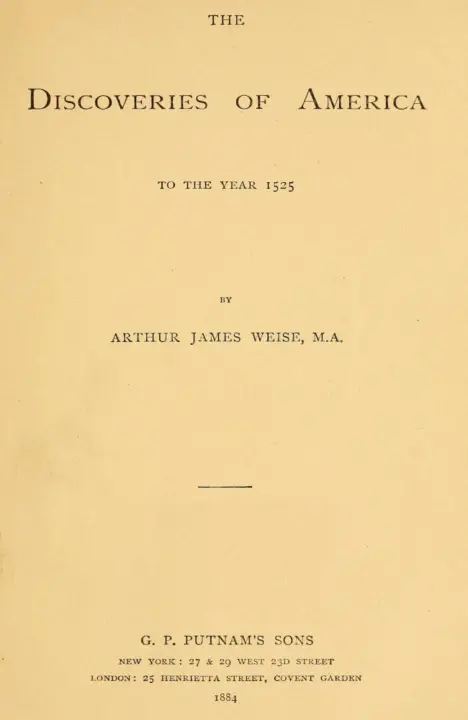
THE CLASSIC COLLECTION · 1884
"The Discoveries of America to the Year 1525" by Arthur James Weise is a historical account written in the late 19th century. This work delves into the early explorations of the American continent, focusing on the significant discoveries made before 1525, particularly by Columbus and other European explorers. The book aims to clarify various narratives about the discovery of America, critically examining the contributions of different explorers and offering insights into the civilizations that existed before European contact. The opening of the book presents a preface that establishes the historical context of America's early discovery and the inhabitants of the continent. Weise discusses the skepticism faced by Columbus and how earlier records, including Egyptian and Greek accounts, hint at a rich and complex civilization in the Americas long before European contact. Additionally, he highlights the contrasting views regarding the supposed discoveries made by the Northmen and other explorers, laying a foundation for the detailed accounts to follow. Overall, the opening sets the stage for a comprehensive exploration of the different narratives surrounding the discovery of America, emphasizing the blend of myth and historical fact.
Introduction adapted from the source catalogue; source summaries may be automatically generated.
Free to read · English · 127,443 words · No account needed
MAKE TIME FOR A GOOD BOOK
On by default. Untick to stop anonymous reading totals. Each page counts after 10 seconds in view. How this works.
Anonymous counting is on unless you have switched it off.
The vessels of the Phœnicians were of a better build, but they also were fitted out with oars and sails.—Ezekiel xxvii. 3-9.
[29] Genesis vi. 5, 6, 7.
[30] Plato: Critias, or the Atlantic.
Vide The Works of Plato. Bohn’s ed. London, 1849. vol. ii. Translated by Henry Davis, pp. 413-429.
[31] The date of the accession of Seti I. or Sethos I. is variously given. M. Champollion Figeac places it in 1473 B.C. Mure thinks it cannot be earlier than 1410 nor later than 1400 B.C.
[32] Transactions of the Society of Biblical Archæology. t. iv. pp. 1-19.
[33] Les Origines de l’Histoire. Lenormant. pp. 448, 449.
[34] Vide Historia Verdadera de la Conqvista de la Nueva-España. Escrita por el Capitan Bernal Diaz del Castillo, vno de sus Conquistadores. En Madrid, 1632.
Antiquities of Mexico: comprising fac-similes of ancient Mexican paintings and hieroglyphics, preserved in the Royal libraries of Paris, Berlin, and Dresden; in the Imperial library at Vienna; in the Vatican library; in the Borgian museum at Rome; in the library of the Institute at Bologna; and in the Bodleian library at Oxford. Together with the monuments of New Spain, by M. Dupaix; with their respective scales of measurements and accompanying descriptions. The whole illustrated by many valuable inedited manuscripts, by Lord Kingsborough. In nine volumes. London, 1831-1848.
[35] Now called the Shetland islands, but the name is printed on the early maps Hetland; from Swedish het, hot, and land, land. The group lies about 180 miles from Norway, between 59° 50´ and 60° 50´ north latitude.
[36] The Fer öe or Far islands lie about 170 miles northwest of the Shetland group, and are between 61° 20´ and 62° 25´ north latitude. The name is derived from fer, far, (Swedish,) and öe, islands.
[37] Iceland lies between latitude 63° 24´ and 66° 33´ N. and longitude 13° 31´ and 24° 17´ W. It is one hundred and sixty miles east of Greenland, six hundred west of Norway, and two hundred and fifty northwest of the Fer öe, or Far islands.
[38] History of the Northmen, by Henry Wheaton. London, 1831. pp. 17, 18.
Iceland, or the journal of a residence in that island, during the years 1814 and 1815, by Ebenezer Henderson, vol. i. Intro. pp. xv. and 308.
[39] “Men of experience say, who have been born in Greenland, and have recently come from Greenland, that from Stadt, in the north part of Norway, to Horns, on the east coast of Iceland, is seven days’ sailing directly westward.”—Antiqvitates Americanæ, sive scriptores septentrionales rerum Ante-Columbianarum in America. Edidit Societas Regia Antiqvariorum Septentrionalium. Hafniæ, 1837. Ivar Bardsen’s treatise. p. 302.
Your reading position is saved on this browser. Take it to another device with a library code. Reading pages adapt to text, rather than matching a printed edition.
BEHIND THE BOOK
This eBook is for the use of anyone anywhere in the United States and most other parts of the world at no cost and with almost no restrictions whatsoever. You may copy it, give it away or re-use it under the terms of the Project Gutenberg License included with this eBook or online at www.gutenberg.org. If you are not located in the United States, you will have to check the laws of the country where you are located before using this eBook. Read the source licence.
The original source file, including credits and licence, is retained by this library. Request an original-format copy at no charge. Please include the book title and Project Gutenberg identifier #67766.
KEEP YOUR CURIOSITY GOING
Wilfrid Scawen Blunt
Wilfrid Scawen Blunt

E. W. (Edgar Watson) Howe
Cécile Tormay

Moritz Busch
John L. Ransom