THE CLASSIC COLLECTION✦My diaries, being a personal narrative of events 1888-1914, Part 2 (1900-1914)CLASSIC FREE BOOKS
My diaries, being a personal narrative of events 1888-1914, Part 2 (1900-1914)
Wilfrid Scawen Blunt
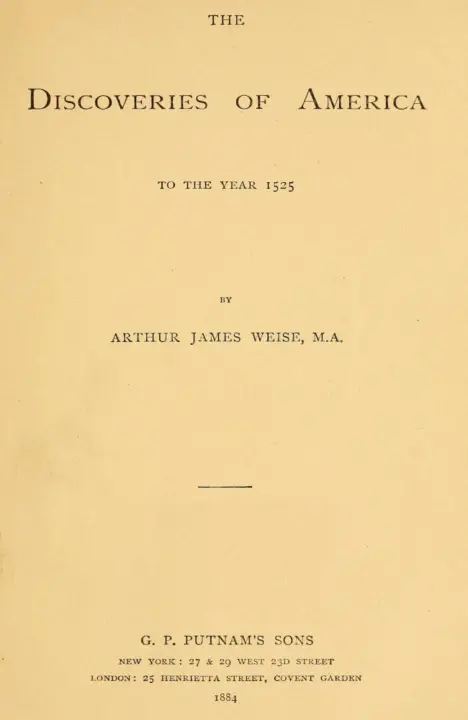
THE CLASSIC COLLECTION · 1884
"The Discoveries of America to the Year 1525" by Arthur James Weise is a historical account written in the late 19th century. This work delves into the early explorations of the American continent, focusing on the significant discoveries made before 1525, particularly by Columbus and other European explorers. The book aims to clarify various narratives about the discovery of America, critically examining the contributions of different explorers and offering insights into the civilizations that existed before European contact. The opening of the book presents a preface that establishes the historical context of America's early discovery and the inhabitants of the continent. Weise discusses the skepticism faced by Columbus and how earlier records, including Egyptian and Greek accounts, hint at a rich and complex civilization in the Americas long before European contact. Additionally, he highlights the contrasting views regarding the supposed discoveries made by the Northmen and other explorers, laying a foundation for the detailed accounts to follow. Overall, the opening sets the stage for a comprehensive exploration of the different narratives surrounding the discovery of America, emphasizing the blend of myth and historical fact.
Introduction adapted from the source catalogue; source summaries may be automatically generated.
Free to read · English · 127,443 words · No account needed
MAKE TIME FOR A GOOD BOOK
On by default. Untick to stop anonymous reading totals. Each page counts after 10 seconds in view. How this works.
Anonymous counting is on unless you have switched it off.
“‘It was ordered for the men on the plain fit for military service that each individual leader should have an allotment of land; each allotment amounting in extent to a hundred stadia; the whole number of allotments being sixty thousand. It is said that many men from the mountains and other parts of the country were assigned, according to their dwellings and villages, certain tracts by their respective leaders. Each leader was required to furnish for war the sixth part of a war-chariot (to make the number of ten thousand), two riding horses, and a two-horse chariot without a driver’s seat, having a mounted charioteer to guide the horses, with another rider to dismount and fight at the side of them; also two heavy-armed men, two archers, two slingers, three light-armed soldiers, the same number of stone-shooters and javelin-men, besides four seamen to make up the crews of one thousand two hundred vessels. Thus were the military affairs of this city arranged. Respecting those of the nine other allotments, there were different regulations, which it would be too tedious to narrate.
“‘The following were the systems of official services and honors: Each of the ten kings ruled supreme over the people and the laws in his own allotment and over his own city, constraining and punishing whom he pleased.[23] As the law was handed down to them, the government and commonwealth in each allotment were regulated by the injunctions of Poseidon. Inscriptions [of this law] were made by the first [kings] on a column of orichalcum which was placed in the centre of the island, in the temple of Poseidon, where the kings consulted together every fifth year, (which they afterward changed to every sixth year,) each king representing at these meetings the entire kingdom and its subdivisions. The kings, when they were assembled, deliberated on matters respecting the common weal, and inquired what transgressions each had committed, and each respectively rendered his decision. Before they sat in judgment they gave one another pledges, according to the following custom: The ten, when they were assembled in the temple, after invoking the god to receive their sacrifice propitiously, went swordless, with staves and nooses, among the bulls grazing within the temple inclosure, and the bull they took they brought to the column and slaughtered it, the head of the bull being under the inscriptions. Besides the laws on the column, there was a malediction written containing denunciations of evil on the disobedient. When, therefore, in compliance with their laws, they sacrificed and burned all the limbs of the bull, they filled a goblet with the blood of the animal, and threw the remainder into the fire, in order to purify the column. Afterward dipping from the goblet with golden cups, they poured libations of blood on the fire, and swore to do justice according to the laws on the column, to punish any one who had previously transgressed them, besides swearing that they themselves would never afterward willingly transgress the inscribed laws, or rule or obey any ruler governing otherwise than according to his father’s laws. Then after invoking these denunciations on themselves and their descendants, and after drinking from the cup and depositing it in the temple of the god, and sitting the necessary time at supper, they, as soon as it was dark and the fire of the sacrifice had ceased to burn, dressed themselves in beautiful dark-blue robes, and sat down on the ground, near the embers of the sacrifice, over which they had sworn. All the fire in the temple having been extinguished for the night, they then mutually judged one another respecting any accusation of transgressing the laws. After their acts of judgment were ended, and daylight had come, they inscribed their decisions on a golden tablet and deposited it and their dresses in the temple as memorials. There were also many other special laws respecting the privileges of the kings. The principal ones were that they should never wage war upon one another, that all should lend their aid when any attempt was made in their cities to destroy the royal race, that they should consult together as their ancestors had done respecting the right course to be pursued in war and in other matters, and that they should allot the government of the empire to the Atlantic race. They did not allow the king, however, any authority to put to death any of his kinsmen, unless the execution was approved by more than five of the ten.’”[24]
Your reading position is saved on this browser. Take it to another device with a library code. Reading pages adapt to text, rather than matching a printed edition.
BEHIND THE BOOK
This eBook is for the use of anyone anywhere in the United States and most other parts of the world at no cost and with almost no restrictions whatsoever. You may copy it, give it away or re-use it under the terms of the Project Gutenberg License included with this eBook or online at www.gutenberg.org. If you are not located in the United States, you will have to check the laws of the country where you are located before using this eBook. Read the source licence.
The original source file, including credits and licence, is retained by this library. Request an original-format copy at no charge. Please include the book title and Project Gutenberg identifier #67766.
KEEP YOUR CURIOSITY GOING
Wilfrid Scawen Blunt
Wilfrid Scawen Blunt

E. W. (Edgar Watson) Howe
Cécile Tormay

Moritz Busch
John L. Ransom