THE CLASSIC COLLECTION✦My diaries, being a personal narrative of events 1888-1914, Part 2 (1900-1914)CLASSIC FREE BOOKS
My diaries, being a personal narrative of events 1888-1914, Part 2 (1900-1914)
Wilfrid Scawen Blunt
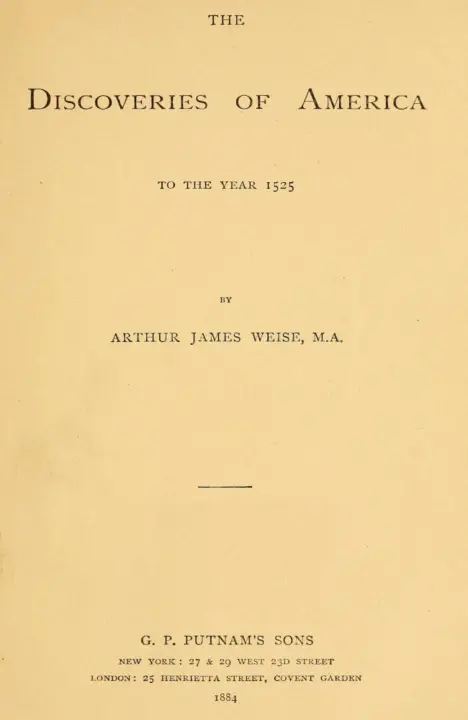
THE CLASSIC COLLECTION · 1884
"The Discoveries of America to the Year 1525" by Arthur James Weise is a historical account written in the late 19th century. This work delves into the early explorations of the American continent, focusing on the significant discoveries made before 1525, particularly by Columbus and other European explorers. The book aims to clarify various narratives about the discovery of America, critically examining the contributions of different explorers and offering insights into the civilizations that existed before European contact. The opening of the book presents a preface that establishes the historical context of America's early discovery and the inhabitants of the continent. Weise discusses the skepticism faced by Columbus and how earlier records, including Egyptian and Greek accounts, hint at a rich and complex civilization in the Americas long before European contact. Additionally, he highlights the contrasting views regarding the supposed discoveries made by the Northmen and other explorers, laying a foundation for the detailed accounts to follow. Overall, the opening sets the stage for a comprehensive exploration of the different narratives surrounding the discovery of America, emphasizing the blend of myth and historical fact.
Introduction adapted from the source catalogue; source summaries may be automatically generated.
Free to read · English · 127,443 words · No account needed
MAKE TIME FOR A GOOD BOOK
On by default. Untick to stop anonymous reading totals. Each page counts after 10 seconds in view. How this works.
Anonymous counting is on unless you have switched it off.
[4] “If Solon ... had not considered the writing of poetry a recreation, but had made it, as others do, an actual employment, and had completed the history which he had brought from Egypt; and had not been forced to relinquish it by seditions and many other troubles in which he found his country involved, I do not think that either Hesiod, Homer, or any other poet would have acquired more extensive fame.”—Plato: Timæus, or Concerning Nature.
[5] Plato was born about the year B. C. 430 and died about the year B. C. 348. He traced his descent from Solon through his mother.
[6] “These very writings, indeed, were in the possession of my grandfather, and are now in mine, having been made the subject of much study during my boyhood.”—Plato: Critias, or the Atlantic.
[7] Plato: Critias, or the Atlantic.
[8] The so-called Pillars of Hercules were the two mountains, Calpe and Abyla, on the opposite sides of the Strait of Gibraltar.
“I wonder, therefore, at those,” says Herodotus, “who have described the limits of and divided Libya, Asia, and Europe, for the difference between them is trifling: for in length Europe extends along both of them, but respecting width, it is evidently not to be compared. Libya shows itself to be surrounded by water, except so much of it as borders Asia.”—Herodotus: Melpomene xlii.
[9] Tyrrhenia or Umbria, in Italy, now Tuscany.
[10] Plato: Timæus, or Concerning Nature.
[11] Plato: Critias, or the Atlantic.
[12] Genesis xvi. 7; xviii. 1-8, 16-33; xix. 1-22; xxxii. 1, 2.
[13] Herodotus: Euterpe cxlii, cxliv.
[14] Genesis vi. 1, 2, 4.
“SOC. Do you know that heroes are half-gods?
“HERM. What then?
“SOC. All of them were doubtless begotten either from a god falling in love with a mortal woman, or from a mortal man [falling in love] with a goddess.”
—Plato: Cratylus, or Concerning the Correct Use of Words.
[15] A stadium is equal to 600 Greek or 625 Roman feet, or to 606 feet 9
inches English measure.
[16] Respecting the names of the persons appearing in the narrative Plato observes: “We must briefly warn you not to be surprised at hearing Hellenic names given to the barbarians; the cause of this you shall now hear. Solon, intending to make use of this narrative in his poetry, made an investigation into the signification of the names, and found that the early Egyptians who recorded these facts transferred these names into their own language; and he again receiving the meaning of each name transcribed it into our tongue.”
[17] “Πᾶσα ἡ νῆσος τότε πέλαγος ἐσχεν ἑπωνυμίαν, Ἀτλαντικὸν λεχθέν.”
[18] Gadeira, an ancient city built, it is said, by the Phœnicians, fifteen centuries before the Christian era, on the site of Cadiz, Spain.
[19] Ὀρείχαλκος, ore of copper. From ὄρειος, mountain, and χαλκός, brass.
Your reading position is saved on this browser. Take it to another device with a library code. Reading pages adapt to text, rather than matching a printed edition.
BEHIND THE BOOK
This eBook is for the use of anyone anywhere in the United States and most other parts of the world at no cost and with almost no restrictions whatsoever. You may copy it, give it away or re-use it under the terms of the Project Gutenberg License included with this eBook or online at www.gutenberg.org. If you are not located in the United States, you will have to check the laws of the country where you are located before using this eBook. Read the source licence.
The original source file, including credits and licence, is retained by this library. Request an original-format copy at no charge. Please include the book title and Project Gutenberg identifier #67766.
KEEP YOUR CURIOSITY GOING
Wilfrid Scawen Blunt
Wilfrid Scawen Blunt

E. W. (Edgar Watson) Howe
Cécile Tormay

Moritz Busch
John L. Ransom