THE CLASSIC COLLECTION✦My diaries, being a personal narrative of events 1888-1914, Part 2 (1900-1914)CLASSIC FREE BOOKS
My diaries, being a personal narrative of events 1888-1914, Part 2 (1900-1914)
Wilfrid Scawen Blunt
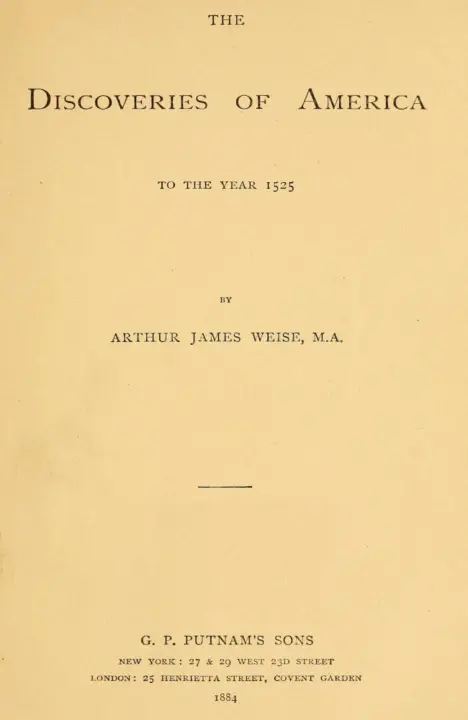
THE CLASSIC COLLECTION · 1884
"The Discoveries of America to the Year 1525" by Arthur James Weise is a historical account written in the late 19th century. This work delves into the early explorations of the American continent, focusing on the significant discoveries made before 1525, particularly by Columbus and other European explorers. The book aims to clarify various narratives about the discovery of America, critically examining the contributions of different explorers and offering insights into the civilizations that existed before European contact. The opening of the book presents a preface that establishes the historical context of America's early discovery and the inhabitants of the continent. Weise discusses the skepticism faced by Columbus and how earlier records, including Egyptian and Greek accounts, hint at a rich and complex civilization in the Americas long before European contact. Additionally, he highlights the contrasting views regarding the supposed discoveries made by the Northmen and other explorers, laying a foundation for the detailed accounts to follow. Overall, the opening sets the stage for a comprehensive exploration of the different narratives surrounding the discovery of America, emphasizing the blend of myth and historical fact.
Introduction adapted from the source catalogue; source summaries may be automatically generated.
Free to read · English · 127,443 words · No account needed
MAKE TIME FOR A GOOD BOOK
On by default. Untick to stop anonymous reading totals. Each page counts after 10 seconds in view. How this works.
Anonymous counting is on unless you have switched it off.
“We saw on them pieces of wrought copper, which is more esteemed by them than gold, the latter being deemed the most ordinary of metals, yellow being a color much disliked by them. Blue and red are the colors which they value most highly. Of the things which we gave them, they preferred the bells, azure crystals, and other toys, which they hung in their ears and about their necks. They do not value or desire to have silk or gold-drapery, or other kinds of cloth, nor implements of steel or iron. When we showed them our weapons, they expressed no admiration, and only asked how they were made. The same indifference was manifested when they were given the looking-glasses, which they with smiles returned to us as soon as they had looked at them. They are very generous, giving away whatever they have.
“We formed a great friendship with them, and one day we entered into port with our ship, having before rode at the distance of a league from the shore, as the weather was unfavorable. They came to the ship with a number of their little boats, with their faces painted with different colors, manifesting real signs of joy, bringing us of their provisions, and signifying to us where we could best ride in safety with our ship, and keeping with us until we had cast anchor.
“We remained among them fifteen days to provide ourselves with many things of which we were in want, during which time they came every day to see our ship, bringing with them their wives, of whom they were very careful, for, although they came on board themselves, and remained a long while, they made their wives stay in the boats, nor could we ever get them on board by any solicitations or any presents we could make them. One of the two kings, however, often came with his queen and many attendants to see us for his amusement. But he always stopped on land at the distance of about two hundred paces from us, and sent a boat to announce his intended visit, saying they would come and see our ship. This was done for safety, and as soon as they had received our answer, they came and remained some time to look around. On hearing the annoying cries of the sailors, the king sent the queen, with her attendants, in a very light boat to wait, near an island, a quarter of a league distant, while he remained a long time on board, talking with us by signs, and expressing his fanciful notions about every thing in the ship, and asking the use of all. After imitating our modes of salutation, and tasting our food, he courteously took leave of us. Once, when our men remained two or three days on a small island near the ship for their various necessities, as sailors are wont to do, he came with seven or eight of his attendants to inquire about our movements, often asking us if we intended to remain there long, and offering us every thing at his command. Sometimes he would shoot with his bow, and run up and down with his people, making great sport for us. We often went five or six leagues into the interior, and found the country as pleasant as can be conceived, adapted to cultivation of every kind, whether of corn, wine, or oil. There are open plains twenty-five and thirty leagues in length, entirely free from trees or other obstructions, and so fertile that whatever is sown there will yield an excellent crop. On entering the woods, we observed that they might all be traversed by any large army. The trees in them were oaks, cypresses, and others unknown in Europe. We found, also, apples, plums, filberts, and many other fruits, but of a different kind from ours. The animals, which are in great numbers, stags, deer, lynx, and many other kinds, are taken with snares and by bows; the latter is the principal weapon of the natives. Their arrows are beautifully made. For points they use emery, jasper, hard marble, and other sharp stones instead of iron. They also use the same kind of sharp stones in cutting down trees, and with them construct their boats of single logs, hollowed out with admirable skill, and sufficiently commodious to seat ten or twelve persons. Their oars are short, with broad blades, and are rowed by the force of the arms, with the greatest care and as rapidly as they wish.
Your reading position is saved on this browser. Take it to another device with a library code. Reading pages adapt to text, rather than matching a printed edition.
BEHIND THE BOOK
This eBook is for the use of anyone anywhere in the United States and most other parts of the world at no cost and with almost no restrictions whatsoever. You may copy it, give it away or re-use it under the terms of the Project Gutenberg License included with this eBook or online at www.gutenberg.org. If you are not located in the United States, you will have to check the laws of the country where you are located before using this eBook. Read the source licence.
The original source file, including credits and licence, is retained by this library. Request an original-format copy at no charge. Please include the book title and Project Gutenberg identifier #67766.
KEEP YOUR CURIOSITY GOING
Wilfrid Scawen Blunt
Wilfrid Scawen Blunt

E. W. (Edgar Watson) Howe
Cécile Tormay

Moritz Busch
John L. Ransom