THE CLASSIC COLLECTION✦My diaries, being a personal narrative of events 1888-1914, Part 2 (1900-1914)CLASSIC FREE BOOKS
My diaries, being a personal narrative of events 1888-1914, Part 2 (1900-1914)
Wilfrid Scawen Blunt
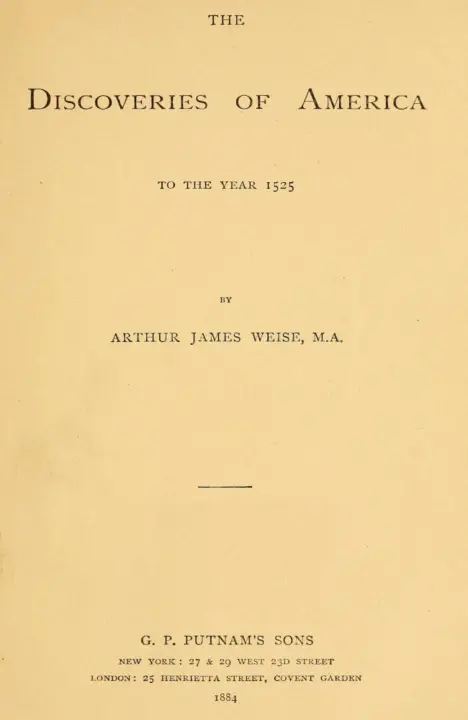
THE CLASSIC COLLECTION · 1884
"The Discoveries of America to the Year 1525" by Arthur James Weise is a historical account written in the late 19th century. This work delves into the early explorations of the American continent, focusing on the significant discoveries made before 1525, particularly by Columbus and other European explorers. The book aims to clarify various narratives about the discovery of America, critically examining the contributions of different explorers and offering insights into the civilizations that existed before European contact. The opening of the book presents a preface that establishes the historical context of America's early discovery and the inhabitants of the continent. Weise discusses the skepticism faced by Columbus and how earlier records, including Egyptian and Greek accounts, hint at a rich and complex civilization in the Americas long before European contact. Additionally, he highlights the contrasting views regarding the supposed discoveries made by the Northmen and other explorers, laying a foundation for the detailed accounts to follow. Overall, the opening sets the stage for a comprehensive exploration of the different narratives surrounding the discovery of America, emphasizing the blend of myth and historical fact.
Introduction adapted from the source catalogue; source summaries may be automatically generated.
Free to read · English · 127,443 words · No account needed
MAKE TIME FOR A GOOD BOOK
On by default. Untick to stop anonymous reading totals. Each page counts after 10 seconds in view. How this works.
Anonymous counting is on unless you have switched it off.
“We were quartered in a large building where there was room enough for us all.... Near it were temples and Mexican idols. This building had been purposely selected for us because we were termed teules, or were thought to be, and that we might dwell among the gods as among our equals. The apartments and halls were very spacious, and those set apart for our general were furnished with carpets. Each one of us had a separate bed, which could not have been better furnished for a gentleman of the first rank. Each apartment was swept clean, and the walls were newly plastered and decorated.
“When we had entered into the great court-yard of this palace, Montezuma came to Cortes, and, taking him by the hand, conducted him to the apartments where he was to lodge, which had been prettily decorated after the fashion of the country. He then hung about his neck a chased necklace of gold, most curiously wrought with figures of crabs. The Mexican grandees were greatly amazed at all these uncommon favors which their monarch bestowed upon our general.
“Cortes returned the monarch many thanks for so much kindness, and the latter took leave of him with these words: ‘Malinche,[328] you and your brothers must now do as if you were at home, and take some rest after the fatigues of the journey.’ He then returned to his palace, which was near.” This was on the eighth of November, 1519. Later in the day Montezuma again visited Cortes, and held a long conversation with him. On the following day Cortes had an audience with Montezuma in his palace.
“The mighty Montezuma,” Diaz further observes, “may have been about this time in the fortieth year of his age. He was tall, slender, and thin; but his body was well-proportioned. His complexion was not very brown, almost the same as that of the inhabitants. His hair was not long, excepting where it hung thickly over his ears, which were hid by it. His black beard, though thin, was handsome. His face was somewhat long, but he had a cheerful countenance, and his fine eyes had an expression of amiability or of ill-will according to his humor. He was particularly clean in appearance, and took a bath every evening. Besides a number of concubines, who were all daughters of note and rank, he had two lawful wives of royal extraction, whom, however, he visited secretly without any one daring to observe him, except his most confidential servants.... In the halls adjoining his private apartments there was always a guard of two thousand men of high station in waiting, with whom, however, he never held any conversation unless to give them orders or to receive some intelligence from them.... In cold weather when he dined a large fire was made of the charcoal of the bark of trees, which emitted no smoke but a delightful perfume. That his majesty might not feel any discomfort from the heat of the fire, a screen was placed between him and it, made of gold, and adorned with the different figures of their gods. The chair on which he sat was somewhat low. It was filled with soft cushions and beautifully carved. The table was higher, and suited to the seat. The former was covered with white cloths, one of which was large. Four very neat and pretty women held before the monarch a round pitcher, called by them xicales, filled with water to wash his hands. The water was caught in other vessels, and then the young women presented him with towels to dry his hands. Two other women brought him maize-bread baked with eggs. Before Montezuma began to dine, a wooden screen, elaborately gilded, was placed before him, that no one might see him while eating. Then the young women stood at a distance. Four elderly men of high rank came to his table, whom he addressed from time to time or asked them some question. Sometimes he would offer them a plate of his food, which was considered a mark of great favor. The gray-haired, aged men, that were so highly honored, were, as we subsequently learned, his nearest relatives, his most trustworthy counsellors, and chief justices. Whenever he ordered any viands to be given them, they ate standing with the greatest reverence, not daring to look at him full in the face. The dishes in which the food was served were of variegated and black porcelain, made at Cholula. While the monarch was at table his courtiers and those who were waiting in the adjoining halls maintained strict silence....
Your reading position is saved on this browser. Take it to another device with a library code. Reading pages adapt to text, rather than matching a printed edition.
BEHIND THE BOOK
This eBook is for the use of anyone anywhere in the United States and most other parts of the world at no cost and with almost no restrictions whatsoever. You may copy it, give it away or re-use it under the terms of the Project Gutenberg License included with this eBook or online at www.gutenberg.org. If you are not located in the United States, you will have to check the laws of the country where you are located before using this eBook. Read the source licence.
The original source file, including credits and licence, is retained by this library. Request an original-format copy at no charge. Please include the book title and Project Gutenberg identifier #67766.
KEEP YOUR CURIOSITY GOING
Wilfrid Scawen Blunt
Wilfrid Scawen Blunt

E. W. (Edgar Watson) Howe
Cécile Tormay

Moritz Busch
John L. Ransom