THE CLASSIC COLLECTION✦My diaries, being a personal narrative of events 1888-1914, Part 2 (1900-1914)CLASSIC FREE BOOKS
My diaries, being a personal narrative of events 1888-1914, Part 2 (1900-1914)
Wilfrid Scawen Blunt
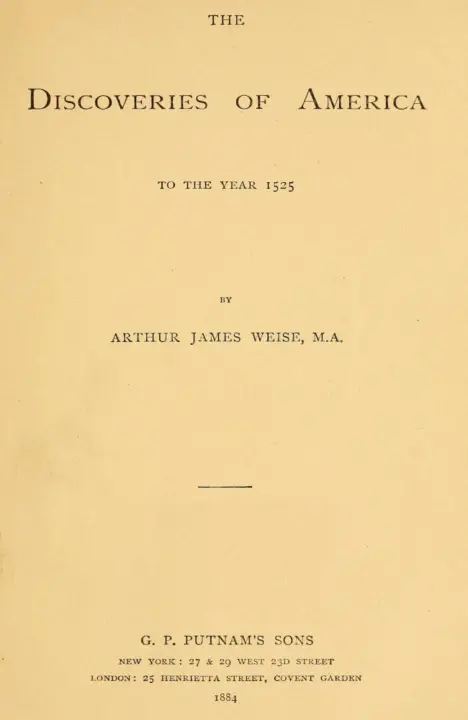
THE CLASSIC COLLECTION · 1884
"The Discoveries of America to the Year 1525" by Arthur James Weise is a historical account written in the late 19th century. This work delves into the early explorations of the American continent, focusing on the significant discoveries made before 1525, particularly by Columbus and other European explorers. The book aims to clarify various narratives about the discovery of America, critically examining the contributions of different explorers and offering insights into the civilizations that existed before European contact. The opening of the book presents a preface that establishes the historical context of America's early discovery and the inhabitants of the continent. Weise discusses the skepticism faced by Columbus and how earlier records, including Egyptian and Greek accounts, hint at a rich and complex civilization in the Americas long before European contact. Additionally, he highlights the contrasting views regarding the supposed discoveries made by the Northmen and other explorers, laying a foundation for the detailed accounts to follow. Overall, the opening sets the stage for a comprehensive exploration of the different narratives surrounding the discovery of America, emphasizing the blend of myth and historical fact.
Introduction adapted from the source catalogue; source summaries may be automatically generated.
Free to read · English · 127,443 words · No account needed
MAKE TIME FOR A GOOD BOOK
On by default. Untick to stop anonymous reading totals. Each page counts after 10 seconds in view. How this works.
Anonymous counting is on unless you have switched it off.
“Cortes then ordered an arm-chair, beautifully painted and adorned with inlaid work, to be brought, also some pieces of precious stones, wrapped in cotton cloth, perfumed with musk, a necklace of imitation pearls, a scarlet cap, with a medal, on which was represented the holy St. George on horseback, with lance in hand, killing the dragon. Cortes then addressed Teuthlille, and said that he presented the chair to his monarch, Montezuma, that he might sit in it when he should pay him a visit, and the string of pearls to wind around his head on the same occasion, all of which presents were from our sovereign, the emperor, who had sent them to Montezuma in token of friendship and as a proof of the esteem in which he held him. Cortes further remarked that Teuthlille should inform us where and when he, Cortes, could personally have an audience with the monarch. Teuthlille accepted the presents, and said in reply that his master, Montezuma, as he also was a great monarch, would in turn be equally delighted to learn something about our great emperor; that he would hasten to lay the presents before him, and to return with his answer.
“Teuthlille had with him very skillful painters, for there were such in Mexico, and he ordered them to paint the portrait and entire person of Cortes, with the dress he wore; also the pictures of all the other chief officers, the soldiers, our ships, horses, Doña Marina, and Aguilar, even our two dogs, the cannon, the balls, in short, every thing that they could see that belonged to us. The paintings they took along with them to show to their monarch.”
After an absence of about six or seven days, Teuthlille returned, as Diaz further observes, “with more than a hundred Indian porters, all heavily laden, accompanied by a great Mexican cacique, who, in countenance, stature, and deportment, greatly resembled Cortes, and on that account had been selected by his monarch to accompany the deputation. For, as it was related, when Teuthlille presented the picture representing Cortes, all the grandees who were present with their monarch, Montezuma, immediately observed that he resembled a person of distinction named Quintalbor. This was the same person who now accompanied Teuthlille. We therefore called one the Cortes of this place, and the other the Cortes of that place. We must now, however, tell what the embassadors did when they came into the presence of Cortes. First of all they touched the ground at his feet with their hands. They then perfumed him and all the Spaniards who were present, with pans made of clay. Cortes gave them a very cordial reception, and desired them to sit down at his side. Quintalbor, the cacique, was commissioned to discuss matters jointly with Teuthlille. The two, therefore, told Cortes that he was most welcome to visit their country, and after considerable talking on both sides, they produced the presents”[319] sent him by Montezuma. As is further related by the Spanish historian, Juan de Torquemada, a contemporary of Diaz, “the embassador of Montezuma ordered mats to be spread on the ground before Cortes, and over them some cotton cloth, on which he arranged the presents, comprising many cotton shirts, and great quantities of other cotton stuffs, beautifully manufactured, and interwoven with feathers of the most splendid colors. There were shields made of the purest white stuffs, decorated with feathers, gold, silver, and pearls, surpassing everything in beauty and skilled workmanship that ever was seen. There was also a helmet, tastefully carved out of wood, filled with grains of gold; also a casque, made of thin plates of gold, decorated with tassels, and with stones resembling the emerald. There were numerous large bunches of feathers of different colors, set in silver and gold; fans for keeping off flies, made of the rarest feathers; a thousand lockets of gold and silver of the most curious and beautiful workmanship; bracelets and military decorations of gold and silver, splendidly embossed with green and bright yellow feathers; leather made of deer skin, curried and colored in the best possible manner; shoes and sandals of the same leather, sewed with thin gold-wire, and the soles of beautiful white and blue stone. There were other kinds of shoes, very tastefully made of cotton; mirrors of marcasite, globular-shaped, of the size of one’s fist, and most ingeniously set in gold, the small frame itself being very valuable, and worthy of the acceptance of any crowned head; coverings and curtains to beds, manufactured of variously colored cotton, more glossy and of a finer texture than silk; a number of other gold and silver trinkets; a necklace of gold, decorated with more than a hundred emeralds, rubies, and various ornaments of gold; a second necklace of many large pearls and emeralds, all of the most exquisite workmanship; numerous gold trinkets in the shape of frogs and animals; jewels in the form of medals. The cases were even more valuable than the precious stones they contained. There was also a quantity of large and small grains of gold. The most valuable of these presents, however, were two round plates, one of gold, on which was a sun with rays and the zodiac. This weighed more than one hundred marks.[320] The other plate was of silver, which in a similar manner represented the moon. It weighed about fifty marks. The two disks were massive and of the thickness of the Spanish coin of four silver reals, and as large as carriage-wheels. Those who saw these splendid presents said that, without considering the beautiful workmanship, the value of the gold and silver alone amounted to twenty-five thousand castellanos de oro; so that the full value of all these presents may rightly be estimated at fifty thousand ducats.”[321]
Your reading position is saved on this browser. Take it to another device with a library code. Reading pages adapt to text, rather than matching a printed edition.
BEHIND THE BOOK
This eBook is for the use of anyone anywhere in the United States and most other parts of the world at no cost and with almost no restrictions whatsoever. You may copy it, give it away or re-use it under the terms of the Project Gutenberg License included with this eBook or online at www.gutenberg.org. If you are not located in the United States, you will have to check the laws of the country where you are located before using this eBook. Read the source licence.
The original source file, including credits and licence, is retained by this library. Request an original-format copy at no charge. Please include the book title and Project Gutenberg identifier #67766.
KEEP YOUR CURIOSITY GOING
Wilfrid Scawen Blunt
Wilfrid Scawen Blunt

E. W. (Edgar Watson) Howe
Cécile Tormay

Moritz Busch
John L. Ransom