THE CLASSIC COLLECTION✦A dead man’s diaryCLASSIC FREE BOOKS
A dead man’s diary
Coulson Kernahan
THE CLASSIC COLLECTION · 1919
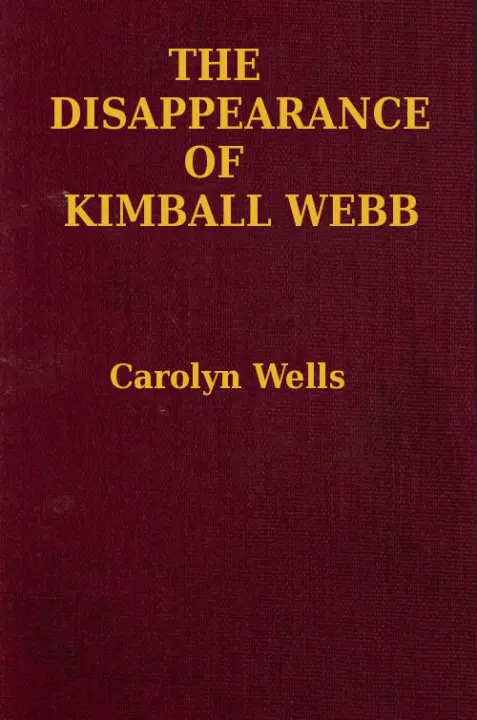
"The Disappearance of Kimball Webb" by Rowland Wright is a mystery novel written in the early 20th century. The story revolves around the mysterious vanishing of Kimball Webb, a New York playwright, on the day he was supposed to marry Elsie Powell. The narrative delves into his family dynamics, particularly the complex relationships with his mother and sister, who seem to hold contempt for Elsie, adding layers to the enigma of his disappearance. At the start of the novel, readers are introduced to Kimball Webb, who seems to lead an ordinary life, on the brink of his wedding. However, on the morning of the big day, his absence sparks concern, leading to the revelation that he is missing under inexplicable circumstances. Despite evidence pointing to the door of his room being locked from the inside, no one can ascertain how he exited without anyone seeing. As his family and Elsie grapple with the mystery, the opening chapters set up a tense atmosphere filled with suspicion, particularly surrounding the disapproving women in his life, hinting at possible motives and leading to a captivating web of intrigue.
Introduction adapted from the source catalogue; source summaries may be automatically generated.
Free to read · English · 64,643 words · No account needed
MAKE TIME FOR A GOOD BOOK
On by default. Untick to stop anonymous reading totals. Each page counts after 10 seconds in view. How this works.
Anonymous counting is on unless you have switched it off.
This, he declared, in no way reflected on his love or consideration for her, but it seemed to him, more fitting in every way, that the husband should own the fortune,--especially as he was willing to give his wife carte blanche and also to provide liberally for her family.
Elsie rather admired the staunchness of his purpose in this respect, for she had come to know Allison well enough to appreciate his strong will and his hard common sense.
Meantime, Coleman Coe was busily stirring up his sleeping dogs.
He seemed to possess an uncanny intuition as to where sleeping dogs were lying, and he went straight, though secretly, after them.
His methods were, perhaps, unusual, for he depended largely on assistants. His belief was, that he could do better work by farming out the drudgery of his pursuit, and doing only the thinking parts himself.
So, he had a fairly good-sized corps of assistants, whom he had trained to do just what he told them and no more.
By far the greater part of them were shadowers.
Not professional trailers, from a detective Bureau, but men, boys,--and also girls, whom he had picked here and there with a view to their special adaptation for the work.
Coe's great first principle was to learn what a suspect is doing when he doesn't think he is watched.
Therefore, with careful and comprehensive effort, he was making a list of the people he wanted shadowed.
Coley Coe, was neither visionary nor imaginative. He did depend a great deal on intuition, but only when it was undoubtedly in accordance with facts.
His list completed, he put his machinery in motion, and soon had quiet but efficient trailers following the daily routine of both Henrietta Webb and her mother, also their two men servants, Hollis and Oscar.
Then, a competent shadow never lost sight of Joe Allison. Another was unobtrusively at the heels of Fenn Whiting, and another reported duly every move of Wallace Courtney.
Lulie Lloyd was under secret surveillance, as was Owen Thorne, the
trusted trustee.
This work in the hands of efficient workers was neither difficult nor onerous, and it gave Coe a wide outlook of possibilities when the reports came in.
Nor was Coley himself idle. He could cover a great many occasions denied to his underlings. He could see the Webb ladies in their home surroundings; could call on Allison or Whiting when he chose, could demand an interview with Wallace Courtney however much that busy gentleman might object; and could see Lulie Lloyd any time he cared to invite her out for an evening.
Your reading position is saved on this browser. Take it to another device with a library code. Reading pages adapt to text, rather than matching a printed edition.
BEHIND THE BOOK
This eBook is for the use of anyone anywhere in the United States and most other parts of the world at no cost and with almost no restrictions whatsoever. You may copy it, give it away or re-use it under the terms of the Project Gutenberg License included with this eBook or online at www.gutenberg.org. If you are not located in the United States, you will have to check the laws of the country where you are located before using this eBook. Read the source licence.
The original source file, including credits and licence, is retained by this library. Request an original-format copy at no charge. Please include the book title and Project Gutenberg identifier #59060.
KEEP YOUR CURIOSITY GOING
Coulson Kernahan

Maurice Baring
Frances Wright
Cécile Tormay

Frederic Jesup Stimson

W. H. P. (William Henry Pope) Jarvis