THE CLASSIC COLLECTION✦A dead man’s diaryCLASSIC FREE BOOKS
A dead man’s diary
Coulson Kernahan
THE CLASSIC COLLECTION · 1919
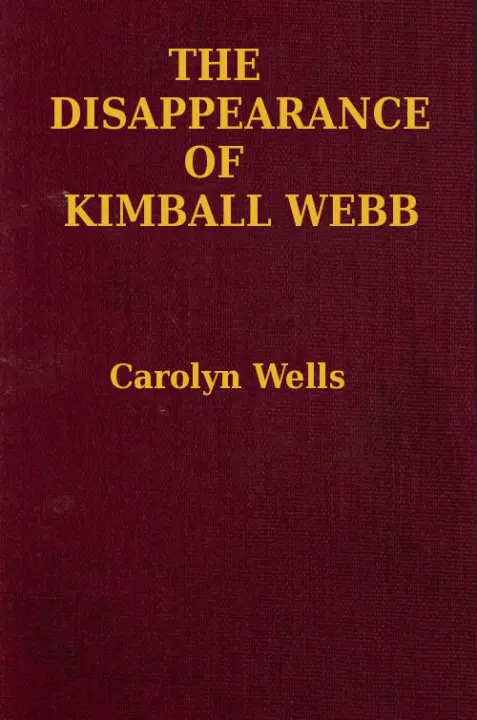
"The Disappearance of Kimball Webb" by Rowland Wright is a mystery novel written in the early 20th century. The story revolves around the mysterious vanishing of Kimball Webb, a New York playwright, on the day he was supposed to marry Elsie Powell. The narrative delves into his family dynamics, particularly the complex relationships with his mother and sister, who seem to hold contempt for Elsie, adding layers to the enigma of his disappearance. At the start of the novel, readers are introduced to Kimball Webb, who seems to lead an ordinary life, on the brink of his wedding. However, on the morning of the big day, his absence sparks concern, leading to the revelation that he is missing under inexplicable circumstances. Despite evidence pointing to the door of his room being locked from the inside, no one can ascertain how he exited without anyone seeing. As his family and Elsie grapple with the mystery, the opening chapters set up a tense atmosphere filled with suspicion, particularly surrounding the disapproving women in his life, hinting at possible motives and leading to a captivating web of intrigue.
Introduction adapted from the source catalogue; source summaries may be automatically generated.
Free to read · English · 64,643 words · No account needed
MAKE TIME FOR A GOOD BOOK
On by default. Untick to stop anonymous reading totals. Each page counts after 10 seconds in view. How this works.
Anonymous counting is on unless you have switched it off.
Her face, per se, was fine, aristocratic, and Bostonian of cast; so now you can get a pretty fair idea of Miss Henrietta Webb's appearance. She had long arms, long fingers, long legs, and--if it interests you at all--long toes. She was that sort, you know, and those long limbs and digital extremities fairly shout a psychic nature. Which she had.
Her voice was charming. It had that indescribable, inimitable timbre,--that only New England birth bestows; and those wonderful inflections never inborn save in Massachusetts.
This voice and these inflections now sounded over the telephone, like the sound of a grand Hello!
For Miss Webb was too truly correct, too innately proper to descend to the silly subterfuges of "Yes?" or "What is it?" affected by the would-be refined.
But her "Hello," with her inflection, was like the benediction that
follows after prayer,--or like the harmonious echo of this discordant
life.
"Hello!" returned Fenn Whiting, in his cheery way. "How are you? How's
old Kimmy?"
"Can you come up here right away?" asked Miss Webb, and catching the serious note in her voice, Whiting replied, "Why, yes; in a few minutes. What's up?"
"I don't want to talk over the telephone," she informed him, "but do get here as soon as you possibly can."
She hung up the receiver, which was her efficacious way of decreeing the
conversation at an end.
"Mother," she said, rising, "we may as well eat our breakfast. Thank Heaven we're not the sort of people who fly into hysterics. I admit if I were that sort I should certainly do so, though, for this mystery is baffling me. I feel my brain reel when I try to think it out! Whatever the explanation of Kimball's absence, no power on earth can explain how he got out of his room."
"There are other powers than those of earth, Henrietta," Mrs. Webb
began, solemnly.
"There now," spoke up her daughter, with some asperity, "don't begin that jargon! You'll be saying next that spirits carried Kim off!"
"Can you suggest anything more believable?"
"I can't think of anything more unbelievable! I'd rather think he went up the chimney or oozed through the keyhole than any supernatural foolishness!"
"Simply a choice of foolishnesses, then," observed Mrs. Webb, calmly, and she took her seat at the table and asked for hot muffins and fresh coffee.
"Where is the diamond pendant?" said Henrietta, suddenly.
"Gracious! I don't know. It must be in Kim's room, somewhere. You'd better hunt it out before anybody more goes searching around. Didn't you say Oscar showed some curiosity?"
Your reading position is saved on this browser. Take it to another device with a library code. Reading pages adapt to text, rather than matching a printed edition.
BEHIND THE BOOK
This eBook is for the use of anyone anywhere in the United States and most other parts of the world at no cost and with almost no restrictions whatsoever. You may copy it, give it away or re-use it under the terms of the Project Gutenberg License included with this eBook or online at www.gutenberg.org. If you are not located in the United States, you will have to check the laws of the country where you are located before using this eBook. Read the source licence.
The original source file, including credits and licence, is retained by this library. Request an original-format copy at no charge. Please include the book title and Project Gutenberg identifier #59060.
KEEP YOUR CURIOSITY GOING
Coulson Kernahan

Maurice Baring
Frances Wright
Cécile Tormay

Frederic Jesup Stimson

W. H. P. (William Henry Pope) Jarvis