THE CLASSIC COLLECTION✦A dead man’s diaryCLASSIC FREE BOOKS
A dead man’s diary
Coulson Kernahan
THE CLASSIC COLLECTION · 1919
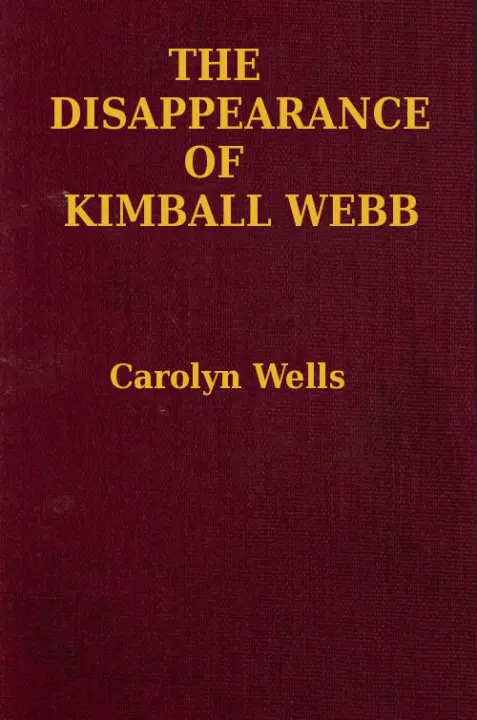
"The Disappearance of Kimball Webb" by Rowland Wright is a mystery novel written in the early 20th century. The story revolves around the mysterious vanishing of Kimball Webb, a New York playwright, on the day he was supposed to marry Elsie Powell. The narrative delves into his family dynamics, particularly the complex relationships with his mother and sister, who seem to hold contempt for Elsie, adding layers to the enigma of his disappearance. At the start of the novel, readers are introduced to Kimball Webb, who seems to lead an ordinary life, on the brink of his wedding. However, on the morning of the big day, his absence sparks concern, leading to the revelation that he is missing under inexplicable circumstances. Despite evidence pointing to the door of his room being locked from the inside, no one can ascertain how he exited without anyone seeing. As his family and Elsie grapple with the mystery, the opening chapters set up a tense atmosphere filled with suspicion, particularly surrounding the disapproving women in his life, hinting at possible motives and leading to a captivating web of intrigue.
Introduction adapted from the source catalogue; source summaries may be automatically generated.
Free to read · English · 64,643 words · No account needed
MAKE TIME FOR A GOOD BOOK
On by default. Untick to stop anonymous reading totals. Each page counts after 10 seconds in view. How this works.
Anonymous counting is on unless you have switched it off.
"No!" both men answered.
"You saw or heard nothing unusual or that you could not understand?" the
detective continued.
"Well, sir," Oscar began, "when I ran upstairs, and Miss Webb was waiting outside her brother's door, I heard her say, to herself, 'Oh, if it should be!'--sort of excited like."
"Whom was she speaking to?"
"To nobody, sir, just to herself."
"What did you mean by that speech, Miss Webb?" Hanley inquired.
"I didn't make it," replied Henrietta coolly. "Oscar is mistaken. He
imagined it all."
"I told you so!" Elsie cried, irrepressibly; "I knew Miss Webb was at
the bottom of it all!"
"Well, such a speech as that doesn't prove it," Hanley observed. "It rather lets her out. If she had concealed her brother previously, why should she say those words? And if she was merely hoping he had gone away, it goes to show she had no hand in the matter."
Henrietta's face was expressionless, as if the subject interested her
not at all.
"You will all have to agree with me, sooner or later," Mrs. Webb began. "There is, as you've seen, no normal explanation. Only the supernatural remains. And, you ought to know, that room of Kimball's has been haunted for a long time."
"What, haunted?" exclaimed Hanley.
"Yes, sir. Not only my son and my daughter have heard and seen strange things in it, but the maids have also had such experiences."
"Such as what?"
"Hearing queer sounds. Once, there was a complete conversation carried on by voices that belonged to invisible people."
"This is interesting only if confirmed by credible witnesses," Hanley
said.
"It interests me, anyway," said Harbison. "I don't believe in levitation and the passing of a human body through a locked door, but a haunted room always thrills me. Tell me some more about it."
"I will," said Henrietta. "For the last year or two, there have been times when voices were audible there. Not loud or entirely distinct,--but vaguely to be heard,--like the sound of a faraway speaker. My brother heard them,--he frequently told me so."
"Well, not frequently, Henrietta," said her mother, correcting her, "but
two or three times."
"Who else heard them?" asked Hanley, briefly.
"The servants," Henrietta informed them. "One chambermaid was so
frightened she left at once."
"Oh, fiddlesticks!" cried Harbison. "This gets us nowhere! If they were really spirits it is absurd; and if, as I thought at first, they were human voices, heard through a secret passage or a hollow panel, it's up to us to find the secret entrance."
"There isn't any," declared Hanley. "I've sounded and tested every bit
of wall in the room."
Your reading position is saved on this browser. Take it to another device with a library code. Reading pages adapt to text, rather than matching a printed edition.
BEHIND THE BOOK
This eBook is for the use of anyone anywhere in the United States and most other parts of the world at no cost and with almost no restrictions whatsoever. You may copy it, give it away or re-use it under the terms of the Project Gutenberg License included with this eBook or online at www.gutenberg.org. If you are not located in the United States, you will have to check the laws of the country where you are located before using this eBook. Read the source licence.
The original source file, including credits and licence, is retained by this library. Request an original-format copy at no charge. Please include the book title and Project Gutenberg identifier #59060.
KEEP YOUR CURIOSITY GOING
Coulson Kernahan

Maurice Baring
Frances Wright
Cécile Tormay

Frederic Jesup Stimson

W. H. P. (William Henry Pope) Jarvis