THE CLASSIC COLLECTION✦A dead man’s diaryCLASSIC FREE BOOKS
A dead man’s diary
Coulson Kernahan
THE CLASSIC COLLECTION · 1919
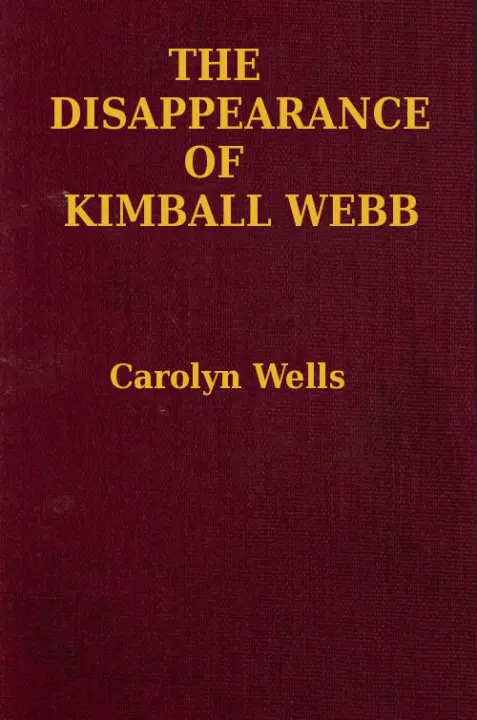
"The Disappearance of Kimball Webb" by Rowland Wright is a mystery novel written in the early 20th century. The story revolves around the mysterious vanishing of Kimball Webb, a New York playwright, on the day he was supposed to marry Elsie Powell. The narrative delves into his family dynamics, particularly the complex relationships with his mother and sister, who seem to hold contempt for Elsie, adding layers to the enigma of his disappearance. At the start of the novel, readers are introduced to Kimball Webb, who seems to lead an ordinary life, on the brink of his wedding. However, on the morning of the big day, his absence sparks concern, leading to the revelation that he is missing under inexplicable circumstances. Despite evidence pointing to the door of his room being locked from the inside, no one can ascertain how he exited without anyone seeing. As his family and Elsie grapple with the mystery, the opening chapters set up a tense atmosphere filled with suspicion, particularly surrounding the disapproving women in his life, hinting at possible motives and leading to a captivating web of intrigue.
Introduction adapted from the source catalogue; source summaries may be automatically generated.
Free to read · English · 64,643 words · No account needed
MAKE TIME FOR A GOOD BOOK
On by default. Untick to stop anonymous reading totals. Each page counts after 10 seconds in view. How this works.
Anonymous counting is on unless you have switched it off.
Elsie believed him and quit pounding. Nor did she scream. An idea had come to her. Whiting had said rooms. Therefore there was more to the suite than the one they were in. Covertly she glanced at the doors, and decided that while one rather narrow one was doubtless a closet, the wide one, the other side of the room, probably opened into an adjoining room, which was likely to give on the hall.
At any rate, it was worth trying.
Cleverly, she seemed not to be noticing these details, but sat, her handkerchief to her eyes, apparently subdued and dismayed. And, in fact she was both, but not to the point of surrender, as she appeared to Whiting's anxious watchfulness.
Cautiously looking about, with seemingly a vacant stare, she saw many little personal belongings, that convinced her the room was Whiting's sitting room. Doubtless the next was his bedroom. All the same, she determined to dash through it in an attempt at freedom. If she were quick, and the other hall door not locked, she could get to the hall,--while if she were trapped in the other room, her plight would be no worse than it was at present.
She rose and walked disconsolately about,--looked from the windows, stared, unseeing, at a picture on the wall,--and generally appeared to be aimlessly wandering, while she thought matters over.
Whiting watched her, but so cannily did Elsie mislead his thoughts, that he didn't notice she drew nearer and nearer the bedroom door.
At last, she was almost against it, her eyes fastened on a small clock which stood on a table at the opposite side of the room.
"What time is it?" she said, dully, as if her decision depended on the
flight of the hours.
The ruse succeeded. He followed the direction of her straining eyes, and looked at the little clock instead of taking out his own watch.
Like a flash, Elsie tore open the door, found that it opened into a bedroom, with a hall door, and crossing the room in the fewest possible steps, wrenched open the hall door. It was not locked, and she flew through it and down the corridor toward the elevators, of which there were two side by side.
Elsie pushed the bell so violently, that the car came up immediately and she sprang into it, just as Whiting came racing down the hall after her.
He rang, a long steady ring, and though Elsie's prayers persuaded the girl in the car with her not to go up again, the other car shot past them flying upward.
Your reading position is saved on this browser. Take it to another device with a library code. Reading pages adapt to text, rather than matching a printed edition.
BEHIND THE BOOK
This eBook is for the use of anyone anywhere in the United States and most other parts of the world at no cost and with almost no restrictions whatsoever. You may copy it, give it away or re-use it under the terms of the Project Gutenberg License included with this eBook or online at www.gutenberg.org. If you are not located in the United States, you will have to check the laws of the country where you are located before using this eBook. Read the source licence.
The original source file, including credits and licence, is retained by this library. Request an original-format copy at no charge. Please include the book title and Project Gutenberg identifier #59060.
KEEP YOUR CURIOSITY GOING
Coulson Kernahan

Maurice Baring
Frances Wright
Cécile Tormay

Frederic Jesup Stimson

W. H. P. (William Henry Pope) Jarvis