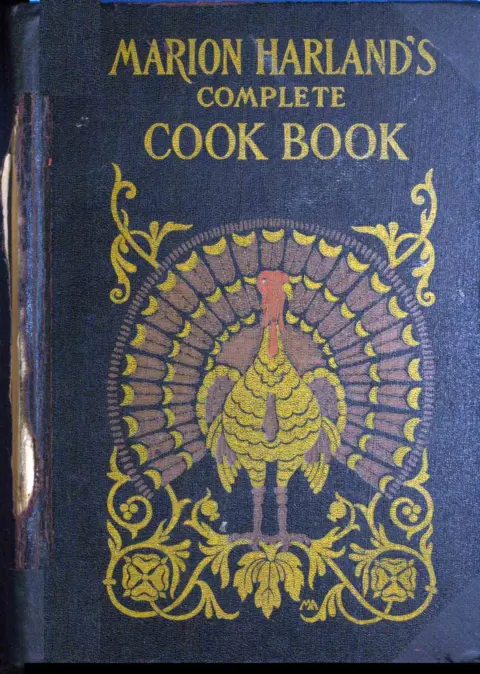
Marion Harland’s Complete Cook Book A Practical and Exhaustive Manual of Cookery and Housekeeping
Marion Harland
THE CLASSIC COLLECTION · 1878
"The Dinner Year-Book" by Marion Harland is a practical cookbook written in the late 19th century. This work serves as a guide for home cooks, focusing primarily on providing a comprehensive set of dinner menus for each day of the month alongside detailed recipes. The author aims to alleviate the daily dilemma faced by many housewives: planning and preparing varied and delicious meals for the family. The opening of the book introduces the author's own frustrations with meal planning, emphasizing the struggles of avoiding monotony and managing leftovers. Harland establishes a friendly tone as she addresses her readers, promising a structured approach to family dinners and a collection of adaptable menus that correspond to seasonal ingredients and the typical American market. Her strategy combines thoughtful meal design with efficient use of resources, including left-over ingredients and practical cooking tips, thereby setting the stage for the various meal options and recipes that follow in the book.
Introduction adapted from the source catalogue; source summaries may be automatically generated.
Free to read · English · 189,347 words · No account needed
MAKE TIME FOR A GOOD BOOK
On by default. Untick to stop anonymous reading totals. Each page counts after 10 seconds in view. How this works.
Anonymous counting is on unless you have switched it off.
Up to that time, she then explained, fried steaks had been the rule in her house, and gridirons a thing unheard or unthought of.
A fried beefsteak being, as I have elsewhere stated, a culinary solecism, I have, perhaps, selected an extreme case as the test of my discourse upon the necessity of a supply of fitting utensils for the proper prosecution of home-cookery. Mrs. Whitney’s idea of the “art-kitchen,” so charmingly set forth in “We Girls,” may not be so chimerical (with limitations) as most practical housewives—practised in nothing more than in the exercise of patience—are apt to suppose. They tell us the tale—known already too sadly well to each of us—of the impossibility of inducing “girls” who are tractable and respectful in most things, to accept labor-saving machines, and the thousand-and-one ingenious contrivances for making cooking easier and even graceful; of the hard usage to which expensive implements are subjected in rude hands, the motive-power of which is the untilled brain, unrestrained by the conscienceless will; of how innovations are openly flouted, or secretly sneered at, “until,” say they, “we find it easier to let the cook have her own way down-stairs, and reconcile ourselves, as best we may, to obstinate stupidity and unmerciful breakages. As to art-kitchens”—a shrug and a groan,—“we are thankful if our tenderest care can keep the upper stories free from the vandalism that rages below.”
Nevertheless, acknowledging, as I have, personally, reasons for doing—the truth of all these things—I make answer, “Have an art-kitchen for yourself!” First, give your cook, or maid-of-all-work, a fair trial. It is a duty you owe to humanity and to her to prove, conclusively, whether her careless or destructive habits be ingrain and wilful, or merely the result of ignorance and bad training. There are bad mistresses, let us remember,—and more still who are indifferent or incompetent. If “our girl” has a heart or a conscience, let us find it. Make her understand the value and usefulness of the appliances you have furnished for her work, where and how they are to be kept, and set her the example of always looking for and putting them in their proper places. If they are misused, show your regret decidedly, but still kindly. Should all means of civilizing her taste up to your standard fail, make, as I have advised, an art-kitchen for your own use. Appropriate one corner of the room, where cooking is done, for your operations, and arrange there your pet tools. Have your scoop flour-sifter; your patent pie-lifter and oyster-broiler; your star-toaster; your pie-crimper, vegetable and nutmeg graters; gravy-strainer, colander, biscuit-cutter, skimmers, larding needles, wire, and perforated, and slit and fluted spoons; your weights and measures, and the tidy, serviceable tinned and enamelled saucepans, Scotch kettles, frying-pans, etc., that will retain tidiness and serviceable qualities so long in your care, and so soon come to grief in boorish clutches. Set all these, and as many others as you like and can afford to buy—always including the Dover egg-beater and its “Baby” (made for whipping one egg to more purpose than one egg, or anything else as small was ever whipped before)—in array upon walls and shelves,[A] and let the logic of daily events prove how far they will deprive work of the wearing vexations attendant upon long searches for the right article, and its wrong condition when found. Make your helpers—one and all—comprehend that these are your especial property, to be used—and kept clean—by no one else. Let them be looked down upon as the toys of a would-be-busy woman by the superior intellects about you, should they see fit thus to do, and provide such tools as are suited to coarser fingers for them to use. The chances are many to one that your dexterous manipulation of your instruments; the excellence of the products achieved by yourself and them; even the attractive neatness of the display and your corner, will win skeptics, first, to indulgence, then, admiration, then, to imitation. If you can afford the great luxury of a pastry or mixing-room, adjoining the kitchen, so much the better for you and your pious undertaking. But without regard to what may be the effect upon others, have your saucepans, of whatever designs and in whatever quantities you like—taking “saucepan” as a generic term for every description of mute helpers in the task of elevating cookery into a fine art, or, at the least, in redeeming it from the stigma of coarseness and vulgarity.
Your reading position is saved on this browser. Take it to another device with a library code. Reading pages adapt to text, rather than matching a printed edition.
Marion Harland
Marion Harland
Marion Harland
Marion Harland
BEHIND THE BOOK
This eBook is for the use of anyone anywhere in the United States and most other parts of the world at no cost and with almost no restrictions whatsoever. You may copy it, give it away or re-use it under the terms of the Project Gutenberg License included with this eBook or online at www.gutenberg.org. If you are not located in the United States, you will have to check the laws of the country where you are located before using this eBook. Read the source licence.
The original source file, including credits and licence, is retained by this library. Request an original-format copy at no charge. Please include the book title and Project Gutenberg identifier #49958.
KEEP YOUR CURIOSITY GOING

Charles G. (Charles Griffith) Ross
Hannah Webster Foster

Emily Lawless
Edwin Hamlin Carr

Charles De Lano Hine
Andrew Ure