The Lone Wolf Returns
Louis Joseph Vance
THE CLASSIC COLLECTION · 1912
"The Destroying Angel" by Louis Joseph Vance is a novel written in the early 20th century. The story revolves around the central character, Hugh Whitaker, a young man who, upon learning he has only a few months to live, confronts the profound unfairness of fate and contemplates the impending end of his life. Struck by despair, his journey spirals through themes of love, loss, and unexpected connections as he attempts to navigate his remaining time. The opening of the novel introduces Hugh Whitaker in a doctor's office, where he receives the crushing news about his terminal illness. Alongside two consulting specialists, Greyerson and Hartt, Hugh struggles to comprehend the finality of his situation—despite feeling fit and healthy. As he grapples with his emotions, he learns about the consequences of his impending mortality, not only for himself but also for Alice Carstairs, the woman he loves. This initial chapter sets up a narrative that promises to explore complex human emotions, the weight of social expectations, and the intertwining of lives in desperate circumstances, hinting at an unexpected turn as Whitaker's fate begins to alter after a chance meeting.
Introduction adapted from the source catalogue; source summaries may be automatically generated.
Free to read · English · 78,296 words · No account needed
MAKE TIME FOR A GOOD BOOK
On by default. Untick to stop anonymous reading totals. Each page counts after 10 seconds in view. How this works.
Anonymous counting is on unless you have switched it off.
"Hugh," she said gently, with a quaver in her voice that wounded his conceit in himself; for he was sure it spelled laughter at his expense and well-merited--"Hugh, you big sulky boy! get up this instant and come back to the house with me. You know I'm timid. Aren't you ashamed of yourself?"
"I suppose so," he grumbled, rising. "I presume it's childish to want the moon--and sulk when you find you can't have it."
"Or a star?"
He made no reply; but his very silence was eloquent. She attempted a shrug of indifference to his disapproval, but didn't convince even herself; and when he paused before entering the house for one final look into the north, she waited on the steps above him.
"Nothing, Hugh?" she asked in a softened voice.
"Nothing," he affirmed dully.
"It's strange," she sighed.
"Lights enough off beyond the lighthouse yonder," he complained: "red lights and green, bound east and west. But you'd think this place was invisible, from the way we're ignored. However...."
They entered the kitchen.
"Well--however?" she prompted, studying his lowering face by lamplight.
"Something'll have to be done; if they won't help us, we'll have to help
ourselves."
"Hugh!" There was alarm in her tone. He looked up quickly. "Hugh, what
are you thinking of?"
"Oh--nothing. But I've got to think of something."
She came nearer, intuitively alarmed and pleading. "Hugh, you wouldn't
leave me here alone?"
"What nonsense!"
"Promise me you won't."
"Don't be afraid," he said evasively. "I'll be here--as always--when you
wake up."
She drew a deep breath, stepped back without removing her gaze from his face, then with a gesture of helplessness took up her lamp.
"Good night, Hugh."
"Good night," he replied, casting about for his own lamp.
But when he turned back, she was still hesitating in the doorway. He
lifted inquiring brows.
"Hugh...."
"Yes?"
"I trust you. Be faithful, dear."
"Thank you," he returned, not without flavour of bitterness. "I'll try
to be. Good night."
She disappeared; the light of her lamp faded, flickering in the draught of the hall, stencilled the wall with its evanescent caricature of the balustrade, and was no longer visible.
"Hugh!" her voice rang from the upper floor.
He started violently out of deep abstraction, and replied inquiringly.
"You won't forget to lock the door?"
He swore violently beneath his breath; controlled his temper and responded pleasantly: "Certainly not."
Then he shut the outside door with a convincing bang.
"If this be marriage...!" He smiled his twisted smile, laughed a little quietly, and became again his normal, good-natured self, if a little unusually preoccupied.
Your reading position is saved on this browser. Take it to another device with a library code. Reading pages adapt to text, rather than matching a printed edition.
Louis Joseph Vance
Louis Joseph Vance
Louis Joseph Vance
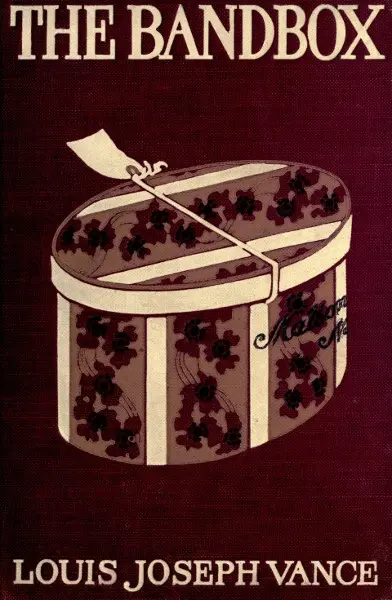
Louis Joseph Vance
BEHIND THE BOOK
This eBook is for the use of anyone anywhere in the United States and most other parts of the world at no cost and with almost no restrictions whatsoever. You may copy it, give it away or re-use it under the terms of the Project Gutenberg License included with this eBook or online at www.gutenberg.org. If you are not located in the United States, you will have to check the laws of the country where you are located before using this eBook. Read the source licence.
The original source file, including credits and licence, is retained by this library. Request an original-format copy at no charge. Please include the book title and Project Gutenberg identifier #32302.
KEEP YOUR CURIOSITY GOING
Coulson Kernahan

Maurice Baring
Frances Wright
Cécile Tormay

Frederic Jesup Stimson

W. H. P. (William Henry Pope) Jarvis